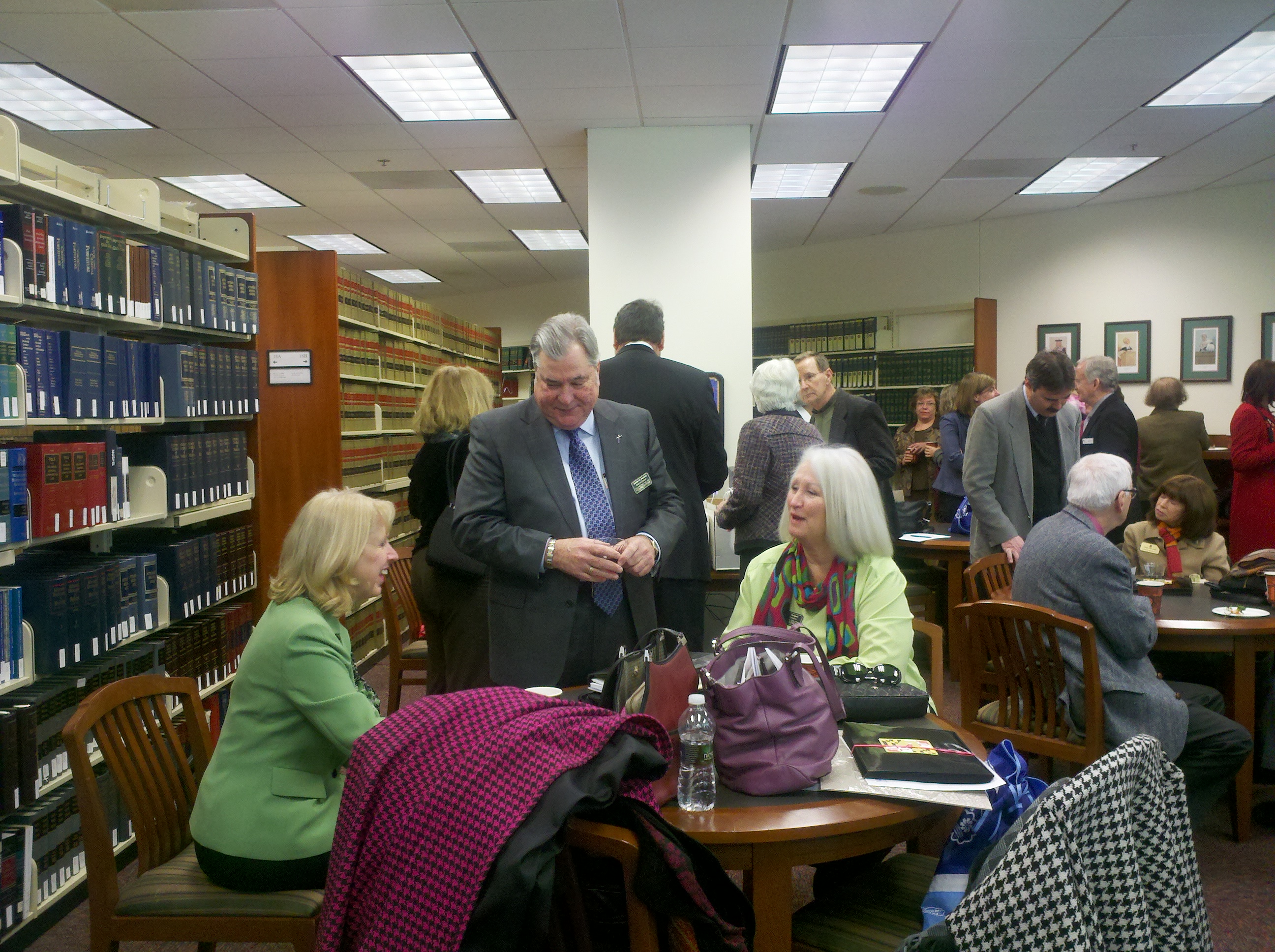
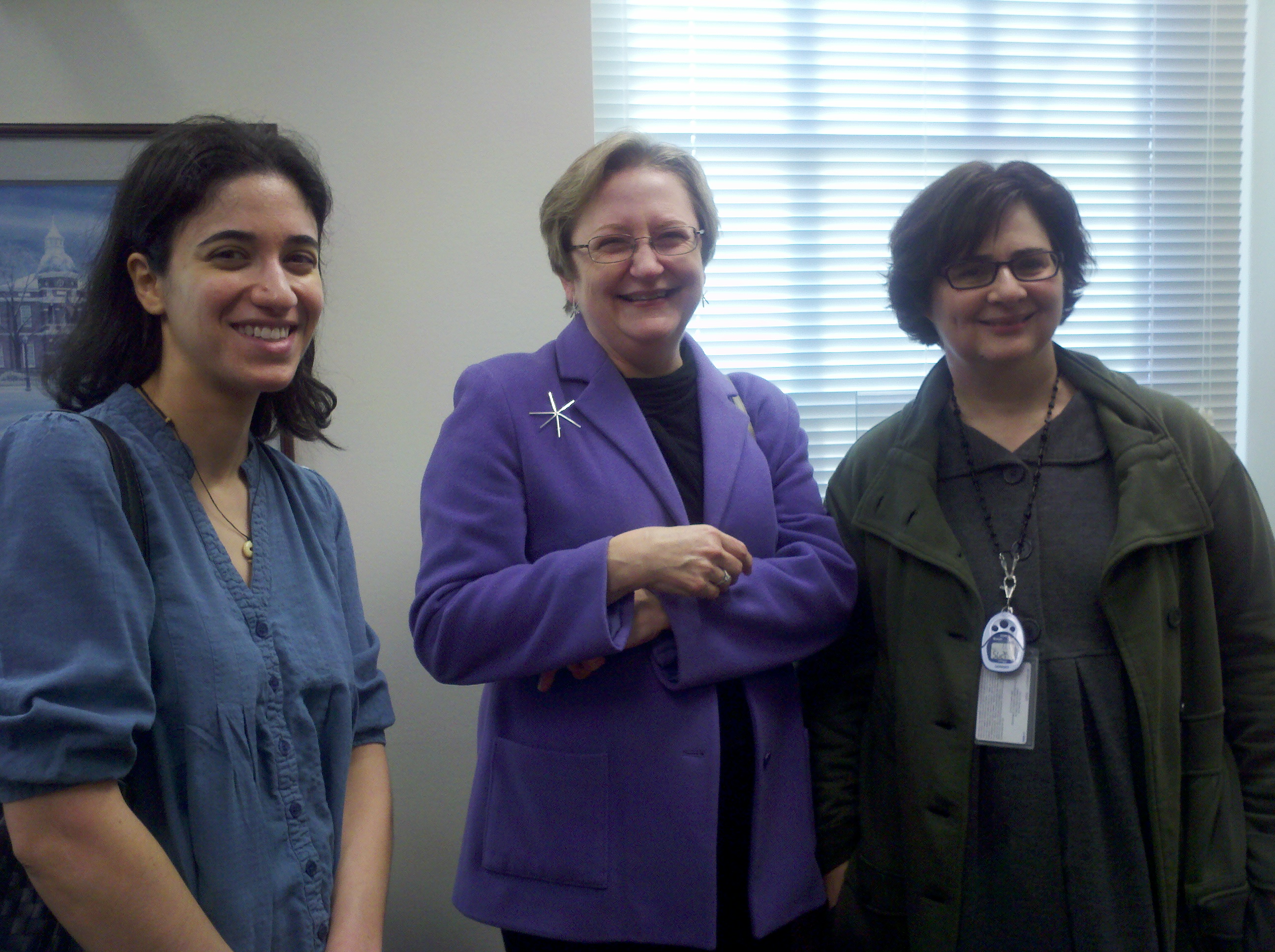
AALL Announcements

Call for Proposals

The 2013 Annual Meeting Call for Proposals is now open.   All submissions are due by end of day on Monday October 15.  There are a few changes in the proposal process so be sure to read the updates included in the above link.

September Issue of Washington E-Bulletin

The latest edition of the Washingtin E-Bulletin outlines what can be expected between now and upcoming election.  AALL are working on a few bills including; HR 1974, Access to Congressionally Mandated Reports Act (ACMRA).  Be sure to take a look at AALL in action.

AALL2go

The 2012 Annual Meeting handouts and Opening seesion/Keynote Speaker available for review and a listen.

President’s Message – Fall 2012

By Mary Jo Lazun, Maryland State Law Library

I hope that everyone had an enjoyable summer and found time for a vacation or at least a bit of time to relax. Although I think most of us thoroughly enjoy our work and are devoted to the profession, finding a bit of time away from email, phone calls, and meetings is well deserved and important.

This year marks the 30th Birthday of the Law Library Association of Maryland and LLAM has a number of special events scheduled. First, please be sure to mark your calendar for December 14 of our Birthday and Holiday Party.  This will be an extra special event at the National Electronic Museum.  Tonya Baroudi has found us a fabulous venue that will include tours of the museum and a LLAM retrospective. We will formally toast Steve Anderson, incoming AALL president, and Chief Judge Bell, who will be retiring in 2013.

We are starting  our birthday year in style with a with a AALL Presidential Visit on October 16th with Jean Wenger, who has graciously agreed to participate in our first fall program a Slice of Full Disclosure on October 16th the University of Maryland Carey School of Law.  Although Jean’s plans are still tentative, we expect her to visit local law libraries and chat with LLAM members. On November 15 at University of Baltimore School of Law, Bloomberg BNA will show us the latest additions to BLaw. Maybe the Tax and Accounting model will finally be available J

The LLAM Board and Committee Chairs are going to be very busy this year. The Board decided in August to review and possibly revise the LLAM committee structure and update LLAM’s strategic plan. LLAM may also be having a serious discussion regarding allowing “vendors” to be full LLAM members. The Board decided that if in October AALL membership votes to allow vendors to be full members of AALL than LLAM would formally consider the issue as well.  If the vote is in favor of membership, I envision a series of discussions for members to explore this important issue.

Libraries and Access to Justice Webinar Series

Libraries and Access to Justice Webinar Series:

This has already started but there are still more that may be of interest.  Best of all they are FREE.

Upcoming Webinars:

Sept 27 – Webinar 2: Connecting Library Patrons with Legal Information: Key Resources
Oct 11 – Webinar 3: Helping Patrons Find Legal Assistance in their Community: Online Referral Tools
Nov 1 – Webinar 4: Developing Legal Aid-Library Collaborations: Models and Replication Resources

http://www.probono.net/librarywebinars/

****************************************************************************************************

Keeping Up with LLAMonline

The next time you visit LLAMonline you may want to seek out a few new features.

The LLAM Calendar: LLAM is now using Google Calendar to share our busy schedule of upcoming meetings, programs, and events!

The LLAM Calendar makes it easy for LLAM to share its calendar with you and for you to add the LLAM schedule to your personal Google Calendar. Now you don’t have to carry your paper calendar with you to see when the next LLAM event is scheduled.

Find the LLAM Calendar under Events and Announcements in the traditional monthly format, and on the home page in the agenda format; to view the LLAM Calendar Agenda in the monthly format, click on the “Google Calendar” button in the bottom right.

Pay Membership Dues Online: LLAM is also accepting membership dues by credit card online, through Google Wallet.  Once you select the membership type on the Membership Payment page, you may be prompted to set up a Google Account. This does not require a Gmail address; any email address will work.

If you are purchasing membership for anyone other than yourself, please follow these four easy steps:

  1. Select the quantity and type of membership(s) you are purchasing using the drop-down menu above
  2. Please create or open a Google Account and uncheck the “Shipping Address-Same as billing address” box
  3. In the “Shipping Address” Name field, enter the names of ALL of the individuals for whom you are buying membership in this transaction
  4. Enter any shipping address you wish since nothing needs to be shipped!

For anyone paying online, don’t forget to also email your completed Membership Application / Renewal Form (Word) to Pat Behles (pbehles at ubalt dot edu). Of course, we also accept payment by check in the mail as well.

Job Announcements: Have you ever misplaced that email from the LLAM listserv about the perfect job and felt a bit odd about asking a colleague to forward it to you? Your worries are over. Mary Rice, our wonderful placement chair, is now posting the job listings on LLAMonline.org she emails to the LLAM listserv. To find the job listings on the website, go to Interact With LLAM > Job Placement > Job Vacancies.

It’s Renewal Time Again…

Don’t forget!

It is membership renewal time. This year there is an an alternative way to pay. You can use Google Wallet, formally Google Checkout, to pay your membership dues by credit card. If a check works better for you, that works for us too. Here are the links you need:

Join LLAM
Information about benefits of joining LLAM  and links to the membership form and payment page.
https://llamonline.org/interact/join/

LLAM Membership Form
If your info is the same as last year just fill out your name and write “same”  on the top of the form. No need to fill out EVERYTHING again.
http://www.aallnet.org/chapter/llam/LLAM_membership_form.doc

LLAM Payments
Pay either either via credit card or check. For details see:
http://www.aallnet.org/chapter/llam/membershippayment.html

Need more info? Contact membership chair Patricia Behles:
Call:   410-837-4583
Email: pbehles@ubalt.edu
Fax:  410-837-4570
Address: University of Baltimore Law Library, 1415 Maryland Avenue, Baltimore, MD 21201


Featured Member – Sandy Brewer

Sandy Brewer is just plain fun to interview. Sandy thought her library career would be in academe but when a full-time position at the law library at the Circuit Court for Howard County opened up, Sandy found her calling. Along with running the library, which she does solo, she assists several offices within the courthouse on various projects, enjoys committee work, and is always up for taking on whatever is needed. Sandy is a firm believer in making oneself visible in the workplace.

Before taking her current position, Sandy received her JD at Georgia State University and her MLS from Catholic University. Between law school and library school, Sandy became a mom; her daughter is now a junior in high school and her son is in eighth grade.  After obtaining her MSLS, Sandy worked at many of the DC and Virginia law school libraries including American University, University of Richmond, and Catholic University.

When asked about her professional achievements, Sandy did not hesitate with an answer. This is because Sandy started the first civil law self-help center in a Maryland court library, a program that other circuit court law libraries have emulated. Every Tuesday morning, Sandy has attorneys ready to assist low-income individuals with legal advice. Knowing that daytime hours don’t work for everyone, Sandy expanded the program to monthly evening sessions at the public library. She is also very proud of her work with the Howard County Pro Bono Committee.  In response to Sandy’s suggestion, the Committee will be organizing their first visit to the women’s prison in Jessup.  Volunteer attorneys will meet one-on-one with inmates, as part of a 3-visit series, to provide free legal advice in family law, wills, trusts & estates and financial matters.  Lastly, Sandy is excited about being admitted into the Maryland Judiciary’s Institute for Court Management Program.

Sandy is a great lover of the outdoors and an avid gardener. When asked if “you could do it all over again”, Sandy would be a National Park Service Ranger. And if she wins the Mega Millions jackpot, Sandy will give plenty of notice and then purchase a luxury RV to visit each National Park, bringing along every historical fiction book on her wish list… in print format!  When asked how she will get to the National Parks in Hawaii, Sandy said she will fly and then buy another RV upon arrival.

LLAM at AALL Annual Meeting

  1. 105th AALL Annual Meeting & Conference in Boston, MA
  2. LLAM Dine-Around at AALL
  3. Still Need Volunteers for the LLAM Table at AALL Annual Meeting

___________________________________________________________

105th AALL Annual Meeting & Conference in Boston, MA

Hope to see many of you at the AALL Annual Meeting being held in Boston, MA from July 21 through July 24 at the John B. Hynes Veterans Memorial Convention Center (there are two Conventions Centers in Boston).  The theme this year is “Learn, Connect, Grow”.  Please remember to take notes at your favorite sessions so you can share with all of us in the next LLAM eNews.

___________________________________________________________

LLAM Dine-Around at AALL

Sunday Night, July 22nd, 7pm at Casa Romero, 30 Gloucester Street, Boston, a couple blocks from the Convention Center.  They are pretty full up, but if you are still interested contact Dave Matchen (dmatchen@ubalt.edu)

___________________________________________________________

Still Need Volunteers for the LLAM Table at AALL Annual Meeting

LLAM will be having their usual table in the Exhibit Hall at the Convention Center in Boston. There are still a few slots that need to be filled.  You can go directly to this doodle calendar to sign-up or contact Mary Jo Lazun (mjlazun@mdcourts.gov).

LLAM Reads: Jane McWilliams and Annapolis

Jane McWilliams, author of “Annapolis: City on the Severn,” gave a delightful presentation to LLAM members on May 14, 2012, at the Maryland State Law Library in Annapolis. What came as a surprise to many of us in the audience was that Jane is actually a former library staff member. Many years ago, Jane worked part-time for the Maryland State Library (the predecessor of the Maryland State Law Library) writing abstracts of articles from the old Maryland Gazette. In fact she members when Bernice Bernstein, who recently retired from Maryland State Law Library, was hired by the library’s director at the time, Mr. Moulter.

The idea of a comprehensive history of Annapolis was the brain-child of the “Annapolis History Consortium.” Jane, a member of the consortium, agreed to take on the challenge of writing a complete history of her hometown.  Her goal was to tell the truth about Annapolis’s history but not in such a way that she would be “run out of town.” Although the genesis of the book was by committee, Jane takes full responsibly and credit for its content.

It was no surprise to learn that Jane found writing a 478-page book to be a challenge. After receiving a grant to start the research, Jane embarked on a quest both locally and nationally for any and materials available about Annapolis. Her final bibliography listed over 500 items. These included diaries, local histories, historical records, and even motion pictures.

The book begins with the Colonial period and ends in 1975. Jane decided to begin her writing and research with the Civil War period because it was the time period that she knew the least about. It was the last chapter, “The City Preserved, 1960-1975” that Jane found the most challenging to write since she had lived through the entire period.

Jane’s presentation lasted just under an hour but was followed by another 45 minutes of questions from the audience. Everyone who left the room gained an appreciation of the work involved in researching, writing, and publishing a local scholarly history.

Lots of New Leaders at LLAM

Election Results

Tonya Baroudi, of the Prince George’s County Circuit Court Law Library, was elected LLAM’s Vice President and President-Elect. Kate Martin, of the Montgomery County Circuit Court Law Library, agreed to run for Toyna’s previous board position and was elected. Since Toyna had already served one year of her 2-year term, Kate’s term will be for a single year. Mark Desiertro will be our new two-year term member. Mark is the Systems Librarian at Venable. And lastly, Sara Thomas of [Whiteford, Taylor & Preston, will be our new secretary.

Committee Chairs

We will have a few new faces on LLAM’s committees this year. Jenny Rensler will be heading the Technology committee along with being our webmaster. Katheine Baer has agreed to chair the newsletter committee with assistance from Paul Lagasse. Pam Luby will be assisting Joanie Bellistri with the Government and Vendor Relations Committee. Katherine Baer will also continue chair the Archives Committee. Catherine McGuire will handle Public Relations; Mary Rice, Placement; Pat Behles, Membership; and Maxine Grosshans, Publications. Sara Witman and Mary Jo Lazun will informally handle the Mentoring Committee this year.

President’s Message-Summer 2012

by Mary Jo Lazun, Maryland State Law Library

For many of us, turning 30 was (or will be) a major milestone. So too for the Law Library Association of Maryland. LLAM turned 30 this month.

What is it about LLAM that has kept it going for thirty years? As a relative newcomer, for me it was the intimateness of the group, and the ability to get to know members, that drew me to LLAM and why I am smitten with our organization.  Take a moment to look at our list of our past presidents and committee chairs. They have brought us a long  way. If you encounter one of these LLAM Leadership Alumni,  pass along a  “thank you” for all the work they have done for our organization.

This year I hope to continue to keep LLAM responsive to members and our new web site is a big first step.  We have moved to a WordPress platform and even have our own URL: llamonline.org. Kirstin Nelson got many of us hooked on WordPress when she moved LLAM eNews to that platform and Jenny Rensler got comfortable using the WordPress platform when she did the website for the spring conference. In fact, we are actually using the same site for  the “new” LLAM online. A very special thanks goes to Jenny Rensler, who ported the content from the old site to this one to give us a better communications tool. Be sure to check out the “receive updates by email” option on the home page. As we learn more about what WordPress can do, we hope to expand its outreach to LLAM members.

As you poke around the web site you will probably notice that some items need a bit of updating. This is the year to do a new strategic plan, and I will be working closely with board members and committee chairs to rewrite the plan this fall. This spring, we will set up short-term objectives and based on those objectives revisit our committee structure and procedures to see if changes are needed.

But now, it’s summer — time for vacations and the AALL Annual Meeting. Tonya Baroudi and I will be attending the chapter leadership training on Saturday and are looking forward to seeing LLAM members at the conference. David Machen has found us a super location to relax and enjoy each others’ company on Sunday. Be sure to drop by the LLAM table and be sure to visit the Exhibit Hall to see LLAM’s poster session on Full Disclosure: Librarians Sharing Best Practices.  LLAM’s own Joanie Bellistri, AALL candidate for Treasurer, will be at the “Meet the Candidates” on Monday morning in the Convention Hall.

I hope everyone has a safe and fun summer.

Mary Jo Lazun

It’s Renewal Time Again…

Don’t forget!

It is membership renewal time. This year there is an an alternative way to pay. You can use Google Wallet, formally Google Checkout, to pay your membership dues by credit card. If a check works better for you, that works for us too. Here are the links you need:

Join LLAM
Information about benefits of joining LLAM  and links to the membership form and payment page.
https://llamonline.org/interact/join/

LLAM Membership Form
If your info is the same as last year just fill out your name and write “same”  on the top of the form. No need to fill out EVERYTHING again.
http://www.aallnet.org/chapter/llam/LLAM_membership_form.doc

LLAM Payments
Pay either either via credit card or check. For details see:
http://www.aallnet.org/chapter/llam/membershippayment.html

Need more info? Contact membership chair Patricia Behles:
Call:   410-837-4583
Email: pbehles@ubalt.edu
Fax:  410-837-4570
Address: University of Baltimore Law Library, 1415 Maryland Avenue, Baltimore, MD 21201


What’s New with LLAM Members

Honorary New LLAM Member

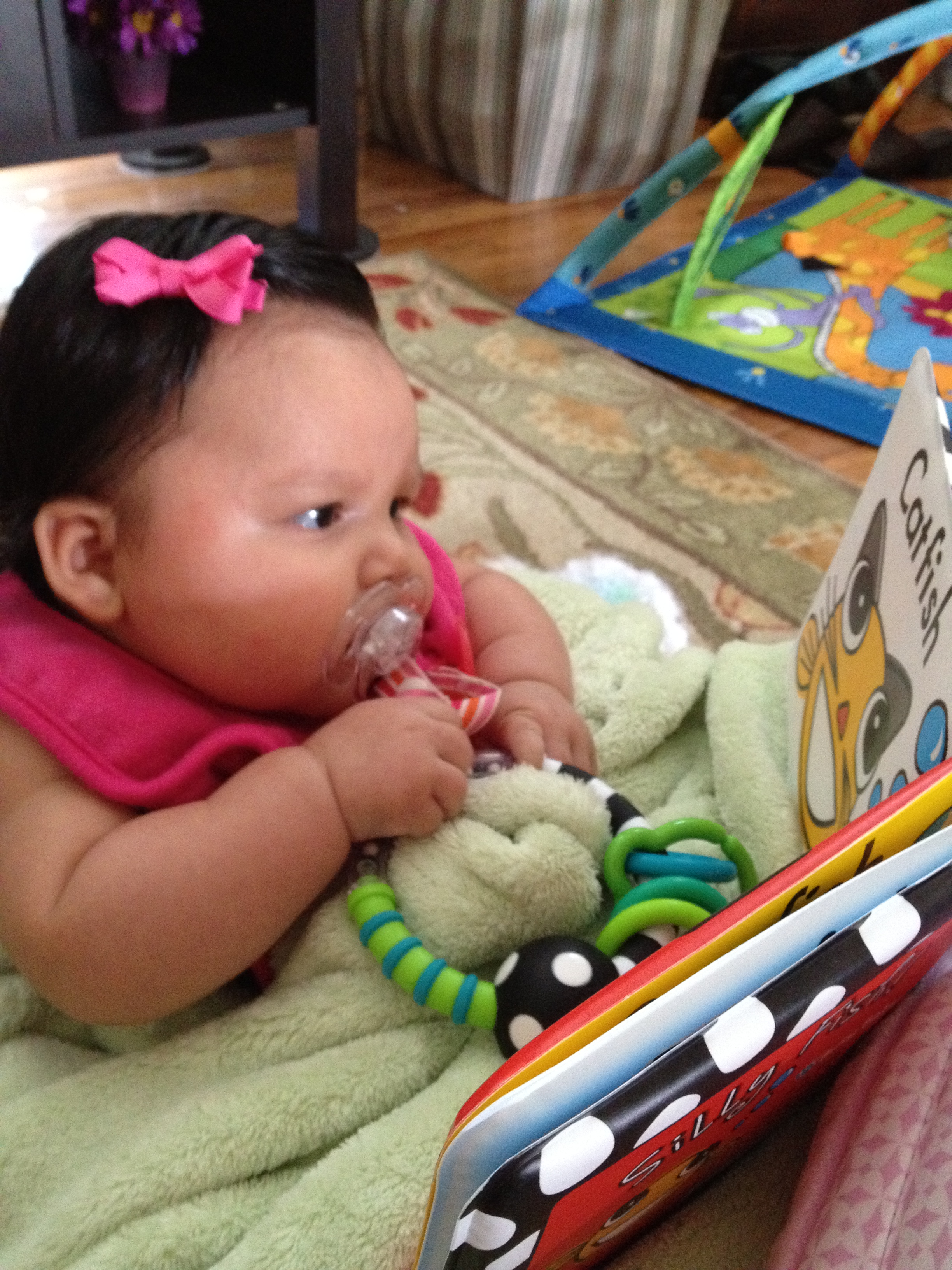
Congratulations to Kirstin Nelson and her husband Mike. We are thrilled to welcome Vivienne Amy Small to the LLAM family. She was born March 15th and was brought home May 2nd. She weighed 71bs 2oz at birth and is now over the 13lb mark. According to Mom Vivienne is a good sleeper, is smiling up a storm and as you can see already on her way to being an avid reader.


_____________________________________________________

New LISP-SIS Chair-elect

Mary Rice from Charles County Circuit Court Law Library has been nominated as Vice Chair/Chair-elect to the Legal Information Services to the Public (LISP) – Special Interest Section (SIS) of AALL.
_____________________________________________________

Teaching Research in Private Law Libraries (TRIPLL)

Carol Mundorf from the law firm Ballard Spahr was selected to attend the TRIPLL Conference last April in Dallas, which is sponsored by Lexis. Selection was limited to 30 attendees and the 2012 mission was “Rethink Research Training: A Practical Approach to Creating High Impact Programs.” More information can be found here.
_____________________________________________________

Proud Grandmother

Kevin Rubenstein and Matthew Jennings, grandsons of Beverly Rubenstein, graduated from High School in June. Kevin, who was vice-president of his class, graduated from Boys Latin School. He is a member of the National Honor Society and received the alumni award for leadership and character. He will be attending Dickinson College. Matthew, through a combination of AP and college courses, graduated at the end of junior year and at the age of 16, from Broadneck High School, where he received an honors diploma. He will be attending the University of Vermont.

_____________________________________________________

Andy Zimmerman’s New Gig

Many well wishes go out to Andy Zimmerman. He is leaving his current post at Gordon Feinblatt in Baltimore to take a position as the Manager of Library Service for the DC office of Morgan Lewis & Bockius.

Learning from Displays – The War of 1812

Fort McHenry Bombardment 1814

by Pam Luby, Research Librarian, MD State Law Library

One of my responsibilities as a part-time reference librarian at the Maryland State Law Library is to maintain the display cases in our lobby. Highlighting items we have in our collection is the goal. Not surprisingly, The War of 1812 is our current display.

When I began planning the display, my thoughts turned to The National Anthem and Francis Scott Key, Dolly Madison saving the huge painting of George Washington while fleeing the burning White House, and the Indian leader Tecumseh. Then my mind went blank and I realized how little I actually knew about the War of 1812. Creating this display turned out to be a fascinating project. For those of you who slept through American History in high school like I did, here is a brief synopsis and highlights of the war.

The War of 1812 was a conflict between the United States and the British Empire that began in 1812 and lasted until early 1815. A declaration of war was requested by President James Madison to protect American ships on the high seas and to stop the British from capturing U.S. sailors. U.S. ships were being stopped and searched by British and French ships, which were both fighting each other in Europe. President Madison also wanted to prevent the British from creating alliances with Native Americans on the American frontier. Americans in the West and South, who hoped to increase the size of the United States by seizing control of both Canada and Florida, influenced his decision. Critics called the War of 1812 “Mr. Madison’s War,” but others saw it as a “second war of independence,” an opportunity for Americans to protect their freedom and honor in the face of European disrespect.

Dozens of battles were fought on land in Canada and in the United States, in the present-day states of Michigan, Indiana, Ohio, New York, Maryland, Louisiana, and Alabama. There were crucial naval battles on Lakes Erie and Champlain, and a wide-ranging maritime struggle with many episodes off Virginia, Massachusetts, Nova Scotia, Cuba, Ireland, the Azores, the Canaries, British Guyana, and Brazil. The United States was surprisingly successful against the great British navy, but the War of 1812 also saw American armies surrender en masse and the American capitol burned.

The war eventually ended in a stalemate. The Treaty of Ghent was signed on December 24, 1814 although not ratified until after the final Battle of New Orleans in January 1815. The settlement simply ended hostilities and restored pre-war borders. The conflict served to define the nation of Canada but the British made no stipulations for the Indians. The U.S. and Canada ultimately each gained a sense of nationalism from the conflict, while the result tolled the end of Native American dreams of a separate nation.

One in particular was Tecumseh. He was a Shawnee Indian who eventually became one of their greatest leaders. By the early 1800s, Tecumseh decided that the best way to stop white advancement was to form a confederacy of Indian tribes west of the Appalachian Mountains. Tecumseh believed that no single tribe owned the land and that only all tribes together could turn land over to the whites and that a united Indian front would have a better chance militarily against the Americans.

During the War of 1812, Tecumseh and his followers allied themselves with the British. Tecumseh hoped that if the British won, they would return the Indians’ homeland to them. Tecumseh died at one of the most important battles of the conflict, the Battle of the Thames, in 1813. A combined English-Indian force met an American army but the British soldiers ran from the battlefield, leaving Tecumseh and his Indian followers to continue on their own. The Americans drove the Natives Americans from the field, and an American’s bullet killed Tecumseh. Tecumseh’s death signified the end of united Indian resistance against the Americans.

By the beginning of 1814, Americans were growing tired of the conflict and opposition to the war was on the rise. However, on August 24, 1814 it became personal. A British force occupied Washington, D.C. and set fire to many public buildings following the American defeat at the Battle of Bladensburg. The White House, the U.S. Capitol, The Library of Congress and many other government buildings were largely destroyed. Less than a day after the attack, a hurricane that included a tornado passed through, injuring British soldiers and putting out the fires. This forced the British troops to return to their ships, many of which were badly damaged by the storm, and so the actual occupation of Washington lasted about 26 hours. The British Commander later reported that more of their soldiers were wounded and killed from the hurricane than from all the firearms the American troops could muster in their ineffectual defense of Washington.

After destroying the Capitol and exhilarated with their easy victory, the British headed north to Baltimore where they hoped to strike a major blow against the demoralized Americans. However, Baltimore, being the country’s third-largest city and a vital port, had been preparing for this attack for a year. Maryland militia numbered 9,000, with every able-bodied male up to the age of 56 having been called up in its service. The Battle of Baltimore was a combined sea/land battle and was a turning point in the war. American militia who were determined to hold the line at Baltimore blocked the land assault. To reach Baltimore by water, it was necessary to capture Fort McHenry. Under the command of Major George Armistead and with 1,000 soldiers, the Fort could not be breached after a 25-hour bombardment and ultimately the British withdrew.

In Baltimore’s preparation for an expected attack, Fort McHenry was made ready to defend the city’s harbor. Major Armistead commissioned Mary Young Pickersgill to make two oversized American flags for the fort. The larger of the two flags would be the Great Garrison Flag, the largest battle flag ever flown at the time. The smaller of the two flags would be the Storm Flag, to be more durable and less prone to fouling in inclement weather. Mary Pickersgill stitched the flag with her daughter, two nieces, and two African American servants in six weeks. She was paid $405.90 for her work — at that time, more money than most Baltimore residents earned in a year. Contrary to popular belief, the flag did not fly during the Battle of Baltimore, but was raised after the U.S. victory, at “dawn’s early light,” to the tune of Yankee Doodle. The Flag remained with the Armistead family until 1912, when it was given to the Smithsonian. By then over 200 yards of it were cut and given away as tokens of appreciation or service, including the 15th star, which has never been located. Today, the flag measures 30 feet by 34 feet. The official name of the flag is the Star-Spangled Banner, and it is on display at Smithsonian’s National Museum of American History, where it continues to inspire generations of Americans.

It was at this battle that Francis Scott Key wrote our National Anthem. When the British left Washington, they took with them an elderly and well-respected American physician prisoner, Dr. William Beanes, whom they accused of spying. Beanes was taken to the British flagship HMS Tonnant, which was anchored in Baltimore harbor. President Madison gave attorney Francis Scott Key the sanction to intervene. On September 3rd, Key and Colonel Skinner, who was experienced in negotiating prisoner exchanges, sailed for Baltimore. They reached the Tonnant under a flag of truce on the morning of the 7th. After defending Dr. Beanes by producing letters from wounded British prisoners who told how he and other American physicians had respected them and treated their wounds, the British agreed to release the three men — but only after a few days. They were placed under guard aboard the HMS Surprise. On the morning September 13th the battle began; it lasted for 25 hours. Francis Scott Key and his two American friends were transferred to their sloop behind the convoy of British warships. They could only watch helplessly from its ramparts, closely guarded by the same enemy that was simultaneously killing their countrymen.

Early the morning of September 14th, Key was inspired by the American victory and the sight of the large American flag flying triumphantly above the Fort. Key wrote a poem on the back of a letter he had kept in his pocket. After being released, Key completed the poem at the Indian Queen Hotel, where he was staying, and entitled it “Defence of Fort McHenry.”

Americans took tremendous pride in their victory over the British at the Battle of Baltimore. Handbills were quickly printed and copies distributed to every man who was at Fort McHenry during the bombardment. Key’s words were first printed on September 20, 1814, in the Baltimore Patriot and Advertiser. By the end of the year, Key’s words were printed across the country as a reminder of the American victory. The poem was set to the tune of a popular British song “The Anacreontic Song” (or “To Anacreon in Heaven”), and later renamed “The Star-Spangled Banner.” The “Star Spangled Banner” became a well-known American patriotic song. It gained special significance during the Civil War, a time when many Americans turned to music to express their feelings for the flag and the ideals and values it represented. By the 1890s, the military had adopted the song for ceremonial purposes, requiring it to be played at the raising and lowering of the colors. Despite its widespread popularity, “The Star-Spangled Banner” did not become the National Anthem until 1931 When President Hoover signed it into law.

Thank You – From the Past President

by Sara Witman, Director of Library Services, Gordon Feinblatt LLC

Honestly, I had a blast serving as President of LLAM this past year. The members of this organization are just plain fun to be around. It is rare to find such a perfect mix of energy, camaraderie, and dedication to public service.

Our Spring Fling in May is a great example of this. First of all, could we get a better location that Nick’s Fish House patio? The view of the harbor was lovely. And although the report called for rain, the weather held up all night with a gorgeous sunset. Moreover, what a great group of people to chat with. That night, we raised all kinds of donations, such as books and household items, for an organization that works to prevent child abuse, called The Family Tree. A successful evening, indeed.

I am thrilled to be able to serve for another year as Past President, since our newly-elected Board members are top notch. I look forward to getting to know better our new Board members Kate Martin and Mark Desierto, and our new Secretary Sara Thomas. We are lucky to have such bright people in our ranks. I am also happy to be able to continue to work with Treasurer Bijal Shah, who is always up for a challenge and is thankfully incredibly organized. This year’s Vice President Tonya Baroudi has already planned a number of events, and we haven’t even made it to August yet! Tonya is awesome! I can’t wait to see what she does with the programming.

And, of course, my year would not have been nearly as wonderful without the phenomenal Mary Jo Lazun, who served as Vice President, and will no doubt be an amazing President this year. She was the driving force behind the successful LRI conference in March, put together some of the best programming we’ve seen, and also has so many great ideas for LLAM in the future. I am grateful to be able to continue to work with her this year.

I will definitely miss working closely with Susan Herrick, who has been a true mentor to me in the last few years.

Obviously, being able to spend more time with LLAM members has been the best aspect of my time served this past year, and I’d like to thank all of the members for being so great.

Greetings From the New Vice President

by Tonya Baroudi, Director of Library Services, Prince George’s County Circuit Court Law Library

Recently, I attended an Employee Appreciation Awards Ceremony where a host of individuals were proudly honored with gifts, plaques, good cheer, and celebration for their exemplary service as a team player, demonstrating superior customer service traits, and performing above and beyond the call of duty. As I glanced around the room, I was reminded of my involvement with LLAM, as both a Committee Chair for several years and as a Board member, in which I had the privilege of working with a number of you who could have easily been one of the recipients of the awards that were distributed that day.

However, my role this year as Vice President will be quite different from previous roles and to be honest more challenging yet quite exciting. I am honored to be partnered with Mary Jo Lazun who is dedicated to our team’s growth and development. In addition to planning and implementing educational and social events, there is much on this year’s agenda. We will revisit our strategic plan, establish short-term objectives, and adjust our committee structure, to name a few. I look forward to building new relationships and to embark on a year-long journey that promises to be a rewarding and insightful experience.

AALL/LLAM Grants for Annual Meeting/Conference

Each year, on a rotating basis, AALL provides grants to members of local chapters to cover registration for the Annual Meeting.  In 2011 it is LLAM’s turn to have a member receive a AALL grant for the Annual Meeting, to be held in Philadelphia from July 23-26.  To make the grant even more appealing, LLAM is adding $500 to AALL’s registration grant to help cover the cost of transportation/hotel/meals at the conference.

To apply for the grant, you must fill out an application and return it to the LLAM Grants & Awards Committee by Wednesday, April 4, 2012.  Applicants must be members of AALL and LLAM at the time of their application.  A committee consisting of Jean Hessenauer, Mark Desierto, and Jim Gernert will review all of the applications, and let the grant recipient know of his/her selection by April 8, 2011.

For more information, or to request a copy of the application, contact Jim Gernert at jgernert@yahoo.com, or (410) 965-6107.  You can also find a copy of the application on LLAM’s website at http://www.aallnet.org/chapter/llam/llamgrantapplication2011.doc .

What’s New with LLAM Members

Goodbye, Janet…

Janet Sinder is leaving the Thurgood Marshall Law Library at the University of Maryland Francis King Carey School of Law. Janet has been the Associate Director for Research Services at TMLL since 2004. She is leaving to become the Director of the Library and Associate Professor of Law at Brooklyn Law School on May 1.

Janet became the editor of Law Library Journal in July 2007 and will continue in that role as she moves to her new job.

Janet is “sorry to be leaving the LLAM community, with all its great law librarians, but looking forward to living and working in New York City.”

Congratulations and good luck!

_____________________________________________________

AALL/LLAM Grants for Annual Meeting/Conference

Each year, on a rotating basis, AALL provides grants to members of local chapters to cover registration for the Annual Meeting.  In 2011 it is LLAM’s turn to have a member receive a AALL grant for the Annual Meeting, to be held in Philadelphia from July 23-26.  To make the grant even more appealing, LLAM is adding $500 to AALL’s registration grant to help cover the cost of transportation/hotel/meals at the conference.

To apply for the grant, you must fill out an application and return it to the LLAM Grants & Awards Committee by Wednesday, April 4, 2012.  Applicants must be members of AALL and LLAM at the time of their application.  A committee consisting of Jean Hessenauer, Mark Desierto, and Jim Gernert will review all of the applications, and let the grant recipient know of his/her selection by April 8, 2011.

For more information, or to request a copy of the application, contact Jim Gernert at jgernert@yahoo.com, or (410) 965-6107.  You can also find a copy of the application on LLAM’s website at http://www.aallnet.org/chapter/llam/llamgrantapplication2011.doc.

_____________________________________________________

2011-2012 LLAM Directory

The LLAM 2011-2012 Directory is now available in PDF and online format. To request a PDF version of the directory or to obtain a password to access the directory on the LLAM website, please contact Mary Jo Lazun at mjlazun@mdcourts.gov.

Full Disclosure Keynote Address

By Mary Jo Lazun
Head of Electronic Services
Maryland State Law Library
 

Lucy Holman, MLA President and Director of Langsdale Library at the University of Baltimore introduced Maureen Sullivan, incoming ALA president and Steve Anderson, incoming AALL president. Rather than a traditional keynote address Lucy Holman asked Steve and Maureen a series of questions. Highlights are below.

 1. The trend now is now toward discovery services and a simple search box. Some people consider this “googlize” searching a major mistake, others wonder why it has taken us so long? What is your opinion?

Maureen sees the current trend towards a simple search box as a positive development since it makes access to our collections easier for patrons. We need to be willing to change the way we like to work and think about how we should work. Steve noted that we need to evaluate what we need the catalog to do. In some cases a simple shelf list is all that is needed. In other cases a full-blown discovery system might be required.

 2. What role should librarians play in helping users understand automated filtering and assisting them in their own efforts to manage information overload?

Steve noted there are benefits to personalized results, but one of our jobs is to educate patrons that there may be more material available than they are currently viewing. He also noted that patron education about how to use our materials, regardless of format, is a perpetual role for librarians.

 3. What advice would you give “up and coming” librarians who wish to become leaders? 

Maureen started the discussion by remarking that librarians must recognize that by getting their MLS they are entering a profession and should have a thorough understanding of what it means to be a professional. She noted that one of the best ways to become a leader is to become actively involved in professional associations. She also noted that leadership is a process and librarians should not wait to be “anointed.” To be an effective leader a person must be attuned to the strengths and weaknesses of others, and be willing to adapt to changes in the environment. In her opinion, the most critical leadership skill is the ability to learn. Steve noted that professional associations are a great way to learn and develop leadership skills. There is also a practical aspect—it is harder for an employer to say “no, you can’t do that” when your work benefits the profession.

 4. What developments in publishing do you see coming in the next decade and how will that affect libraries?

Steve started the discussion by commenting that the publisher’s job is to package and ensure that the product we buy is of high quality. The role of the librarian becomes even more important when evaluating self-published materials. Maureen discussed a meeting between New York publishers and ALA. The meeting illuminated the fact that publishers do not have a clear understanding of what libraries or librarians do.  What was clear was that we are both committed to serving readers. Maureen also recently attended a meeting at Harvard with academic publishers, faculty, and librarians who are interested in how people are using newly digitized materials. ALA plans to continue the dialogue with both groups.

 5. How do you see the physical space, we call a library, evolving from material repositories into learning spaces for campuses or community centers for neighborhoods?

Maureen believes that the physical space of a library, if there is one, should be determined by the library’s constituency. For example, the recent closing of the stacks at Welsh Library at Hopkins Medical was well planned and designed to meet the needs of their students and faculty. We may someday not only have embedded librarians, but embedded libraries. She recognizes that “closing the doors” does have an impact. In public and school libraries, open and fluid spaces that can be configured and reconfigured are a good trend. Steve emphasized that libraries are part of institutions so what each institution needs will vary. What we need to be ready to do is respond to the needs of the institution. Embedding doesn’t mean the loss of the library; it is just a different kind of library.

6. What advice would you give librarians on advocating for change on their own campuses or joining larger efforts?  How can we encourage faculty to advocate for more open access?

 Steve advises caution in this area. While the move to open access journals has value in terms of cost savings and improved access, we are at great risk if these materials are not preserved. Deciding what to keep in print and what to leave online are issues that need to be balanced against institutional needs.

 7. Many librarians, particularly those who work in a business environment, are no longer calling themselves librarians but are using titles like information analyst, knowledge broker, cybrarian, or informationist. Is it time for a name change? What are your thoughts?

Maureen noted that the changes we are seeing with job titles is about conveying to our clients and funders what we do. We will probably see our titles change and evolve with the professions climate.

 8. How do you envision the transition to from online to print changing the job of librarians? (Audience question)

Steve said that regardless of the format  library materials are made available and our patrons need accurate services; therefore, he sees little change in our current roles. Librarians need to remember it is not about the space, either shelf space or server space, our goal is to provide accurate information. Maureen thought our jobs may evolve to allow for more flexibility for managers and their employees. For example, some libraries are moving toward generic positions descriptions and eliminating annual performance evaluation.

9. Please provide details on adaptive leadership (audience question for Maureen)

Maureen cited Warren Bennis author of Geeks and Geezers who saw leaders becoming deep generalists with broad competencies. She also cite’s Kouzes and Posner’s book The Leadership Challenge that discusses that individuals can develop leadership skills but noted that socialization does determine how quickly those skills develop. She also mentioned Ron Heifetz book, Practice of Adaptive Challenge as another good source of information about adaptive leadership. A detailed bibliography of selected readings on Leadership recommended by Maureen Sullivan is available at https://llamonline.org/agenda/

10. With eBooks, self-publishing, open access etc., what is the librarians role in protecting the first amendment. (Audience question).

Steve pointed out that protecting access to information, speech, reading etc., is what our profession is all about. And we need to pay particular attention to fostering diversity of speech.

Full Disclosure Program Summaries and Program

Download the Conference Program.

Program Summaries

The “New” Librarian Toolkit

Webinars: They’re Not Just for Vendors Anymore – Carol Mundorf, Manager of Training Services at Ballard Spahr LLP, gave us a peek at what it looks like to hold a WebEx webinar meeting.  For those of us that have only attended webinars but never facilitated one before, Carol’s informal presentation made the process much less intimidating. In fact, Carol made the process look downright simple! Key takeaway: Webinars aren’t just for instruction; they can be used for association meetings, to pass control of people’s desktops, or to assist long-distance patrons.

    • A Recipe for Facebook Success  – Joyce Garczynski, Communications and Development Librarian at TowsonUniversity and a very dynamic speaker, described how she and the Cook Library at Towson University use Facebook to promote library services, interact with students, and connect with faculty. Her library has two Facebook accounts – one for more professional communications and one (“Albert”) for more personal and fun posts.  The latter account connects more with students, while the former is the official face of the library. Interestingly, Joyce has both a professional and personal account on Facebook, herself. She uses the professional account to friend faculty.  Since she started friending faculty, her requests to teach classes and for information shot up. Joyce suggested that even on your professional Facebook page, you should put some non-controversial personal information up, so that co-workers/faculty feel like they can connect with you. Joyce puts up pictures of the cakes she decorates.  (They look lovely! And delicious!)
    • Don’t Let Your e-Files Manage You –  Paul Lagasse, from Active Voice Writing & Editorial Services and a former archivist, explained how he organizes his electronic files. This was an eye-opener for those of us who have some trouble finding documents and emails. He said that although directories of folders are still the best way to organize online documents, he suggested that you create your file structure independent of the defaults, since you can remember what each folder is for better if it’s self-created.  Names should not be obscure (he starts them off with dates), and “smart folders” – “folders” created by tags or keywords — are a great way to handle complex filing.  Paul also described how organizing and maintaining a good group address book and then applying rules to emails that come in can make organizing automated and easy.  Key takeaway: Right-click!  Right-clicking emails of folders will often give you opportunities to select “categories” or “tags” or to create individual icons.
    • PowerPoint Doesn’t Have to Suck – Michael Shochet’s presentation on PowerPoint was a highlight on the conference.  His key point – don’t let the slides detract from the speaker; the speaker is the center of the presentation, not the slides.  In order to accomplish this shift, the slides should contain very little text and be as simple as possible. More complex charts or information can be put in a handout.  Michael suggested planning what you want to say first, then adding slides of images to compliment your presentation. If you’d like to see Michael’s presentation and handout materials, it is available on his website at: http://ubalt.libguides.com/powerpoint
  • Not Your Father’s Gov Docs
    • Navigating U.S. Government Information with FDSys – Kelly Seifert from the United State Government Printing Office gave us an overview of the new system FDsys. This replaces GPO Access which was taken offline a couple of weeks ago. Kelly walked us through the different collections and navigation tools, highlighting the depth and breadth of FDsys. Kelly used a variety of searching techniques and stressed the fact that FDsys is continuing to add and grow. FDsys will also be acting as a preservation repository creating permanent access to Federal Government information.
    • Reports: Understanding the Process – Sarah Albert from Maryland’s Department of Legislative Services Library walked us through the process of Maryland Mandated Reports. These are reports that come from various state agencies and have been mandated through law. Sarah’s responsibility is to track these reports down so they meet their mandate. She showed us the database she created to help track and acquire these reports. This process can be quite challenging because of the volume and variety involved.
    • Who owns the law?” Law.gov and Efforts to Return the Law to the Public Domain – Who owns the law?  Fastcase CEO Ed Walters thinks the answer should be straightforward: the public.  But, as Walters demonstrated in his thoughtful presentation, primary legal material is largely inaccessible to the public via Google or other popular search engines, and what is available is poorly organized, rarely authoritative, and can disappear without warning.  Further, the current Lexis/Westlaw duopoly over primary legal material only serves those who can afford access to those databases.So Fastcase has been working closely with leaders in government, academia and technology to develop Law.gov, an open access system for making primary legal material readily available to the public.  Walters dismisses notions that Law.gov is trying to undermine Lexis and Westlaw, although he peppered his presentation with anecdotes about some of Fastcase’s more interesting interactions with Wexis over the yearsInstead, he likens the Law.gov effort to the implementation of the U.S. interstate highway system.  He believes that Law.gov can provide a uniform, unified infrastructure for providing authoritative legal material to the public, instead of forcing users to navigate a patchwork of local, rural roads for locating federal or state law.
    • Going Old School In The New World: How Legislative Procedure Drives Legislative History – John Cannan from Drexel University’s Earle Mack School of Law discussed the legislative process and how changes in technology are impacting legislative history and our ability to track it. He outlined the historical process and how a bill could be traced as it went through committees. Now through the use of “cutting and pasting” and email a lot of the process is getting lost. A librarian needs to have a strong understanding of congressional procedure in order to keep on top of these ongoing changes.
  • Under the Hood
    • Twinkies, Kodachrome and MARC: the Changing Landscape of Libraries – Mary Jo Lazun of the Maryland State Law Library began the session with a discussion of lessons librarians can learn from the recent bankruptcy filings by Kodak and Hostess. Kodak’s mistake was that they forgot that their core mission was selling memories and not film. Librarians must not lose sight that we are about more than providing access to books and databases. Mary Jo sees the core mission of librarians as a providing “access to opportunities.” Hostess’ inability to adapt caused them to lose market share beginning with the publicity related to the “Twinkie Defense.” Unlike Hostess, librarians have a long history not only adapting to change but embracing it as seen by adoption of the card catalog, OPACs, and most recently discovery systems.
    • Discovery Tools at Pence Law Library-  Jeanne Felding of the Howard Hughes Medical Institute Library discussed how she is using EBSCO’s Discovery Service to bring together two very distinct user populations—the scientists at their Janelia Farm campus in Virginia and administrative staff of lawyers, accountants, and endowment managers in Maryland. Her ultimate goal is to provide full-text access available anywhere, anytime, to all HHMI staff and researchers. It is a goal she may not achieve in her lifetime, but it keeps her focused on making sure her decisions lead to achieving that goal.
    • One-Stop Search Environment For Full-Text Materials – At the American University, law librarians realized that the aging look of their online catalog was causing students and faculty to believe that the library’s collection was also aging. To get students to use the wide variety of print and online sources at Pence Law Library, Christine Dulaney and Sima Mirkin are using Innovative Interfaces products—Encore, Synergy, and Pathfinder Pro not only to enhance the look of the catalog but to provide students with easy access to their print collection, article databases, and specialty databases.
    • The Future of Discovery – Dave Hemingway of Innovative Interfaces, Inc. described major enhancements coming is Encore. High on the list in integration of social media, via community tagging, Facebook, and Twitter within the catalog records. Patrons will be to use a new dashboard to manage their library account and share lists of what they are reading and have read with others. Direct integration eBooks and LibGuides is also coming soon.
  • Eyes Wide Open
    • Google As A Legitimate First Step In Research-  Joanne Colvin presented Teaching Google as a Legitimate First Step in Research. Joanne, librarian at the University of Baltimore School of Law, acknowledges that the first step most researchers take when starting a new project is to Google their topic. This fundamental change in research strategy is here to stay; librarians serve their patrons best if they accept the change and focus on teaching patrons how to optimize their Google search skills and evaluate their results. Joanne explained some of the basics of how the Google search engine works – especially how results are relevance-ranked. She then showed how some features of the search engine can be manipulated to override the default ranking, and how others can provide Google with additional information to improve the accuracy of relevance ranking. The second part of the presentation outlined how researchers can evaluate websites once they’ve done their Google search. Factors to consider are authorship, accuracy of information, currency, publisher/sponsoring institution, bias/point of view, and citation to authority. The presentation ended with several examples of how a seemingly legitimate website can in fact be misleading.
    • “Teaching Technologies” for Legal Research Instruction – Jason Hawkins and Jenny Rensler, librarians at the University of Maryland Carey School of Law, presented on “Teaching Technologies” for Legal Research Instruction.  Jason began by challenging the assumption that technology should always be used in teaching; instead, he pointed out that the first step in planning a lesson is whether or not to use technology at all. The goal in weighing the benefits and pitfalls of teaching technologies is to consider whether the technologies provide an added benefit to students in the learning process that outweighs its pitfalls. Jason and Jenny went over a number of “teaching technologies” that may be useful in a range of settings from formal classroom settings to just-in-time instruction. Computer-Assisted Legal Instruction (CALI) provides several online tools including lessons on dozens of topics for self-directed learning, basic polling, and a growing number of e-books. Creating a screencast through software like Camtasia can be used to create video tutorials of an instructor walking the viewer through computer-based research steps to support self-directed learning, and to supplement class time. Other software they addressed included chat reference through the free Meebo Messenger, Prezi the dynamic presentation software, an institutional Facebook page, and a class website using Blackboard.
    • Letting Students Teach Your Class – Jill Burke presented Letting Students Teach Your Class. Jill is a librarian at the Community College of Baltimore County, Dundalk. Due to recent construction on campus, her library did not have a library instruction lab, and librarians had to learn to teach research classes with just five laptops. In this presentation Jill shared how she kept the students engaged and taught them basic research skills. Each class began with an initial introduction to basic concepts such as keywords, Boolean operators, and databases. With just a handful of laptops, Jill then had the students work in groups of two or three.  Each group was assigned a database to explore (through a series of structural/process questions) and a substantive question to answer. At the end of the breakout session each group presented their findings to the entire class. The structure of this class was both efficient and effective. The students were engaged and learned the necessary skills despite the limited resources caused by the construction.
  • How May We Help You
    • Seeking a Monograph – This program described the work conducted by Steven Heslip, Director of User Experience at Johns Hopkins University’s Sheridan Libraries. According to Wikipedia, user experience design (abbreviated as “U.X.D.” or “U.X.”) “… incorporat[es] aspects of psychology, anthropology, sociology, computer science, graphic design, industrial design and cognitive science…. User experience design most frequently defines a sequence of interactions between a user (individual person) and a system, virtual or physical, designed to meet or support user needs and goals, primarily, while also satisfying systems requirements and organizational objectives.” Using the example of a student seeking a known monograph, Steven walked the audience through the process of analyzing the various paths by which a student could locate and obtain the monograph. Using input from librarians in different departments, and visual tools such as Visio and Balsamiq, he tracked the process with the objective of clarifying and improving library procedures.
    • Using An iPad To Redefine Roving Reference Service In An Academic Library-  Joanna Gadsby and Shu Qian of UMBC discussed the pragmatic details of implementing the project, such as where on campus to post the roving librarian and at what times of day; how to design a cart or carrying case for the iPad and other necessary accoutrements; and how to publicize the initiative. They also presented some of the detailed statistics they kept, including the types of questions received from what types of patrons; the times of the semester and times of the day that most questions were received; and the most popular locations for the roving librarians.
    • Faculty Services Librarians + Faculty = Student Success –  Three energetic librarians from different Montgomery College campuses detailed their joint and separate efforts to educate faculty about the library resources and services via a wide variety of innovative outreach initiatives. Diane Cockrell (Germantown campus), Kathy Swanson (Takoma Park/Silver Spring campus), and Christine Tracey (Rockville campus) described how their outreach results in faculty devising realistic and appropriate assignments which facilitate effective student learning about research and about using library resources.
  • In the Stacks
    • Digital Initiatives at UB – Thomas Hollowak described the digitization projects recently undertaken by the Special Collections Department at UB’s Langsdale Library. Many of these projects reflect regional and Baltimore history; one example is “Baltimore 68: Riots and Rebirth” which collects oral histories and photographs from the Baltimore riots following the assassination of Martin Luther King Jr.  Thomas also touched on the digitized collection of UB yearbooks and catalogs.
    • We’ve Got a Lot of Stuff: Maryland Historical Society – Iris Bierlein discussed how the small staff of the Maryland Historical Society juggle their collection management and patron services duties, and described projects where the two aspects of their mission can work together.
    • The Road to Chapter 11: Library Serials Procedure – Mary Murtha, Lisa Bellamy Smith, and Clement Lau of UB Law Library described the workflow process that they have developed for their extensive cancellation of print serial subscriptions in favor of electronic, as a result of budget cuts, rising subscription costs, and the need to reduce the size of their print collection due to space constraints in their new library, which will open in 2013.
    • Stuck In The Middle With You: Print v. Online – Sara Thomas, Librarian at Whiteford Taylor in Baltimore, reflected upon the strengths and weakness of print versus online sources, including the new interfaces of Lexis Advance and Westlaw Next, and the challenges librarians face in helping their researchers achieve efficiency and effectiveness by making appropriate choices among the available options.
  • Librarians Just Wanna Have Fun
    • Boost The Fun (Factor) In Your Outreach – We first heard from Gergana Kostova and Nicole Smith from University of Maryland Baltimore County.  Gergana is a librarian and Nicole is one of the student interns. Gergana wanted to reach more of the first-year students at UMBC and she enlisted the help of fellow students such as Nicole to see what would draw them in. They hosted a variety of events including a coffee and UMBC cupcake meet-and-greet, as well as a full-fledged concert with a popular UMBC acappella group.  They combined these events with quizzes, etc and were able to determine that by their last event they had over 50% attendance by first-year students.  They are going to continue to think outside of the box to reach this vital audience.
    • PAWS for Reading:  Read with Us On Saturday Mornings – The next speaker was Lorraine Martorana from Cecil College’s Cecil County Veterans Memorial Library.  She has also strived to reach an audience and this one being children & parents who wouldn’t normally visit the Cecil College campus.  Lorraine partnered with the PAWS Reading Program which provides trained dogs & cats to which children can read.  The program started slow but word of mouth has kept the numbers growing.  Lorraine has gotten buy-in from the campus community and plans to continue with this worthwhile program.
    • Putting a (Technology) Petting Zoo to Work for You – Kristen Welzenbach from Goucher College spoke next with the intriguing topic of a technology petting zoo.  Kristen was surprised to find that a number of both faculty and students were not familiar with many of the latest “smart technology” devices.   With the help of Goucher’s Information Technology department, Kristen was able to showcase several devices including a variety of tablets, eReaders, and smart phones.  They even offered a raffle to give away one of the items. They held a few of these petting-zoos in varied parts of campus and were very happy with the turn-out.  Kristen was then able to put an eReader pilot program in place which is underway now.  Here is the libguide Kristen created for her eReader program: http://libraryguides.goucher.edu/ereader
    • Library Yogi – The final speaker of the day was Wendy Maines from Thomson Reuters Westlaw. Wendy’s topic was Library Yoga.  Wendy is a yoga teacher as well as an information professional.  She gave several demonstrations of seated yoga positions that we can all do from our desk.  All of those present took advantage and practiced the poses right along with her.  She started with the importance of breath, highlighted areas affected by carpal tunnel syndrome and finished with some words about meditation.  It was fantastic way to end this incredibly full and enriching day.
  • Legal Aid
    • Attorney, Client and the Librarian – In this session, Joan Bellestri discussed the steps she took to create a once-a-week “Lawyer in the Library” program at the Anne Arundel County Circuit Court Law Library.  This very successful and beneficial program now offers county residents a free 20-minute session with a lawyer. Challenges included finding appropriate space, getting enough attorneys to regularly volunteer, answering malpractice insurance questions, solving logistical problems with sign-ups, scheduling and waiting lists, and getting the word out to the public. A pilot program proved that the public would come and that attorneys would support the initiative. The program now includes sessions at the Courthouse library well as evening sessions in public libraries.
    • Stealth Learning: Librarian Interactions with Patron – Vickie Yiannoulou, of thePrince George’s County Circuit Court Law Library, assists the public in researching difficult legal questions. They run the gamut from family law issues to landlord tenant disputes to business law problems. Research roadblocks include legal texts with unfamiliar and confusing legal language, complicated legal online search syntax and a shortage of easy-to-understand layman’s materials. Here are her first steps for answering these difficult questions:
      • Get an idea of what the patron needs to know – often the patron him/herself doesn’t know what is needed.
      • Start with the Code/Rules, then look at form books or the Maryland Law Encyclopedia
      • Expand your search to specific practice treatises
      • For answering basic questions, use either Nolo Press books or the MSBA book on Civil Pre-Trial

PracticVickie also recommends reading Mary Whisner’s 94:1 Law Library Journal article  on the art of the reference interview as a start.

Free Online Tools for Legal Researchers – Imagine legal research without Lexis, Westlaw or any other paid legal databases, or even access to a print law library – how would you answer legal questions using only free Web sources?  Sara Witman discovered she could indeed answer many questions within this limited scenario. As an example, she recently was asked to find cases explaining the in pari delicto defense. She started with Nolo’s Free Dictionary of Legal Terms to define her phrase, then found a list of cases from Google Scholar and the Maryland Judiciary’s Casesearch.  CornellUniversity’s Legal Information Institute also provided federal and state court opinions and has searchable codes and regs. Other useful free legal research sites are Zimmerman’s Research Guide for specific questions of law, the National Council of State Legislatures site for 50-state surveys or the People’s Law Library to answer basic questions of court procedure. For people searches, she uses Facebook, LinkedIn and PIPL.com. For company research, Google news and Yahoo Finance are helpful starts.

Thank you to the following people who submitted summaries:  Katherine Baer, Joanne Colvin, Mark Desierto, Susan Herrick, Mary Jo Lazun, Kate Martin, Jenny Rensler and Sara Witman.

AALL Announcements

  1.  Learn How to Become a Thought Leader with Social Media
  2. AALL2go Pick of the Month
  3. Register Today for the 2012 AALL Annual Meeting
  4. Renew Your AALL Membership Early for a Chance to Win a Free 2012 AALL Annual Meeting Registration

___________________________________________________________

Learn How to Become a Thought Leader with Social Media

The value of social media as a communication tool is fast becoming ubiquitous in the professional law library culture. However, its value as a leadership tool is less evident. A new webinar, Open Leadership: Using Social Media as a Leadership Tool, to be held April 25 at 11 a.m. CDT, will demonstrate how all types of law librarians can become thought leaders inside and outside their institutions by using well-known social media applications to achieve strategic openness and transparency. This webinar is sponsored by the AALL Leadership Development Committee. Register by April 18.

___________________________________________________________
 
1. AALL2go Picks of the Month
 

AALL’s Continuing Professional Education Committee presents the AALL2go pick of the month – March: The New Generation of Legal Research Databases: Eighteen Months Later.

In January 2010, WestlawNext and Lexis for Microsoft Office were unveiled at the Legal Tech trade show inNew York. Both products, with their natural language and Google-like search capabilities, promised simplified research and workflow collaboration for attorneys, paralegals, law students, and law librarians.

At the 2011 AALL Annual Meeting, a panel of law librarians convened to discuss the results of their survey of WestlawNext users and share their experiences using the next generation of legal research databases (due to the delayed debut of Lexis for Microsoft Office and Lexis Advance, only WestlawNext was discussed). The panel used a “lessons learned” approach regarding database strengths and weaknesses, pricing, generational differences among users, and training. This session provides an excellent overview for any law library that is considering WestlawNext or already using it but wants to compare it with other database options.

Find this and more than 80 other free continuing education programs and webinars for AALL members on AALL2go.

AALL’s Continuing Professional Education Committee presents the AALL2go pick of the month – April: Getting to Yes for Your Library: Negotiating Vendor Contracts in Your Favor.

Law library directors, managers, and electronic services librarians now spend most of their days negotiating vendor contracts. The contracts are getting more and more complex.

A panel of law librarians and attorneys convened to talk about the art of negotiating a contract with vendors. The panelists discussed PREPARE, BE AWARE, and REPAIR and COMPARE. PREPARE refers to the steps you need to take before the negotiations begin. BE AWARE relates to what you need to focus on during the negotiations. And REPAIR and COMPARE refers to the concept of taking a break after negotiations to review and decide if you want to proceed with the contract.

The panelists also went through various provisions in a contract and discussed their views on what provisions and clauses are of the most importance. The panelists concluded with a discussion of nondisclosure agreements as a part of the contract negotiations and vendor permissible-use requirements. This session provides a wealth of information to all those who negotiate vendor contracts.

Find this and more than 80 other free continuing education programs and webinars for AALL members on AALL2go!

___________________________________________________________

2. Register Today for the 2012 AALL Annual Meeting

Designed by law librarians, for law librarians, the AALL Annual Meeting is an event you look forward to every year. Join nearly 2,000 of your colleagues from across the country to find out what they are doing in their libraries.

This year inBoston, July 21-24, you can look forward to:

Make sure your plans for this summer include the No.1 educational conference for legal information professionals—you can’t afford to miss it. Registration today!

Spread the word to your nonmember colleagues: Nonmember Conference Registration packages include a complimentary one-year AALL membership. By joining us inBoston, they’ll be joining AALL!

___________________________________________________________

 3. Renew Your AALL Membership Early for a Chance to Win a Free 2012 AALL Annual Meeting Registration

In March, AALL dues invoices for 2012-2013 mail out to all library directors for their institutionally paid memberships and to all other individual members. The deadline for membership renewal is May 31.

When you renew early—by May 1—you will be entered in a drawing for a free 2012 AALL Annual Meeting and Conference registration. If you renew on time—by May 31—you’ll be entered in a drawing for a free AALL webinar of your choice in 2012-2013. Following is the 2012 membership renewal schedule:

  • March: First dues invoices mailed out.
  • May: Second dues invoices mailed out.
  • June: Final dues invoices mailed out.
  • July: Expiration notices e-mailed to all members—individuals and those paid by institutions.
  • August 1: Expired members deleted from the AALL membership database and access to the AALLNET members-only content and Law Library Journal and AALL Spectrum subscriptions discontinued.

For more information or to renew your membership online, view the application form on AALLNET. If you have any questions about your membership renewal, contact AALL Headquarters at membership@aall.org or 312/205-8022.


My Disastrous New Job!

By Bill Sleeman
Assistant Librarian for Technical Services and Special Collections
Supreme Court of the United States
 

In May of 2011, after seventeen years at the Thurgood Marshall Law Library at the University of Maryland Francis King Carey School of Law, I moved to a new position as the Assistant Librarian for Technical Services and Special Collections at the Supreme Court of the United States. While I was sad to be leaving so many friends and talented colleagues at Maryland, it was not possible to pass up the opportunity to be a part of the Supreme Court. Little did I know that my first six months on the job would be such a disaster or, more accurately, a series of disasters. These incidents helped to focus my understanding of how a library disaster plays out in real time and just how very necessary a disaster response plan is. In this article, I hope to share some of this hard earned knowledge with the LLAM community while encouraging those who do not yet have a plan to prepare a disaster response plan.

Shortly after I moved to the Court, the then Court Librarian Judith Gaskell asked me to assume responsibility for preservation planning and for re-writing the library’s disaster plan. She also explained that this was not a high priority task. As I have prepared disaster plans for other institutions and have completed some preservation training from the Johns Hopkins University Library and through PALINET (now Lyrasis) I felt fairly secure in my ability to complete the task despite being new to the Court. Since it wasn’t a priority I thought I would work on it around all of the other tasks that come with learning a new position.

Unfortunately, only a couple of months into my tenure – and before the plan was started – a potential disaster loomed in the form of Hurricane Irene. By itself a glancing blow from a hurricane might not have been a cause for concern but that very week a contractor working on repairs to the Court’s roof inadvertently damaged the roof of the building directly above our rare book storage area. With help from the Special Projects Librarian, our Administrative Secretary and the Collections Management staff, we were able to scrounge up some plastic from the Marshal’s Office and were able to cover the compact shelving that housed part of our rare book collection. As a precaution we also moved our oldest and most unique material out of that area.

As we all breathed a sigh of relief that there were no leaks in the rare book area I resolved to get moving on the plan. Suddenly it seemed like a much higher priority!

I completed an initial draft of a plan and sent it up to the Court Librarian to be reviewed when we, along with much of the east coast, experienced the earthquake of 2011. While this did not cause any of our book stacks to collapse as happened at the McKeldin Library of the University of Maryland, it did send some of our books crashing to the floor so that I, along with Collections Management staff, had to spend time walking the stacks to re-shelve material and replace bookends.

Having side-stepped an earthquake, a hurricane, and a tropical storm that had passed through the Washington DC area (again, before the roof was repaired) I mentioned to a co-worker that I had better get that disaster plan approved before we had a volcano! I was starting to feel truly jinxed regarding disasters when a sprinkler head in the library’s main reading room was damaged resulting in water damage to the building and the collections.  It is that event that I want to explore in more detail.

A sense of disbelief was the first reaction I had when one of my staff members stopped by my office that September morning and asked if I knew that there was water leaking in the main reading room. As I mentioned above we had been joking amongst ourselves about my recent run of disasters; it didn’t really seem possible that something else could have happened but as I stepped into the hallway I could hear the water streaming out of a broken sprinkler head.

We do not know exactly how much water was released but the type of sprinkler system installed in the Library’s reading room is intended to fully douse a fire in its particular zone or range in a few minutes – this damaged sprinkler ran for over ten minutes – and resulted in nearly three inches of water on the floor and water draining down the vertical supports of the shelving units. There was so much water in fact that it ran down between floors and was pooling also in the main hall of the Court building two floors below the library.

Despite the volume of water we were quite lucky in several ways. First, the main reading room was in the midst of a renovation project and some plywood boards had been placed across the top of the upper tier of double-book stacks which helped to deflect some of the water. Second, we had two staff members who, along with one of the contractors working on the renovation, quickly gathered some plastic sheeting from the renovation workers and then climbed up on the top level of stacks, while the water was still going, and spread the plastic out across the top of the upper shelving further deflecting the water away and protecting a significant portion of the material.  Some of the contractors working on the renovation also quickly threaded plastic sheeting through the shelving in the bottom tier across the books on the top shelves.

Initial response /safety: This brings me to the first point I want to share with readers. While we are very grateful for their efforts, had I been in the room at the time I would not have allowed anyone to get up on the top tier of the bookcases while this event was going on. There was still power going to the lights and floor receptacles and the water was dousing metal framed book stacks – from a safety standpoint this was so not a good idea!  One of the first things to keep in mind when responding to a disaster is that safety really does have to come first – no book collection is worth risking life or injury to protect in an ongoing disaster.

Initial response / building security: My second point goes hand-in-hand with personal safety and that is building security. As staff from around the Supreme Court converged on the area the librarians were, to some extent, relegated to the sidelines. As counter-intuitive as that may seem it really is the most appropriate course of action.  Library staff were anxious to get in and start saving the materials but those several inches of water were still on the floor and the power was still on. The Marshal of the Court, the Court Police, and the Building Support Services staff really did not want or need the librarians underfoot until they had completed the tasks that they needed to do – including wetvacing up the water and getting the power turned off. The contractors working on the renovation also played a role as they quickly pitched in to help get the water cleaned up.

The key point here is that it is important for library staff to maintain contact with responders but to also stay out of the way of the public safety and facilities staff in your institution in the initial response to a disaster. Until the space where your materials are shelved can be secured it is not safe for you or your staff to try and rescue the materials

Initial response / ‘ready to rescue’: Once the power was off and most of the surface water had been mopped up – we were ready to start. Your disaster plan should guide you in making preparations for the initial survey of the damage and how you will sort and shift materials. The disaster response plan should also direct you to what supplies to have at hand for immediate reactions and what first steps you need to take. While our plan had yet to be approved by the Court Librarian I had outlined what we might need and, as building staff worked on securing the area, library staff began the process of getting organized.

Some other initial steps that should be a part of your disaster response plan:

  • Contacts: Your plan should have an up-to-date contacts list. Using the list in our disaster plan I contacted a colleague at the Library of Congress as I knew that they had some cold storage space at Fort Meade. I did not yet know how much damage we had or how many books we were talking about but it is a good idea to begin making contacts and arrangements for possible responses as quickly as possible.
  • Packing supplies: Your plan should outline what supplies you will need and where they will be stored. As we waited to get into the damaged area we began rounding up the various boxes, crates and book carts we would need to move and/or ship materials.
  • Building resources: Your plan should outline where to get those resources you will need in an emergency but that you can’t really keep in the library. In this instance we worked with our Building Support Services to begin lining up large floor fans so that if we had to air dry material we could be ready. The fans would also be useful to circulate air in the library stacks to try and keep the humidity down.
  • Staff involvement: Your plan should detail the steps that staff will employ to begin rescuing your materials. As we waited for access to the area, the Special Projects Librarian and I circulated among the library and buildings staff reminding them not to remove any books from the shelf until we could make a survey of the damage.

Once into the area we discovered that the damage was not as extensive as the amount of water suggested. The plywood and the tarps helped to divert much of the water away from the collection. However, the water that flowed to the lower parts of the building, as I mentioned earlier, traveled down the shelf support beams so that material touching the vertical supports were saturated and those next to them, books being a lot like sponges, began absorbing water from their next door neighbor on the shelf. Wet books can quickly become too heavy to support themselves and will suffer additional mechanical damage if handled incorrectly. It is a good idea to include early on in your disaster plan instructions on how to handle wet materials.

After a survey of the entire affected area, I began, with the guidance of the Court Librarian, to assign staff specific tasks to perform. One thing we needed to do very quickly to avoid the spread of water (and potential mold) was to separate the material that had not gotten wet from those that had. Even as we were working we could feel the humidity in the area going up – we needed those fans to move air and we needed to get the dry books away from the wet items. Because of the already mentioned renovation work we had several long runs of open shelves that served as swing space to temporarily move dry materials.

Ongoing action / prioritizing the response: Knowing the priorities for response is integral to planning a successful rescue. In our situation this meant being fully aware of the Court’s needs as we moved forward with salvaging the materials. Working with the Special Projects Librarian, two members of the Research Department and the Collections Management staff, we quickly determined that there was too much wet material and that it was far too compromised for us to air dry. We needed to quickly make a decision about remediation.  Unfortunately we did not have any sort of “if and when” contracts in place for remediation or freezer space -“this was on my list of things to do.” The Court’s Supervisory Contracts Specialist was a tremendous help in getting an emergency contract in place with a remediation vendor. Our colleagues at the Library of Congress also kindly agreed that we could use their Fort Meade facility but since they had materials there already it would not hold very much and we would have to arrange packing and transit. After talking it over with the Court Librarian it was agreed that we needed a full service response.

As we sorted material, shifting the dry material away from the wet, the remediation vendor arrived on site. After a walk-thru of the affected book stacks with the vendor and a discussion of the Court’s schedule with the Research Department Librarians we were able to prioritize our response. It is worth noting how important it is in a disaster to involve all library staff in the rescue process. In this instance the Research Librarians had a much better understanding of the Court’s needs than I did and were instrumental in helping to identify key tools that needed to be at the forefront of our remediation efforts. Since much of the affected materials were state codes that will be retained but superseded by newer editions and state reporter volumes, we knew that we did not want to invest a lot of money in any remediation response but that the books also needed to be treated in a way that would ensure their continued viability in the future.

A final factor to consider for us was the fact that the Court’s new term was only a month away and the Research Librarians felt that we could not be without the material for long. This time frame eliminated any sort of cold remediation (freezing) treatment for the material as that would take too long for our needs; accordingly we decided to employ a combination dehumidification and desiccant air drying option. With this decision made we began creating an inventory of materials to be sent off site and packing boxes for shipment to the vendor’s treatment facility.*
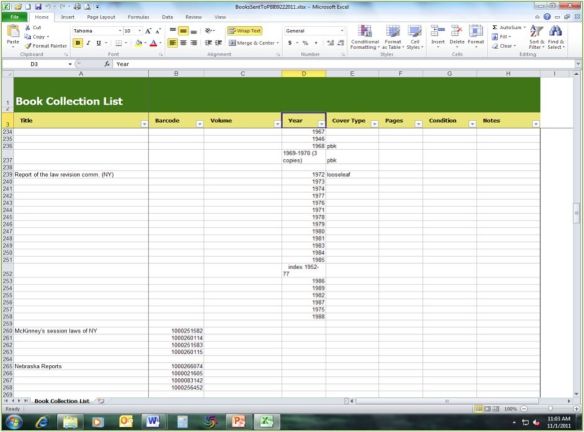
 Sample inventory of material sent for remediation

Post-op: On the following day, I arrived bright and early with doughnuts for everyone on staff; never underestimate the value of sugar coated fried dough as an expression of thanks for hard work and certainly everyone worked hard. I also arranged a de-briefing of participating staff from all levels of the library to evaluate what went well, what did not work and how we might need to tweak our disaster plan. When you are called to use your plan one of the best things you can do afterward is review what worked or did not and then adjust your plan accordingly.

Our books return: The books came back at the end of the second week of the Supreme Court term. Admittedly a bit crinkly but dry, mold-free and ready for use. I decided it was prudent before we sent the books to the shelves to remind library staff that we had paid for the material to be returned to a usable condition in as short a time frame as possible so while they may not look pretty they were all fully functional and stable. Using our shipping inventory (an inventory form or document should be a part of your disaster plan) we quickly re-sorted the material and got it back onto the shelves and available for use.

The role of the plan: We got through our first real disaster successfully. Our disaster response plan, although not finalized at the time of the sprinkler incident, proved to be an invaluable guide to our response. In the end we sent 530 individual volumes out for treatment. We disposed of approximately 200 volumes of various federal reporters and U.S. Reports, replacing those from back up sets that we had in off-site storage. We air dried a handful of less valuable and only slightly damp standalone supplements and directly purchased replacements for less than a dozen volumes.  Staff from all areas of the library and the Court worked together as a team to deal with the event and we were able, through the efforts of so many people, to return to use the important print resources that the Court relies on and we were able, guided by our plan, to do so in an efficient and cost-effective manner.  

Final thoughts

The series of disasters that represented the first few months of my new job brought home to me the importance of having a disaster plan in place and helped us to hone our response so that we can be  more efficient and better prepared the next time. With luck “next time” will never come but if it does we will be ready and with a well-thought out disaster plan your library will be too.

*For more on the desiccant drying process please see the useful description of disaster response options on the Lyrasis website at: http://www.lyrasis.org/Products-and-Services/Digital-and-Preservation-Services/Resources-and-Publications/Drying-Wet-Books-and-Records.aspx (last viewed 12/30/2011)
Advocating for Maryland Libraries: MLA Legislative Day in Annapolis

Joan Bellistri
Anne Arundel CountyPublic Law Library
 
Cas Taylor

Cas Taylor

The Maryland Library Association Maryland Legislative Day was held on January 25, 2012, a bit earlier than in years past.  The day began as always with a breakfast briefing in Anne Arundel County Public Law Library.  The breakfast, provided by LLAM, is always appreciated by the librarians who have traveled from across the state for the event.  Cas Taylor, former Speaker of the House and now lobbyist with the firm Alexander and Cleaver that represents the Maryland Association of Public Library Administrators, briefed the group on the issues before the legislature of significance to Maryland libraries.

After the briefing everyone headed to the State House where proclamations were read in both the Senate and House chambers.  The House even gave MLA president, Lucy Holman, an opportunity to speak.

The rest of the day was dedicated to delegate visits.  Librarians from most of Maryland’s counties visited their delegations to distribute information packets and talk about library issues.  With the Library Legislative Day being scheduled earlier in the session than usual, more delegates were available to meet with the librarians.  All members of the House and Senate and the Governor’s office were invited to the MLA reception.  As usual, this was a lovely event with librarians and members of library friends groups being able to talk with the legislators.  This year DLLR Secretary, Alexander M. Sanchez, addressed attendees and voiced his support for the DLLR /public library partnership in workforce initiatives.

Glennor Shirley and Mary Baykan

The number one issue this session involves the budget proposal to shift pension costs from the state to counties.  Although this proposal is most often seen as an issue that concerns teacher pensions, it would also affect public libraries.  Libraries are only a tiny percentage of the whole pension shift, yet such a move could have a large detrimental impact. There is a concern that since schools have the protection of maintenance of effort, the libraries would shoulder the burden of the pension shift.  Delegates were asked to see that library pensions not be shifted to the counties.  Other budget issues concerning libraries were capital funding for public libraries and the per capita funding.  Librarians asked their representatives to protect both of these sources that are essential in the continued operation and growth of Maryland public libraries. As of this writing, it has not been recommended that the capital funding be removed from the budget.

There were bills introduced, SB858/HB1001, that did not concern funding of libraries. These bills would designate public libraries as essential services in times of emergencies. This bill will make public libraries  among those public services that Maryland’s Emergency Management Administration (MEMA) will list as a priority in getting services restored and funds allocated. Both of the bills have passed.

It is always a relief when there are no bills introduced that would affect law libraries adversely.  Still, it is nice to know that if there were such a bill that the MLA Legislative Panel is there to address it.  We will look to MLA for support if  UELMA is introduced in Maryland.

LLAM members who attended Maryland Library Day at the Legislature this year were Joan Bellistri of the Anne Arundel County Public Law Library, Monica Clements of Legislative Services, Susan Herrick of the University of Maryland School of Law, Mary Jo Lazun of the Maryland State Law Library, and Vicky Yiannoulou of the Prince George’s County Public Law Library.

Vicky Yiannoulou, Susan Herrick and Mary Jo Lazun

Ideas in Client Service: Lean Techniques for Law Libraries

By Monique LaForce
Corporate Intelligence Analyst
Steptoe & Johnson LLP
 

“The use of the term “Lean”, in a business or manufacturing environment, describes a philosophy that incorporates a collection of tools and techniques into … business processes to optimize time, human resources, assets, and productivity, while improving the quality level of products and services … [for] customers.”[i] Traditionally, Lean techniques have been applied to streamline manufacturing operations by eliminating waste from repeatable processes, but in the October 2011 issue of the Harvard Business Review, Bradley R. Staats and David M. Upton authored a piece analyzing the application of Lean principles to knowledge workers.[ii]  Staats and Upton maintain that Lean principles can be applied to knowledge work, even though many aspects of it are not repetitive (unlike, say, an assembly line at a widget factory).  Staats and Upton argue that Lean techniques can make knowledge work (like that performed by law librarians) more efficient and more predictable, and thus, provide better client service for patrons.

While Staats and Upton discuss many Lean techniques in their article, a few that may be applied to law libraries include:

Eliminate waste in routine, repeatable activities. 

While each research project undertaken by a law library’s research team is unique, the process by which queries are received, logged, and disseminated generally has routinized aspects that might be standardized to eliminate waste.  Other law library processes could also be streamlined.  Are there multiple access points for reporting time spent on projects?  For example, in some law firm libraries, librarians bill their time via a time entry program, but also separately report on projects to a department head.  Could these processes be combined? Is equipment used by librarians and patrons located to maximize efficiency?  For example, in a law school library, are photocopiers located near collections that patrons must frequently photocopy (such as historic materials that are not available electronically), or are they in an area that requires users to travel long distances laden with materials for copying (and which subsequently need to be taken back by the library staff for re-shelving)? 

Make tacit knowledge explicit. 

Waste can be eliminated by ensuring that the wheel is not reinvented for every similar project.  Librarians implicitly recognize this by creating research guides or pathfinders.  Likewise, legal project management seeks to tame this area by creating timelines and decision trees for various legal proceedings (from real estate closings to complex litigation).  Commercial databases that gather data (such as information about transactions, or clauses in various contracts) and attempt to create accumulated knowledge also seek to eliminate waste, as do KM systems, which allow retrieval of past work upon which to base current projects.  Are there internal law library functions that might benefit from similar processes to avoid recreating past work?

Use communications effectively.

Effectively managing communications may increase efficiency in the law library.  In their article, Staats and Upton suggest, for example, that implementing guidelines as to whom to copy on emails can eliminate waste, by culling unnecessary time spend reading irrelevant communications — time that could be better spent serving clients.  Additionally, guidelines for the method of communication between librarians and patrons might also create more streamlined processes.  For example, it may be more efficient for researchers to refrain from sending results on a rolling basis, unless specifically requested, to reduce the volume of email requestors receive and the chances that results may be buried in the vast tide of correspondence faced by lawyers on a daily basis.  

 While Lean techniques are not universally applicable to knowledge workers, the fundamental idea behind Lean – elimination of waste – may be helpful in improving client service in the law library.  


[i] Lean Manufacturing and the Toyota Production System, R. Becker, http://www.sae.org/manufacturing/lean/column/leanjun01.htm.

[ii] Lean Knowledge Work, B.R. Staats and D. Upton, Harvard Business Review, October 2011,  pp. 100-110.