‘Link Rot’ and Legal Resources on the Web: Have We Reached a Plateau?

THE CHESAPEAKE GROUP’S FOURTH ANNUAL ANALYSIS FINDS THAT LINK ROT IS SLOWING, BUT STILL PRESENT IN MORE THAN 30% OF URLs

WASHINGTON (April 25, 2011) – Does the rate at which Web pages are lost to “link rot” slow down over time? The latest link rot study conducted by the Chesapeake Digital Preservation Group shows that this might be the case.

As National Preservation Week 2011 begins, the Chesapeake Digital Preservation Group is releasing the results of its fourth annual analysis of link rot among the original URLs for law- and policy-related materials published to the Web and archived by the Chesapeake Group. After three years of observing the rate of link rot nearly double on an annual basis, the Chesapeake Group found that link rot in its sample of URLs originally collected in 2007 and 2008 increased by only 2.5 percent in 2011. The sample includes URLs primarily from state government (.state.__.us), government (.gov), and organization (.org) top-level domains.

The Chesapeake Group is a shared digital archive for the preservation of Web-published legal materials, which often disappear as online content is reorganized or deleted over time. Participants include the Georgetown and Harvard Law Libraries and the State Law Libraries of Maryland and Virginia.

The 2011 analysis reveals that 30.4 percent of the online publications in the sample have now disappeared from their original Web pages but, due to the group’s Web preservation efforts, remain accessible via permanent archive URLs. This sample of online publications was first analyzed in 2008 and showed link rot to be present in 8.3 percent of the publications’ original URLs. In 2009, the same sample showed an increase in link rot to 14.3 percent, and in 2010, link rot in the sample jumped to 27.9 percent.

Although the 2011 link-rot rate of 30.4 percent represents a significant loss of content over the four-year period, the increase observed from 2010 to 2011 is less than three percent and deviates from the pattern of steadily increasing link rot observed in previous years.

The analysis also explores the prevalence of link rot among top-level domains. A detailed summary of the study is available at http://legalinfoarchive.org/.

The Chesapeake Group is a founding member of the Legal Information Preservation Alliance (LIPA) Legal Information Archive, a collaborative digital preservation program for the law library community. For more information, visit the LIPA Web site at www.aallnet.org/committee/lipa or the Chesapeake Group at www.legalinfoarchive.org.

UB Law Collection Development Reflects Changing Trends in Librarianship

By Joanne Dugan Colvin
Assistant Director for Public Services
University of Baltimore Law Library
 

Construction on the new John and Frances Angelos Law Center at the University of Baltimore is well underway. Travelers on Charles Street can see the girders climb out of the foundation that was poured this winter. (You can see it, too, through our live webcam! http://tinyurl.com/3plmpmo) The building has now reached the fourth floor of what will be a twelve story building.

The new library space has significantly affected our approach to collection development. We are taking the plunge and often relying solely on electronic resources for primary sources material. Only a few years ago it would have been inconceivable for an academic law library to jettison the National Reporter Series or the statutes of all of the states; now it’s an easy decision. Most states publish their cases and statutes online now, plus students and faculty have access to Lexis and Westlaw. We also provide public access Lexis for lawyers and members of the public who come to research. It doesn’t provide the full coverage that regular Lexis does, but it does make primary law readily available.

We are approaching secondary sources a little differently. We have just finished an “extreme makeover” of our classified collection, discarding about 25% of the collection. We have also canceled and will not be moving our law journal collection, instead relying on Hein Online. (As legal scholarship becomes more interdisciplinary we have also devoted more money to other journal databases such as JSTOR and Academic Search Premiere.)

Once the new building is occupied, the law library footprint will have both expanded and contracted. Our physical space (and in particular, our shelf space) will be much smaller. On the other hand, by emphasizing electronic resources, the library reaches beyond the physical confines of the building to serve our patrons wherever they travel.

Volunteer Needed: LLAM eNews

Are you experienced in using Cascading Style Sheets (CSS) in WordPress? If not, do you want to learn? LLAM eNews is looking for a volunteer to enhance the look and format of our WordPress newsletter page using CCS. This is a perfect opportunity to learn valuable new technology skills to add to your resume or take on a new challenge. And being a member of the Special Committee for Communication and Technology requires just a few hours of work each quarter.

There are many web tutorials and step-by-step guides available that teach CSS so even if you’ve never heard of it there are plenty of ways to learn. If you are interested in enhancing your web skills please contact the committee at llamnewsmd@gmail.com.

Document Delivery at the Maryland State Law Library

By Mary Jo Lazun
Head of Electronic Services
Maryland State Law Library
 

It is an unusual day when staff at the Maryland State Law Library (MSLL) does not fulfill a request for a brief, bill file, or unreported opinion. For fifty cents per page, or for free to Maryland state employees, the library staff will retrieve, scan, PDF, and email the document. To make the process even easier, the library accepts, and prefers, payment via Visa or MasterCard. The usual turnaround time is the same business day for requests received before 2:00pm. To request a document, just call the reference desk at 410-260-1430 or use the document delivery form on the library’s home page.

Available for Document Delivery from the Maryland State Law Library

  • Unreported opinions back to1988
  • Court of Appeals briefs
  • Court of Special Appeals briefs for “reported” cases
  • Maryland superseded codes
  • Maryland session laws
  • Maryland General Assembly bill files 1977-1997
    Please note that some bill files are too long for library staff to make a copy.

Now online!

Ideas in Client Service: Lessons from the Union Square Café

By Monique LaForce
Corporate Intelligence Analyst
Steptoe & Johnson LLP
 

Famed New York City restaurant owner Danny Meyer is widely considered to be an expert in creating memorable dining experiences for guests and providing “engaging hospitality”[1] in all his restaurants, which range in style and formality from white linen to BBQ, chichi Indian fare to half smokes.  Mr. Meyer’s first restaurant, Union Square Café, has been given Zagat Survey’s #1 ranking as New York’s Most Popular Restaurant eight times.  His restaurant Eleven Madison Park was this year honored with the James Beard award for outstanding restaurant.

In 2006, Mr. Meyers published a successful tome on bringing hospitality principles to business.  With the announcement that Mr. Meyer is invading neighboring DC (with the opening of one of his Shake Shack diners and the procurement of a Nats Park concession license), the time seemed ripe to examine the applicability of Mr. Meyer’s philosophy of hospitality to the law library.

Several of Mr. Meyer’s observations about life in the demanding and fast-paced world of New York cuisine are applicable to law librarians.

  1. Service is a monolog . . . [h]ospitality is a dialog.”  As librarians, a significant focus of our interactions with our clients is providing excellent customer service.  Perhaps occasionally we should stop to consider whether we are providing excellent hospitality.   Are we performing an engaged reference interview, or simply responding in a rote way to whatever the patron asks?  Are we seeking feedback from our clients as to what research services they need or are lacking?  Lore has it that there was a transactional lawyer who, when he realized that one of his major clients was seeking counsel from another law firm on some deals, asked the client why it was hiring the other firm.  Turns out, the competing firm wasn’t any better at providing transactional advice, but had better office supplies in its conference rooms. Hospitality ruled the day.
  2. Before you go to market, know what you are selling and to whom.  It’s a very rare business that can (or should) be all things to all people.”  As information archivists, retrievers, and analyzers, we as librarians may try to become all things to all people.  Sometimes, it might be beneficial to step back and examine a request, procedure or purchase in an effort to determine:  Is this the appropriate department to solve this problem?  Are the resources necessary to solve this problem appropriately spent in solving it?  If we add a particular service or database, is it beneficial to a large or important contingent of stakeholders?  Hard as it is for us to swallow, it is okay to say no sometimes.  Albeit in a hospitable way.
  3. People who aren’t alerted in advance about a decision that will affect them may become angry and hurt.”  A solid principle of hospitality is good communication – making stakeholders feel they are part of a process, not hapless victims of a decision thrust upon them.  For example, many electronic database providers have recently changed their interfaces and lexicons – some drastically.  Have we made our clients aware of these changes in advance? Provided learning opportunities?  Educated ourselves as to all the intimate details of these changes so as to provide counsel to our patrons during the change-over and after?   Change is the ultimate constant, so there are opportunities for us to welcome stakeholders into the decision-making process on an almost daily basis.
  4. The road to success is paved with mistakes well handled.”  Mr. Meyer provides multiple examples of mistakes that have happened in his restaurants – dinners spilled on designer ensembles, floral arrangements catching fire, guests passing out in dining rooms.  What sets a great restaurant apart from a good one, Mr. Meyer argues, is its ability to “write a great last chapter.”  Mishaps will forever go hand-in-hand with running any service organization – how we handle them determines whether one can “earn a comeback victory with the guest.”  How do we handle a missed deadline?  A response to a research request that lacked critical information when delivered?  A mistaken quote to a client on the cost of performing a search in a database?  How we follow-up with our patrons will determine whether our customers give us “a chance to earn back their favor.”

Mr. Meyer has built his entire restaurant empire on a philosophy of hospitality, generosity to the customer, and dedication to a great dining experience.  As law librarians, we can adapt these lessons to flavor our interactions with our clients to provide a superlative research experience.


[1] Quotations are drawn from Danny Meyer’s 2006 New York Times best-seller, “Setting the Table: The Transforming Power of Hospitality in Business” as are the basic ideas of hospitality that appear throughout the article.

AALL Program Preview: Services for Self Represented Litigants In Pennsylvania

By Joan Bellistri
Anne Arundel County Public Law Library
 

As a member of the Self Represented Litigation Network (SRLN) Law Librarians Working Group, I volunteered to propose a program for AALL 2011 that would provide information on how court libraries in Pennsylvania provide service to the self represented. After agreeing to come up with a program, I realized that I didn’t really know any court librarians in Pennsylvania. I just started calling court librarians in the AALL directory to find out what they do. I was able to persuade three county law librarians to talk about their experiences with self represented litigants.  Eleanor Gerlott of Lancaster County, Melanie Solon of Berks County and Tracy McCall of Dauphin County all work in court law libraries with a small staff. Still, all of them have been involved in the development of programs for the self represented in their courts. Eleanor was instrumental in the creation of the Lancaster County self help center. She manages the center, which is not on the same floor as the law library, with a staff of two. Melanie works with  her court’s Pro Se Task Force, which creates forms packets for use by self represented litigants. Tracey established the self help center in her law library and was a member of the forms committee.

The program was not accepted by the AMPC, but will be sponsored by the State, Court, and County Law Libraries Special Interest Section. The program is scheduled for Sunday, July 24, at 3:00. Only two of my original contacts, Eleanor and Melanie, will be presenting, but the program will be of interest to those of us in county law libraries that are seeing an increasing number of self represented litigants. The Value of the Public Law Library: How County Law Libraries in Pennsylvania Collaborate with the Courts to Provide Service to the Self Represented Litigant will provide information on the creation of a self help center and SRL forms development. More importantly, I hope that it will enable county law librarians to demonstrate the value of the court law library as an indispensable element in the court’s ability to provide service to the self represented litigant.  By taking the lead in the development of services to meet the needs of self represented litigants, law librarians can enhance their visibility while demonstrating their value.

AALL Program Preview: Chinese and American Forum on Legal Information and Law Libraries (CAFLL) Conference

By Bijal Shah
Electronic Services Librarian
University of Baltimore Law Library
 

Two days prior to the upcoming AALL annual meeting in Philadelphia, the second biannual Chinese and American Conference on Legal Information and Libraries will take place in the same city.  The first such conference was held in Beijing, China in May, 2009.  This conference is being sponsored by the Chinese and American Legal Forum on Legal Information and Law Libraries (CAFLL), a non-profit organization whose membership includes legal information professionals in China and the United States.  The Forum’s mission statement indicates that the organization “promotes the accessibility of legal information and fosters the education of legal information professionals in the United States and China.” (http://cafllnet.org)

The two-day conference on Friday, July 22 and Saturday, July 23 will serve as an opportunity for Chinese and American legal professionals to come together and share views on topics relevant to law libraries in both countries.  Since conference attendees will include law school deans and librarians from China and the United States, all sessions will be presented in both Chinese and English.  On the first day of the conference, workshops for Chinese library administrators and librarians on American law libraries are scheduled.  These pertain to such topics as leadership training and the internationalization of legal research.  The second day will feature keynote speakers, as well as panel discussions on evolving trends in law librarianship and future collaborative efforts between legal information professionals in the two countries.

One of my colleagues and I will be co-presenters during the panel discussion on technical services topics.  Clement Lau, Associate Director for Technical Services and Administration at University of Baltimore Law Library, and I are planning to briefly talk about resource sharing systems used in Maryland libraries.  Resource sharing is considered a “hot topic” in Chinese library circles, and Chinese library administrators are curious about how such systems operate in U.S. libraries.  We hope the discussion of our policies, practices, and challenges may foster additional dialog among both our American and Chinese colleagues.  In addition, I look forward to this unique opportunity to learn about a different library world.

Featured Articles

Featured Articles

AALL Maryland Working Group Update

By Joan M. Bellistri
Anne Arundel County Public Law Library

If you visit the AALL Government Relations Office page on AALL’s website you will see that “AALL is organizing working groups in every state to respond to challenges that threaten the authentication and preservation of online legal resources, and to contribute to the development of a ground-breaking national inventory of primary legal information at all levels of government.”

The following objectives in the AALL 2010-2013 Strategic Directions for Advocacy demonstrate the importance of the availability of authentic, permanent and publicly accessible legal information to law librarians:

Continue advocacy efforts to ensure the authentication and preservation of official digital legal resources.

Continue to advocate that government information must be in the public domain, and that information on government websites must be permanently available to the public at no charge.

The AALL Access to Electronic Legal Information Committee (AELIC) adopted “Core Values Concerning Public Information on Government Web Sites.”   These core values stress that information on government web sites be accessible, reliable, that official status of electronic versions be designated, comprehensive and preserved.  The core values act as a guide for the formation of the AALL working groups.

The goals of the AALL Working Groups are outlined in the GRO Advocacy Toolkit issue brief, “AALL State Working Groups to Ensure Access to Electronic Legal Information.” The first goal of the working groups is to challenge and stop attempts to discontinue print of legal sources unless “there is an official, authenticated online version that will be preserved for permanent public access.”  Working groups will also work to ensure that legal information included in the state’s data portal have a disclaimer stating the information is not official if the information is not authenticated or preserved.  The third task of the working groups is to contribute to the national inventory of all U.S. primary legal resources.  The data collected will be analyzed and used by LAW.gov, the Law Library of Congress and AALL policy committees.

The Maryland AALL working group was the first to form.  However, we formed our Working Group under pressure in November of 2009 when we had to respond to the prospect of the Maryland Register ceasing to publish in print without any provision for authentication or permanent public access to the proposed digital only publication.  We still have a print Register through the efforts of our working group and the advocacy efforts of the Maryland Judiciary. The whole story is included in the AALL GRO Advocacy Toolkit case study, “Maryland Working Group Stops Elimination of Print Register.”   No sooner than we began work on the Register issue did we became aware of bills introduced during the 2010 session that would have allowed that counties publishing their county codes electronically to discontinue providing print copies to certain institutions as the law currently provided.  The Working Group provided testimony and the bills were part of bills mentioned to legislators during MLA Library Day at the legislature.  As a result, only the print copies required to be sent to the county delegations were discontinued.

So from the start, the Maryland Working Group has worked to respond to challenges that threaten the authentication and preservation of online legal resources.   With our group already formed, it was easy to answer the call to contribute to the National Inventory of Primary Legal Information.  By collecting information on all of Maryland’s primary legal information we will contribute to this large national project and at the same time will have created a great resource for use in Maryland.

A spreadsheet on Google Docs is being used to collect the information for all levels of Maryland government: state, county and municipal and for all branches of government: executive, judicial and legislative, for each of the levels.  The spreadsheet is populated via a fill-in-the blank form that has a section for each level of government.  So far, we have completed the state level for all branches.  We have created a Google group for group discussion of Maryland issues and we also belong to the AALL Google group for communication with other working groups.

We met at the Maryland State Law Library in August for a demonstration of the spreadsheet and form.  We were able to add the first entries as a group. Members of the group then volunteered to collect information for the judicial and legislative branches.  The executive branch was divided alphabetically using the Maryland Manual online, Maryland.gov, and a search of the Maryland State Law Library catalog.  We gave ourselves a deadline of November 1, which we did a pretty good job of meeting.  The deadline for the national inventory is June of 2011.

Our next step is the counties.  Court librarians have already volunteered to gather the information for most of the counties but there are still some counties that are not yet spoken for.   The State Law Library has made this step easy with links to all codes and/or catalog records.  The Maryland Manual county page is another source for links to the county information.  After the county information is complete, we will then go on to the municipalities.  Luckily the Maryland State Law Library and the Maryland Manual have provided links to all of Maryland’s municipalities, as well.  (I am working on a list that will combine the two.)  Still this will be quite a job as there are about 250 municipalities in Maryland.

Emily Feldman in the AALL GRO office has just issued a challenge to all of the working groups.  Working groups are being challenged to add 75 new titles to their inventories before the end of the year. There will be a contest to see who can add 75 titles in the least amount of time and then who can add 100 or more titles before the end of the month.

If you would like to volunteer for this project we will be happy to have you.  You can contact me for more information (library@circuitcourt.org or 410-222-1387).  If you would like more information see section 4.4 of the Advocacy Toolkit on working groups and take advantage of the slides from the AALL webinar on the National Inventory.

The Maryland State Law Library Adds Live Chat to Its Reference Services

By Catherine I. McGuire
Outreach Services Law Librarian
Maryland State Law Library

Last June (2010), the Maryland State Law Library began monitoring the Maryland AskUsNow! 24/7 chat reference service for live questions, four hours per week.

The Library has been a partner with Maryland AskUsNow! since the program’s start in early 2003. Maryland AskUsNow! (http://www.askusnow.info/) is a statewide interactive chat reference service, and is a partnering member of an international consortium called the QuestionPoint 24/7 Reference Cooperative. Librarians from the AskUsNow! and partner libraries globally respond to reference questions from customers via chat.

The Maryland State Law Library has been participating, as a back-up subject specialist, in the chat service since the service began in March 2003. When a customer asks a law-related question during a live chat session and the resources or knowledge required to respond are too specialized for chat or the providing librarian, the session transcript is referred to the participating law librarians. The Charles County Public Law Library joined the State Law Library in responding to follow-up questions in 2005.

In June 2010, the State Law Library began making a law librarian available through live chat as well, four hours per week, on Tuesdays and Thursdays from 2:00 p.m. to 4 p.m. (except holidays.) During those hours, a law question in the system is answered live when the customer needs help, not later via email.

During the hours that a law librarian is “live”, someone with a question can enter the AskUsNow! chat service in a number of ways: through participating libraries’ websites including the State Law Library’s site; through www.askusnow.info; or via a link on the Maryland People’s Law Library (www.peoples-law.info). On the People’s site, during non-live-chat hours, a link is provided so that the public can choose to email a question to the State Law Library’s reference desk. That question will be picked up and responded to through the Library’s regular email reference services.

Questions through the service have come from a broad range of Marylanders. A large portion of the AskUsNow! customers are students; however, while law-related questions have come in from the student population, there have also been a good number of non-student customers: self-represented litigants, teachers, a few attorneys, and even a few non-law fellow librarians.

The Library is tracking usage; however, from June 2010 until early January 2011, there was no wide advertisement of the availability of law librarians. This was a deliberate choice, made to allow the law librarians staffing the service to adjust to the different functionality of a virtual reference service, and to allow testing time to sort out optimal service hours and scheduling conflicts. In January 2011, the link from the Maryland People’s Law Library went live, and with it, a general announcement that the service is available. Since January, usage of the law connection on AskUsNow! has trebled. Though it’s still early to measure the consistency of the response, it is clear that the service is both utilized and appreciated.

Questions received through the service vary on topics as widely as they do at the regular reference desk. There have been consistently higher numbers of questions on family law (particularly custody issues) and foreclosure, but there also have been questions on tax issues, zoning, landlord/tenant, privacy laws, neighbor law, criminal law, and more. When responding to chat questions, chat librarians try to point the customer to web resources as much as possible. When a question clearly requires non-online materials, librarians have the option to route the question to the follow-up system, to respond in a more lengthy and comprehensive manner after researching in alternate resources.

Patron response has been very positive. After a session, patrons have the option of completing a brief online survey relating to the service. The surveys received relating to law sessions have almost uniformly come back with “excellent service.”

MLA Maryland Library Legislative Day

By Joan M. Bellistri
Anne Arundel County Public Law Library

Susan Herrick, Pat Behles, and Tonya Baroudi

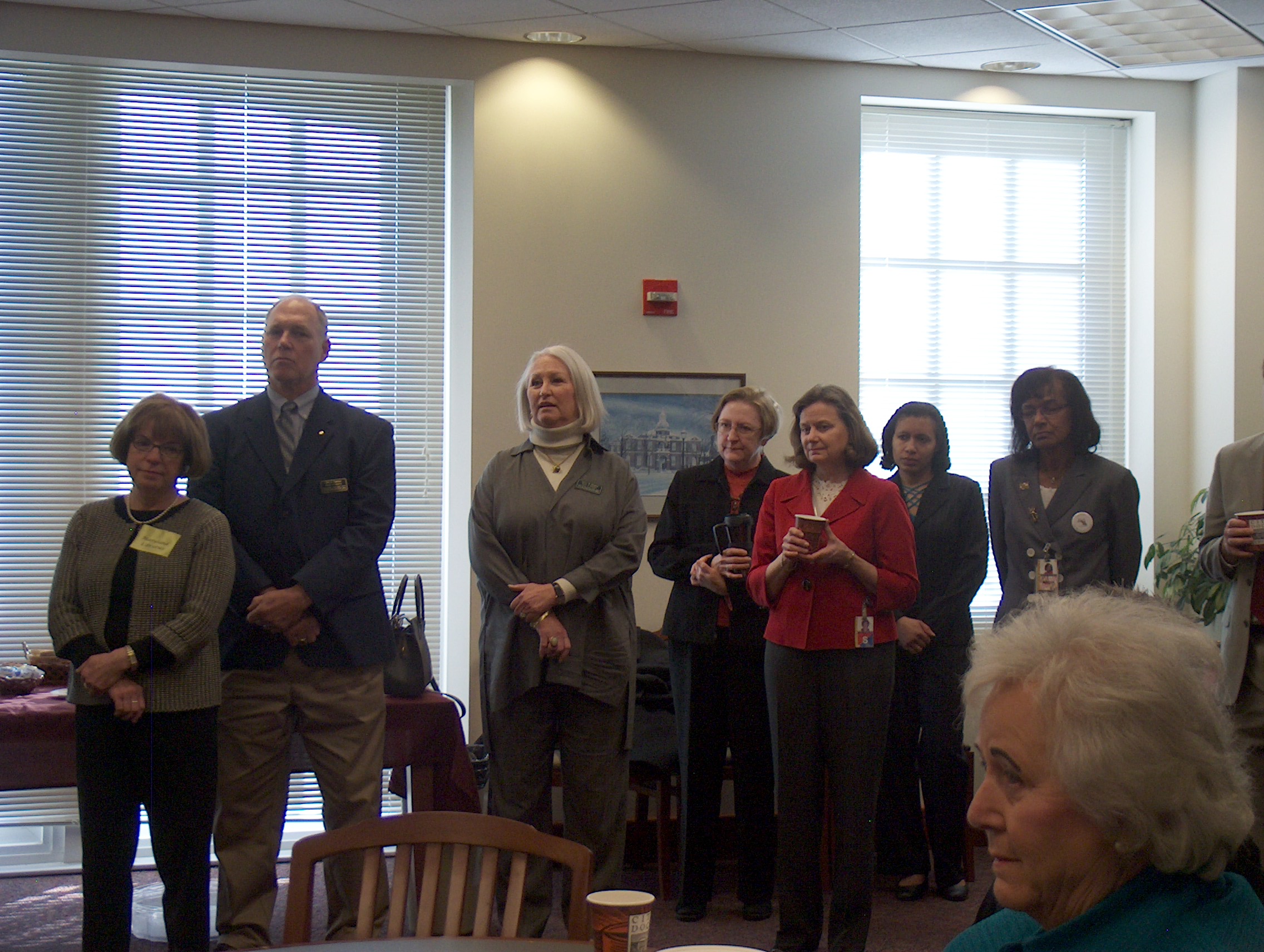
On February 23, 2011, librarians from across the state came to Annapolis for the Maryland Library Association’s Maryland Library Day at the legislature.  LLAM was represented by members Joan Bellistri, Jackie Curro, Pat Behles, Susan Herrick, Tonya Baroudi, and Janet Camillo.

For the past few years, the Anne Arundel County Public Law Library has been the gathering spot for librarians to prepare for their day in Annapolis. The first task of the day was to prepare the packets for distribution to the legislators. The folders were already filled with statewide information including the LLAM brochure.  Each county brought local information specific to their county to add to the folders. Circuit court law libraries were able to add information to the county side of the folders as well.  Bags of candy, chocolate turtles, and Maryland library buttons were also distributed to be handed out with the information packets.

As packets were prepared, a continental breakfast, provided by LLAM, was available.  Hannah Powers of Alexander and Cleaver, a firm that provides lobbying assistance to MAPLA, began the breakfast briefing by reviewing the issues facing libraries in the 2011 session.  Funding for public libraries in the budget will remain at current levels rather than increase as provided by MD. CODE ANN. EDUC. §23-503.  Although this will in effect be a decrease in funding, libraries are willing to do their part in helping the state of Maryland to recover from current budget woes. With public library funding remaining flat over the last four years, public libraries will have in fact lost more than 11 million.   Mary Baykan, legislative officer of the MLA Legislative Panel, provided those who would be visiting their delegations with talking points.  Librarians would not be asking for reinstatement of funding amounts but would instead promote public and school libraries.  Included in the message was that “over three million Marylanders have library cards; a recent Maryland poll found that Marylanders use and value libraries as an essential service; and that public libraries have proven to be a life line in helping Marylanders improve their job skills, search online for employment, get an email account, fill out job applications online, and improve resume writing skills.”

The group then headed to the statehouse to hear Maryland Library Day proclaimed in the Senate.  The gallery was packed, as it was also the day that the Senate debate on the gay marriage bill was to begin. Those who were able to get a seat did find it a bit more interesting to remain in the gallery after the proclamation than in past years.

Librarians then formed into county groups and began visiting their delegations.  Some librarians were able to break for lunch at the Reynolds Tavern across the street from the courthouse – a fitting location, as it once housed the Anne Arundel Public Library in Annapolis.  The AACPLL’s “reading room” became the break spot for librarians throughout the day until it was time for the reception held in the Senate Office Building, where there was a good turnout of legislators and librarians.  This reception traditionally is another means for librarians to promote libraries to legislators,and also for librarians to talk with each another. The day on the whole is also a great opportunity for law librarians to make connections with and support our colleagues in other Maryland libraries.

Susan Herrick and Margaret Carty, MLA Executive Director

The Importance of Being “Gently Stewed”: Marion Elizabeth Rodgers on Mencken, Governor Ritchie, and Prohibition

By Sara Witman
Research Librarian
Gordon, Feinblatt, Rothman, Hoffberger & Hollander

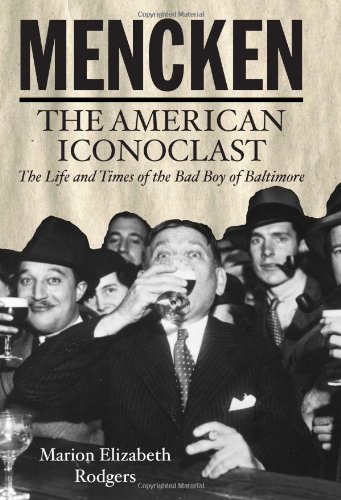
At the start of her lecture to a packed room at the Baltimore Bar Library on February 8, Marion Elizabeth Rodgers, author of Mencken: The American Iconoclast, mentioned the wine reception immediately following the talk.

“On such occasions,” she said, “I am reminded of one of Mencken’s favorite doctrines, that ‘the whole world would be better if the human race was kept gently stewed’ … which brings me to the topic of this evening.”

Rodgers kept the audience laughing throughout her lecture on “Mencken, Ritchie and Prohibition.” Her focus: how a driving force behind the repeal of Prohibition was a combination of the independent character of the state of Maryland, the 42 newspaper columns Mencken wrote against Prohibition, and Governor Albert Ritchie’s stand against enforcing the anti-liquor law.

In 1920, H.L. Mencken began writing against Prohibition in his weekly column for the Evening Sun. Governor Ritchie was a regular visitor of Sun offices and began to agree with the anti-Prohibition ideas.  When Ritchie attended a Governor’s Conference in DC, he was the only governor to protest the requirement that states enforce Prohibition, a policy that Ritchie called a federal infringement on Maryland’s rights. Interestingly, Maryland never had a state enforcement act for Prohibition.

Rodgers provided fascinating details about life in Maryland during Prohibition. According to Rodgers, by the end of Prohibition, Maryland was “one of the wettest states in the Union.” Ritchie announced that state troopers would not bother places selling alcohol in Maryland. Speakeasies were declared to be “cigar stores” with a door in the back with a window; when you knocked on the door and said, “Joe sent me,” you’d be let right in.

Another interesting fact was that many people brewed their own beer in Baltimore during the time because alcohol was very expensive. In some neighborhoods, the air on Sundays would smell deeply of hops and malt. Mencken brewed his own beer each Sunday; the guinea pigs for his brew experiments were often the musicians of the Saturday Night Club.

Rodgers mentioned that Ken Burns is currently producing a documentary about Prohibition, which should focus in part on Mencken and Baltimore, as well. That documentary is scheduled to be aired in December.

The growing friendship between Mencken and Ritchie, particularly through a failed bid for the Democratic presidential nomination, was described beautifully by Rodgers.  Her meticulous book, Mencken: The American Iconoclast, is widely known as H.L. Mencken’s definitive biography. Additionally, when speaking about Mencken, Rodgers’ enthusiasm for the subject is contagious.

Many thanks to the Bar Library for another successful program!

Book Review: The Pluto Files: The Rise and Fall of America’s Favorite Planet

by Rudolf Lamy
Cataloguer & Research Librarian
Maryland State Law Library

“The Pluto Files: The Rise and Fall of America’s Favorite Planet”
by Neil DeGrasse Tyson

W.W. Norton & Company (Reprint edition: December 2009)
Nonfiction / Astronomy

Pluto: is it really a planet, a dwarf planet, or a plutoid?

This is the story of how our solar system first found, and then later lost, its 9th planet.  The story of Pluto’s rise and fall is told with intelligence and humor.   The author provides many amazing details about all the planets.  But the story of the demotion of Pluto from planet to object, and the controversy that accompanied that demotion, is just astonishing. The book even includes the lyrics from songs and annotated hate mail from 6th graders!

Dr DeGrasse Tyson first takes us through the planning, building, and furnishing of the American Museum of Natural History’s Hayden Planetarium.  Then he describes the effort that went into the design of the displays – one of which inadvertently pushed Pluto into its fall from grace.

Dr. Tyson is a terrific educator, and it shows in this light-hearted primer on our solar system in general and on Pluto in particular.  Dr. Tyson’s book is meant to be popular science rather than a text book, and it succeeds remarkably well at both the “popular” and the “science” aspects.  Casual readers will learn more about Pluto than they ever thought there was to learn.  The book also presents a good look behind the scenes at the disposition of academic controversies.

Even if you do not normally read nonfiction, this is a book that you can easily enjoy.  This book is an educational opportunity, a quick and enjoyable read, and a barrel of laughs.

As to Pluto’s planetary status, read the book and make your own judgment.

Two Quarters and a Penny: Hello Title 51!

After more than eight decades of 50 titles in the U.S. Code, there is a new neighbor on the block. Bill H.R. 3237 was signed by President Barack Obama in December 18, 2010, and became Public Law 111-314. Title 51, also known as “National and Commercial Space Programs,” is a compilation of existing general law related to space programs.

The Office of Law Revision Counsel explains

Over the past five decades, a substantial amount of legislation was enacted relating to national and commercial space programs. In the United States Code, some of these provisions appeared in title 15 (Commerce and Trade), some in title 42 (The Public Health and Welfare), and some in title 49 (Transportation). No distinct title for national and commercial space programs existed in the United States Code because the organizational scheme for the Code was originally established in 1926, before such programs were contemplated.

Public Law 111-314 gathers provisions relating to national and commercial space programs, and restates the provisions as title 51, United States Code, “National and Commercial Space Programs”. Public Law 111-314 does not provide for any new programs. Nor does it modify or repeal any existing programs. Rather, the Act restates existing law in a manner adhering to the policy, intent, and purpose of the original enactments, while improving the organizational structure of the law and removing ambiguities, contradictions, and other imperfections.

But wait…there’s more. Titles 52 – 55 are also in the works. These proposed titles are:  Title 52 Voting and Elections, Title 53 Small Business, Title 54 National Park System and Title 55 Environment. As with Title 51, these titles will be comprised of exiting law and will become positive law upon enactment.

Ideas in Client Service: Assisting New Associates with Business Development

By Monique LaForce
Steptoe & Johnson LLP

In many law firms, come September, a new crop of eager first year associates joins the ranks.  As librarians, we often think of training our new associates on CALR techniques or outlining procedures for making research requests, but we don’t always think of how we might be of assistance to these new lawyers in building their future books of business.  Below are three pieces of advice for new associates looking to build their practices, and suggestions for librarians on how to assist in these endeavors.

1.  Become an amazing lawyer. When law students graduate, they are not yet superstars in their field.  They still have to learn the substantive practice area they have chosen, as well as related skills, like negotiating or trial techniques.  One of the major sources of new business for lawyers is referrals.  Becoming an expert in a particular substantive area is a great way to get those referrals.

If a new lawyer is interested in becoming a white collar trial attorney, refer her to sources such as Mauet’s Trial Technique, Courtroom Criminal Evidence by Edward J. Imwinkelried, or Lafave’s Criminal Procedure to help her develop a strong foundation in the practice area of her choice.  Assist her in setting up current alerts for developments in criminal law.  Offer to put her on the route list for any relevant publications the library might receive.  In short, help her to expand her substantive knowledge of her chosen area, so that she can build her expertise, which she can then sell to potential clients.

2.  Keep your networks warm, warmly. Again, referrals are critical for attorneys, so new associates should plan to keep their networks warm.  Of course social media is a great way to do this (Facebook, Twitter, etc.), but a personalized message can go a long way in making a lasting impression.  Such personal touches might include a congratulatory letter when a former classmate changes positions or a copy of a recent article about a subject a contact is passionate about.

Remind new lawyers that they can set up free news alerts on Google or other services about companies, colleagues, or subjects.  Offer to help associates with specific business development information requests for keeping in touch with contacts.  This can be as simple as assisting in locating a snail mail address if an associate wishes to forward a hard copy of an article and has only electronic contact information for a potential client.

3. Join one organization where you will interact with people who are in a position to refer work to you. Again, referrals are a primary source of business development, so a new associate should consider joining one organization where he will come into contact with people who are in a position to hire him or refer clients to him.

For example, if an associate wishes to pursue a career in estate planning, she might volunteer to assist a non-profit organization with a legacy gifts program.  This would give her experience with structuring legacy gifts, and would bring her into contact with individuals in a position to hire her to counsel on other estate planning matters.  A librarian may offer to assist the attorney in locating a few possible organizations, based upon the attorney’s interests and chosen area of law.

While there are many other strategies associates may pursue in becoming rainmakers for their firms, these three provide opportunities for librarians to assist in building the future leaders of their law firms, and, in turn, educate new patrons on the breadth of library services available to them.

What’s New with LLAM Members?

Joanne Colvin Participates in USPTO Program

On February 15 Joanne Colvin participated in a Roundtable hosted by Director of the Patent and Trademark Office David Kappos. The purpose of the Roundtable was to consider the future direction and expansion of the Patent and Trademark Depository Library Program. The University of Baltimore Law Library is one of 80 PTDLs in the country, and the only law library. PTDLs offer access to PTO databases and reference support to independent inventors and others doing patent and trademark research.

In related news, Joanne and Pat Behles will be attending a week-long training conference at the Patent and Trademark Office in April.

Announcements – March 2011

1. AALL/LLAM Grants for Annual Meeting/Conference
2. Unraveling the Mysteries of the Law Firm Marketing Department
3. Save the Date: April 28 AALL Webinar on Library Technology
4. Get a Free Year of AALL Membership with Nonmember Annual Meeting Registration
5. Renew Your AALL Membership Early for a Chance to Win a Free 2011 AALL Annual Meeting Registration
6. AALL2go Pick of the Month
7. Unleash Your Inner Leader October 28-29

_______________________________________________________

1. AALL/LLAM Grants for Annual Meeting/Conference

Each year, on a rotating basis, AALL provides grants to members of local chapters to cover registration for the Annual Meeting.  In 2011 it is LLAM’s turn to have a member receive a AALL grant for the Annual Meeting, to be held in Philadelphia from July 23-26.  To make the grant even more appealing, LLAM is adding $500 to AALL’s registration grant to help cover the cost of transportation/hotel/meals at the conference.

To apply for the grant, you must fill out an application and return it to the LLAM Grants & Awards Committee by March 31, 2011.  Applicants must be members of AALL and LLAM at the time of their application.  A committee consisting of Jean Hessenauer, Mark Desierto, and Jim Gernert will review all of the applications, and let the grant recipient know of his/her selection by April 8, 2011.

For more information, or to request a copy of the application, contact Jim Gernert at jgernert@yahoo.com, or (410) 965-6107.  You can also find a copy of the application on LLAM’s website at http://www.aallnet.org/chapter/llam/llamgrantapplication2011.doc .

_______________________________________________________

2. Unraveling the Mysteries of the Law Firm Marketing Department

How much do you know about the marketing department in your firm? What does your chief marketing officer (CMO) envision as the biggest challenges and opportunities in this tough business climate? And most importantly for you, what is your role in helping your firm win new business and sustain longstanding and profitable client relationships?

In this installment of the Private Law Libraries (PLL) Change as Action Summit, you will hear from Joe Calve and Kelly Brown of Morrison & Foerster. Calve is MoFo’s chief marketing officer, and Brown is the director of client relations. For the past year, the MoFo Research and Intelligence Group (the library) has reported to Calve and Brown in the Marketing Department. Calve and Brown bring a deep understanding of the capabilities of the MoFo Research and Intelligence team, and they are in a unique position to share their thoughts about how libraries can position themselves to become active participants in the practices of their firms by providing research at the highest level, both for business development and for client work.

This program will be videotaped and posted on the PLL website and will be available for free beginning on March 28 on AALL2go. It can be viewed by individual members or by groups. You may want to suggest that your chapter or SIS plan an educational program around the video. For example, tap a marketing director from a local firm to attend a brown bag lunch and watch the video with you; then, follow-up with a Q&A session.

This is the third in a series of five programs moderated by PLL members to provide a primer in law firm management from the view point of firm managers and administrators. The series is part of a two year program undertaken by the Private Law Libraries Special Interest Section (PLL-SIS) of AALL. The goal is to identify significant changes taking place in the legal world, to understand how these changes provide opportunities for assuming leadership roles, and to develop concrete plans for librarians to become leaders within their organizations. The culmination of these efforts, the Change as Action Summit, will take place in Philadelphia on July 23.

__________________________________________________________

3. Save the Date:  April 28 AALL Webinar on Library Technology

The Private Law Libraries Special Interest Section will host AALL’s April webinar, Library and Technology: Finding Common Ground on April 28 at 11 a.m. Central Standard Time. Check the AALL Calendar of Events for more details to come.

_________________________________________________________

4. Get a Free Year of AALL Membership with Nonmember Annual Meeting Registration

AALL offers nonmembers a complimentary one-year membership when they register for the AALL Annual Meeting and Conference, to be held July 23-26 in Philadelphia. The membership includes:

  • Career resources, such as the online Career Center and continuing education to help you learn new skills to advance in your career
  • Access to specialized information created just for law librarians, such as the Biennial Salary Survey and the Price Index for Legal Publications
  • Subscriptions to the monthly magazine, AALL Spectrum, and quarterly journal, Law Library Journal, to help you keep up on the latest trends in law librarianship
  • The opportunity to network and connect with other law librarians from across the country who share similar interests and are facing the same challenges
  • Discounted rates on all AALL products and services, such as publications, webinars, and online job postings

Annual Meeting registration is now open. Register by June 1 at the early bird rate and save $100. Be sure to take advantage of this special offer for nonmembers.

___________________________________________________________

5. Renew Your AALL Membership Early for a Chance to Win a Free 2011 AALL Annual Meeting Registration

In March, AALL dues invoices for 2011-2012 will mail out to all library directors for their institutionally paid memberships and to all other individual members. The deadline for membership renewal is May 31.

When you renew early—by May 1—you will be entered in a drawing for a free 2011 AALL Annual Meeting and Conference registration. If you renew on time—by May 31—you’ll be entered in a drawing for a free AALL webinar of your choice in 2011-2012. Following is the 2011 membership renewal schedule:

  • March: First dues invoices mailed out.
  • May: Second dues invoices mailed out.
  • June: Final dues invoices mailed out.
  • July: Expiration notices e-mailed to all members—individuals and those paid by institutions.
  • August 1: Expired members deleted from the AALL membership database and access to the AALLNET Members Only Section and Law Library Journal and AALL Spectrum subscriptions discontinued.

For more information or to renew your membership online, view the application form on AALLNET. If you have any questions about your membership renewal, contact AALL Headquarters at membership@aall.org or 312/205-8022.

_____________________________________________________________

6. AALL2go Pick of the Month

AALL’s Continuing Professional Education Committee presents the AALL2go pick of the month: Web 2.0 Challenge.

Need a refresher on blogs or RSS? New to creating wikis? Want to know what colleagues are saying about the value of social networking for your library? AALL2go offers you solutions.

The AALL Computing Services Special Interest Section (CS-SIS)‘s Web 2.0 Challenge is an online course for law librarians about social media and how to use it in their libraries. It is a comprehensive and social learning opportunity designed for law librarians based on hands-on use of these technologies.

Each of the five sessions includes:

  • An introduction to the topic and suggested learning outcomes for the week
  • A screen cast explaining the technology with step-by-step instructions on its use
  • Links for further learning
  • Examples of libraries/librarians using the featured tool
  • An assignment with activities designed to give you hands-on experience with each tool

Whether you’re just browsing some of the articles listed or you’re looking for additional ideas for a particular social networking solution, you have the flexibility to decide how much or how little information meets your needs. To follow along with the course, log in as a guest. (Guests may access most course content, but may not contribute to the site.)

Find this and more than 80 other free continuing education programs and webinars for AALL members on AALL2go!

_____________________________________________________________

7. Unleash Your Inner Leader October 28-29

New law librarians in the early stages of your career—achieve your leadership potential by attending the 2011 AALL Leadership Academy, October 28-29 in the Chicago area. Designed as an intensive learning experience aimed at growing and developing leadership skills, the academy program will help you discover how to maximize your personal leadership style while connecting with other legal information professionals.

The program will feature speakers Gail Johnson and Pam Parr. Johnson is a widely regarded leadership and communications expert and holds a Master of Arts in Communication Studies. Parr has extensive business management and customer service expertise. They have conducted many leadership programs for library organizations and will speak at the 2011 American Library Association Annual Conference.

The application period will start April 1, and applications will be due by June 30. Watch for more details coming soon.

2011 Election Announcement

The election of LLAM officers and board members will take place in early April.

Please watch your email for an announcement and link to the ballot. Votes will be collected and tabulated via Survey Monkey, similar to last year.

Our nominations committee, consisting of Chair Joanne Dugan Colvin, Pat Behles, and Janet Camillo, have recruited a great slate of candidates.  Many thanks to those who agreed to run as well as those whose terms are ongoing for the upcoming year.

Results of the election will be announced, and both the outgoing and the new board members will be recognized, at the Spring Fling on May 6.

Celebrating Anna Ella Carroll

By Pat Behles
Gov. Docs. & Reference Librarian
University of Baltimore Law Library

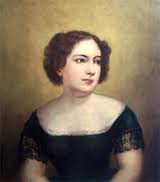
Anna Ella Carroll

“Once in a while, a real hero is forgotten.”

Maryland honored one of those forgotten heroes, as November 20, 2010 was designated Anna Ella Carroll Day.

Anna, long footnoted in history, was a secret member of Abraham Lincoln’s cabinet. Cloaked in obscurity and forgotten by all but a few for over 150 years,  Ann, as she was known by her contemporaries, was recognized in her home county of Dorchester with a day of festivities.  A ceremonial wreath laying (by Brig. Gen. Wilma L Vaught, USAF Ret), unveiling of a special painting, and the premiere of a movie entitled Lost River: Lincoln’s Secret Revealed.

Ann was born in 1815, and was the granddaughter of Charles Carroll and the daughter of Maryland Governor Thomas King Carroll.  Her father educated her in law and politics, which was very unusual for a woman in that era, for as a woman she could neither vote nor hold office.  Though only 15, she ran the family business and the household while her father was governor.  She was a pamphleteer and lobbyist, and she naturally gravitated towards politics.  She got a job at the National Intelligencer, a Washington investigative  newspaper.

Not satisfied with political parties of the time, she helped to form the American Party (known in history as the Know Nothing Party), noted for their nativist policies.  They backed Millard Fillmore, who lost to James Buchanan.  In 1860, the party merged with the Republican Party and helped to make the deals that led to Abraham Lincoln’s nomination as the candidate.  Ann was instrumental in suggesting to Lincoln the strategy that he used to keep Maryland from seceding; she prepared a brief for him of his presidential powers.  She continued to prepare briefs on relevant issues, including battle strategies.  Travelling to the west to visit relatives, Anna talked to troops and generals and researched the rivers in the area.  She developed the battle strategy for the Tennessee River campaign (1861) and suggested General Grant as commander. Her strategy  was accepted and used, and the victory is credited with shortening the war and saving lives.  President Lincoln couldn’t give her credit during the war for morale purposes, because she was a civilian and a woman, but promised her that he would do so after the war.  She was accepted by other members of Lincoln’s cabinet but not by the First Lady, Mary Lincoln, who was jealous of the attention that was paid to her.  When artist Francis Bicknell Carpenter painted “Signing of the Emancipation Proclamation” in 1862,  originally Ann was part of the painting as part of Lincoln’s cabinet.

Featured Member – Bernice Bernstein

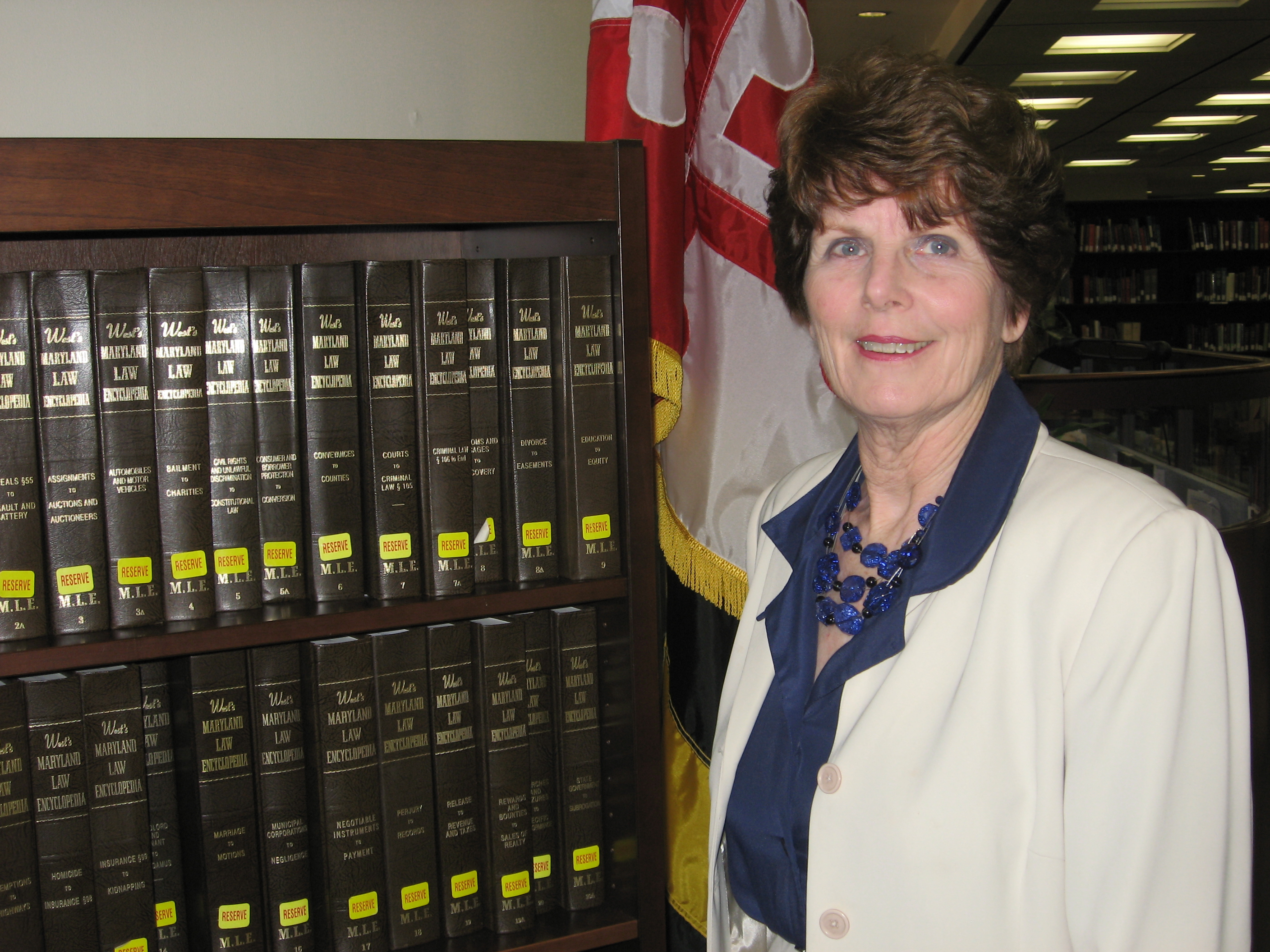
Bernice Bernstein Retires from the Maryland State Law Library

By Catherine I. McGuire
Outreach Services Law Librarian
Maryland State Law Library

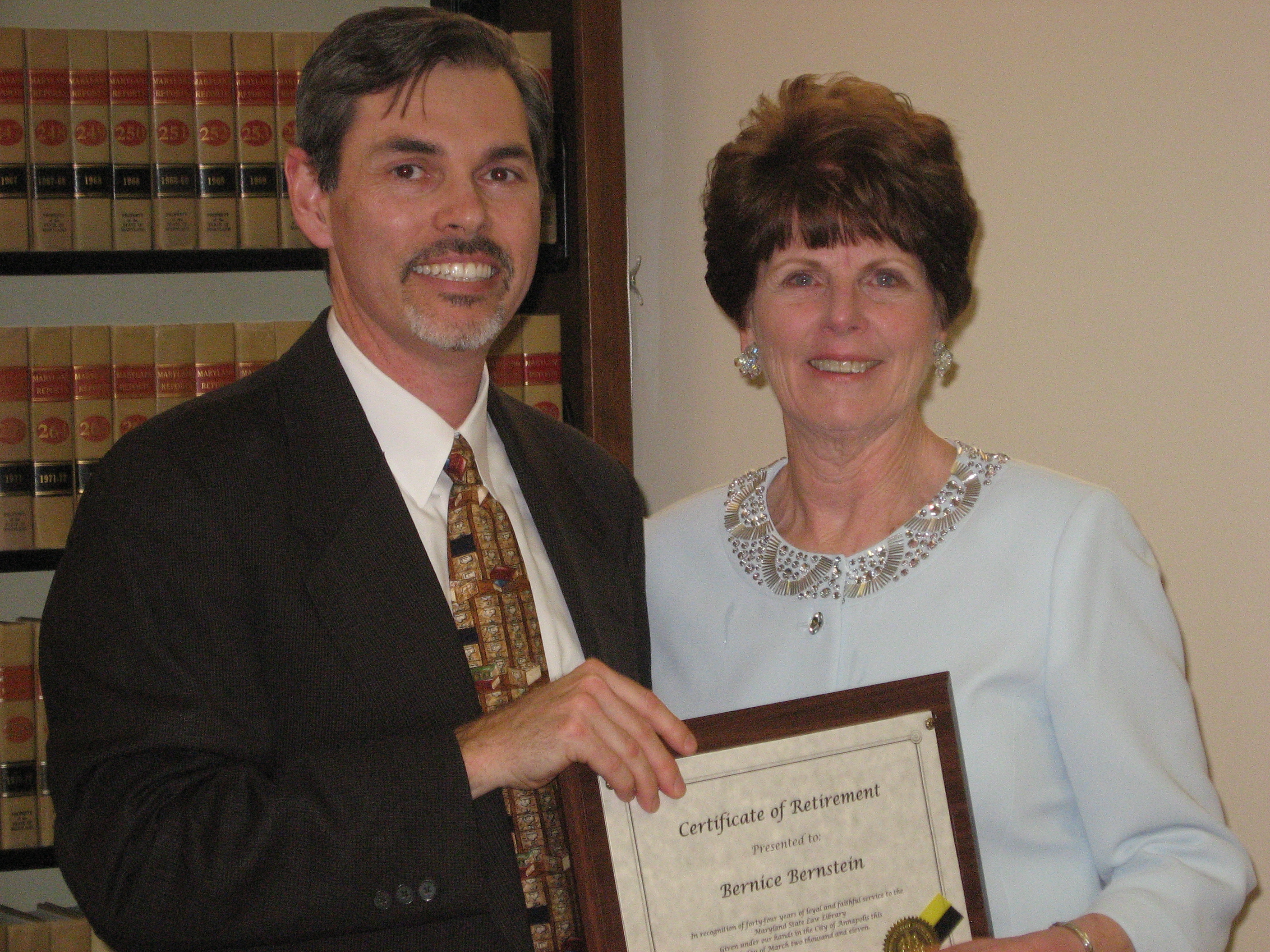
When Bernice Bernstein joined the then-named Maryland State Library on June 29, 1966 as Assistant Librarian, she planned to stay for a maximum of five years. Little did she know that she would be retiring, with more than eight times her original goal, in February 2011. In her more than 40 years with the State Judiciary, Bernice has seen a number of significant changes. She has worked under three Directors (Nelson Moulter, Mike Miller, and Steve Anderson.) She has seen several former law clerks become judges. And she has seen the Library through one major move and several slightly smaller renovation upheavals, including asbestos removal and the construction of the Special Collections Room.

In June 1966 when Bernice began working at the Library, the institution was housed in the Court of Appeals building in downtown Annapolis, across from the Capital. The stately facilities – three tiers with glass floors and steel stairs – were used by members of the Legislature and the Judiciary together. Bernice took the place of Ruth Burton, who had moved on to become the first head of the newly-established Legislative Services Library. In addition to her regular library duties, Bernice also handled requisitions and supplies for the legislature.

Almost simultaneously with her 1966 start, the Court of Special Appeals was established, with the swearing in of the first Court of Special Appeals judges in January 1967. Bernice recalls that the new Special Appeals judges had chambers in the Jeffrey Building on Francis Street, which ironically also housed the new Legislative Services Library.

When it was decided to tear down the old Court of Appeals building to make room for a new Legislative Services Building downtown, the Library moved to the new Courts of Appeal Building, in August 1972. The Library staff, which consisted at that time of five full-time and two part-time employees, helped by a few summer students, packed the entire collection using a color code system developed by Bernice’s co-worker, Dee Van Nest. Special attention and precautions were taken to pack and move the John James Audubon Birds of America elephant folios.

The formal relationship of the Library with the Judiciary was established in 1978, when it took on its present name of the Maryland State Law Library.

The Library’s collection up through the 1970’s had consisted mainly of print and microform materials. With the introduction of computer technology, the Library’s operation changed substantially. Bernice’s entire operation went from a manual system to a much more sophisticated system allowing faster input of information and a quicker response to inquiries, all of which she considers a plus.

One down side to the growth of computer technology, in Bernice’s opinion, has been a loss of personal interaction with customers and co-workers. Bernice remembers that once upon a time, she knew most of the regular Judiciary patrons because they came to the Library in person. Now that they can access much of their research from chambers, the Library staff and Judiciary patrons interact much more frequently via email and telephone, and less frequently in person.

The basic arrangement of the collection has stayed the same, with periodic shifting as needed by the expansion of various series. Over 40 years, the Library has added numerous online research products to enhance and expand the collection.

Over more than 40 years, Bernice has accumulated her own ‘library’ of special memories. Two stand out the most for her.

The first is when Bernice was expecting her first child. On Friday, May 6, 1977, she worked late to clear up any details before the birth. Mike Miller, Director of the Law Library at that time, mentioned Bernice’s circumstances to Chief Judge Robert C. Murphy, who then sent Bernice a personal letter congratulating her on the happy event and thanking her for her dedication.

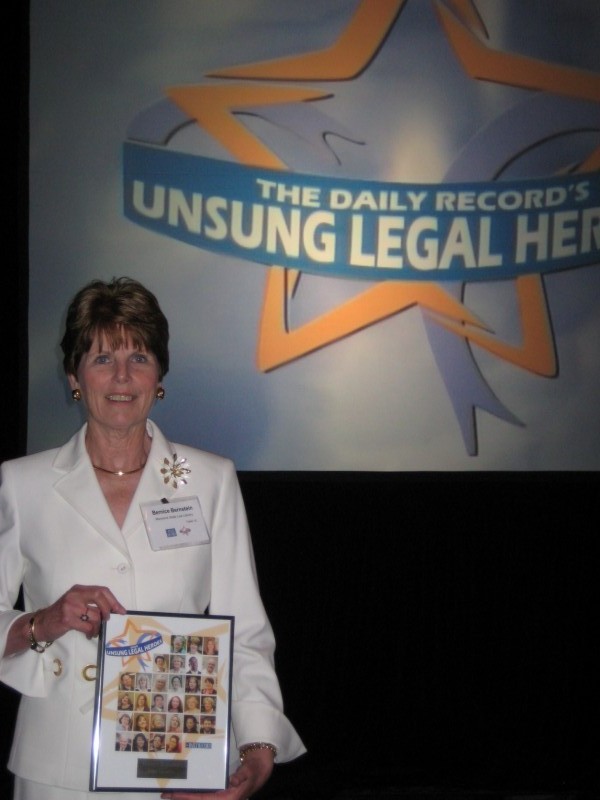
The second memory is of her nomination by Court of Special Appeals Judge Arrie W. Davis for the Daily Record’s Unsung Legal Heroes awards program. On May 8, 2008, Bernice received word that she had been selected as one of that year’s recipients. The award is, she says, the highlight of her career.

In her years at the Library, Bernice has made many dear friends. To this day she stays in close touch with some of her original colleagues, Joan Saalwachter Princeotta, Bev Mattheau Roberts, and Pat Phillips Bucheimer.

Bernice will miss the people at the Library and the Judiciary. She says she will even miss the work. A self-described “regimented individual” who has always been “more career-minded than domesticated,” she knows the change to a more relaxed lifestyle will take some adjustment. She looks forward, however, to having more time with family and friends, and especially to not having to drive on icy winter roads. Bernice is even thinking about learning to cook!

President’s Message – March 2011

By Susan Herrick
Research Librarian
University of Maryland School of Law

Hello LLAM Members,

By the time you read this, March will have come in like either a lion or – dare I say it? ….a lamb. Either way, I’m sure you all join me in welcoming the end of winter and the longer and (I hope!) balmier days.

Spring brings much to anticipate… whether it’s a religious holiday, a spring break, or perhaps making plans for gardening or a summer vacation… and of course some great LLAM programming!

We had a very informative program on bankruptcy law on February 17, thanks to attorney Edie Altice of Saul Ewing (see the article in this issue for a full description.)

LLAM again co-sponsored the annual Maryland Library Association Legislative Day at the General Assembly on February 23, thanks to the efforts of Joan Bellistri, our Government Relations Committee chair. This was my first year attending the Legislative Day, and it won’t be the last. It’s no surprise that this year the major legislative concerns of librarians relate to the ongoing budget constraints they face.  It was an inspiration to hear our colleagues in Maryland public and school libraries speak on this topic at the briefing that begins the Legislative Day, and a reminder that all librarians share a common interest and purpose in protecting our institutions and our services to patrons, no matter what type of library we may represent. An added bonus this year was that while attending the session of the Maryland State Senate, we were able to hear the consideration of amendments on the second reading of the Maryland same sex marriage bill, one of which renamed the bill the “Civil Marriage Protection Act.”  Not only was the debate substantively interesting, it was fun as librarians to hear the references to the Maryland Code, COMAR, and the Maryland Register which were flung about during the discussion of the various amendments.

Our Program Chair/Vice President Sara Witman has other great programs planned for this spring as well. In upcoming weeks we can look forward to our annual “LLAM Reads” author talk. We are pleased to welcome Charles W. Mitchell, author of Maryland Voices of the Civil War. Check out the reviews of his book on Amazon.com! This one is a don’t miss, so please join us on March 21 at University of Maryland School of Law Library. See Sara’s article within this issue for details on this and on a program planned for April at the Maryland Archives. And of course save the date and plan to attend our annual Spring Fling, for which the tentative date is Friday, May 6. Please come out and join us to celebrate spring and a great year for LLAM, and to congratulate our current, outgoing, and new board members.

Speaking of which – spring is also election time for LLAM. Our Nominations Committee, composed of Joanne Colvin, Pat Behles, and Janet Camillo, has worked hard to recruit members for the positions of Vice President/Program Chair and Board member. Our election will be held in early April, with the ballot available electronically via Survey Monkey. Watch for the email announcement. What better time for me to encourage you to step forward and volunteer for a position as committee member or chair? It’s a rewarding experience and a real opportunity to contribute something to your local law library chapter; a local chapter position to enhance your CV; and a chance to work with a really smart, helpful, and nice group of people. LLAM needs your involvement!

This year LLAM is in the fortunate position of being able to award both an AALL Chapter Registration Grant (for the amount of the AALL Annual Meeting registration fee) and a grant funded from LLAM Silent Auction proceeds and general funds. This a great opportunity because since the travel expenses  for Philadelphia will be less than they often are, receiving a grant may enable a LLAM member who has not attended AALL, or hasn’t attended recently, to be able to go. So please don’t hesitate to apply!  Our Grants & Awards Committee, chaired this year by Jim Gernert and also including Jean Hessenauer and Mark Desierto, have provided complete information on how to apply (see announcement within this LLAM eNews.)

In closing, on behalf of LLAM, congratulations to Bernice Bernstein on her retirement after 44 years of service at the Maryland State Law Library. The State Law Library sponsored a lovely reception for Bernice on Feb. 23, attended by LLAM members who had participated in the Legislative Day and many other active and retired members of the law library community, in addition to court personnel. It was a great party!

Ah spring, bringing changes and reminding us of both renewal and regeneration… Enjoy, everyone!

GPO’s Federal Digital System (FDsys) America’s Authentic Government Information

By Pat Behles
Gov. Docs. & Reference Librarian
University of Baltimore Law Library

One mission of the GPO (Government Printing Office) is to provide for, in partnership with the Federal depository libraries, perpetual, free, and ready public access to the print and digital publications of the Government.

In keeping with this mission FDsys http://www.gpo.gov/fdsys/ continues to give the American people a one-stop site to authentic, published information, while enhancing the searching and browsing capabilities found on GPO Access. Transition to FDsys was completed in January 2011, with more collections to be added in updates.

FDsys provides free online access to official Federal Government publications. Through FDsys you are able to search for documents and publications; browse for documents and publications; access metadata and download documents in multiple file formats. FDsys contains almost 50 collections of Government information ranging from Congressional materials, to Presidential materials, and materials from Federal agencies. For a full list of FDsys collections visit http://www.gpo.gov/fdsys/browse/collectiontab.action

In many ways, using FDsys is similar to conducting a typical Web search. One of the changes from GPO Access is that you can easily search across multiple publications or collections from a single search box. When you enter a search query, FDsys will locate relevant information for you, just as if you were using any other search tool. After inputting your search terms, you will be provided with a list of relevant results, which can be narrowed down and filtered.

FDsys enables GPO to manage Government publications from Congress and Federal agencies that are submitted to GPO in digital form, gathered from the Federal web sites, and created by scanning previously printed publications.

FDsys will allow Federal content creators to easily create and submit content which will then be preserved, authenticated, managed and delivered upon request.

For almost 150 years, the U.S. Government Printing Office (GPO) has been the official disseminator of government documents and has assured users of their authenticity. In the 21st century, the increasing use of electronic documents poses special challenges in verifying authenticity, because digital technology makes such documents easy to alter or copy, leading to multiple non-identical versions that can be used in unauthorized or illegitimate ways

To help meet the challenge of the digital age, GPO has begun implementing digital signatures to certain electronic documents on GPO Access that not only establish GPO as the trusted information disseminator, but also provide the assurance that an electronic document has not been altered since GPO disseminated it.

Currently, the following documents are signed in FDsys:

• Additional Government Publications (select documents)
• Budget of the United States Government (FY 2010 and 2011)
• Code of Federal Regulations (select years)
• Compilation of Presidential Documents
• Congressional Bills
• Congressional Directory
• Congressional Record (Bound Edition)
• Federal Register
• House Rules and Manual
• List of CFR Sections Affected
• Public and Private Laws
• Public Papers of the Presidents of the United States
• Senate Manual
• United States Code
• United States Government Manual
• United States Statutes at Large

GPO uses a digital certificate to apply digital signatures to PDF documents. In order for users to validate the certificate that was used by GPO to apply a digital signature to document, a chain of certificates or a certification path between the certificate and an established point of trust must be established, and every certificate within that path must be checked

What is GPO’s Seal of Authenticity?

The GPO Seal of Authenticity is a graphic of an eagle next to the words “Authenticated U.S. Government Information.”

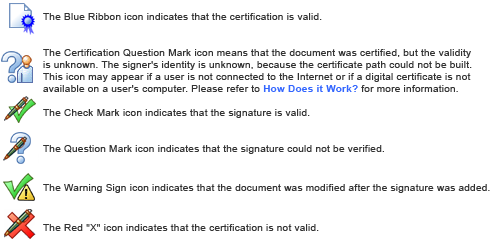
What are validation icons?

Validation icons appear next to the GPO Seal of Authenticity to notify users of the content’s validity status. The following is a list of icons that are used by Adobe to convey information about digital signatures.

There are tutorials, help screens, FAQs and a manual to help with use of FDsys, as well as ask GPO functions.

Featured Member- Andy Zimmerman

If you know anything at all about Andy Zimmerman, it probably doesn’t surprise you to learn that before embarking on his 15-year (to date) law library career, Andy was a legal writer. He began his writing endeavors while a law student at Fordham, giving up a job as a library filer for more scholarly pursuits. One of his early jobs, with Matthew Bender, involved writing case annotations for Moore’s Federal Practice.  After graduating with his J.D. from The Dickinson School of Law, Andy wrote for Prentice-Hall Tax and Professional Practice (a division of P-H Law and Business) for about 5 years, and also free-lanced.  After earning his library degree at Pratt Institute, he worked in law firms in New York (Proskauer Rose and Dewey Ballantine) and Cleveland (the former Arter & Hadden), then moved to Maryland, where he was librarian at the Baltimore office of Hogan & Hartson before becoming Director of Library Services at Gordon, Feinblatt, Rothman, Hoffberger, and Hollander.

It was while employed at Proskauer Rose, and keeping a set of research notes to help him in his everyday work, that Andy conceived the idea which eventually developed into Zimmerman’s Research Guide. With support from his library director, Andy connected with LLRX, and his writings evolved from a set of in-house notes for his and his colleagues’ use into one of the earliest legal reference works in online database form.  Now hosted by LexisNexis, the guide currently averages 37,000 site visits per month. His frequent updates and additions to the Guide can be followed on Andy’s ZRG blog and on the Guide’s Facebook page.

Andy has been observing the changes in legal publishing from various perspectives since his days at Prentice-Hall. He notes the continuing contraction of the legal publishing industry, the increasing complexity of purchasing decisions, and the bifurcation of the legal information world, where “so much is becoming free, when so much else is becoming more expensive.” Another of Andy’s contributions to the growth of current and reliable legal information on the Web was his article (co-written with Trevor Rosen) “Is there a Future for an e-USC?” which appeared in the Winter 2010 issue of Law Library Lights. This article, as well as Andy’s discussions with Peter LeFevre of the House of Representatives Office of the Law Revision Counsel (OLRC), likely influenced the launch of OLRC’s USCPrelim, a pilot project to update the online version of some titles of the United States Code on an ongoing basis – a first step toward the creation of an unofficial-but-nearly-current edition of the USC similar to the e-CFR. For more information on USCPrelim and Andy’s contribution to its development, see the Law Librarian Blog posting of September 29, 2010.

Andy says: “I would like to leave the information world a better place.” He has already made a pretty good start on that!

When not writing research guides or his blog, Andy enjoys road biking and playing guitar. He lives in Baltimore County with his wife, a professor of religion at George Mason University, and his teenage daughter.

Committee Report – LLAM Placement Committee

The current chair of LLAM’s Placement Committee is Tonya Baroudi, Law Librarian at the Prince George’s County Law Library. Tonya has served admirably in this capacity for several years.

The Placement Committee serves to communicate career and volunteer opportunities to members by posting announcements to LLAM’s discussion list.   Responsibilities include monitoring national and regional law library association websites and listserves, and state and federal government websites, for appropriate job announcements, then forwarding them to LLAM members in a timely fashion.  Several re-posting requests are made and handled accordingly.   Job listings are free and are also accepted from employment agencies.  Revisions and additions to committee procedures are made as necessary as well as updates to the placement brochure.  Placement brochures are forwarded to local campus job fairs and LLAM’s incoming President.

To date in 2010, 170 jobs have been posted.  See statistics below:

January 12
February 14
March 16
April 12
May 18
June 20
July 16
August 15
September 19
October 16
November 12
December
TOTAL

Holiday Party

On December 9th over 35 LLAM members, friends and family started the season with a holiday party at The Waterfront Hotel on Thames Street in Fells Point.

The restaurant, located just across the street from the Homicide: Life in the Street building, was the perfect setting for holiday fun and cheer. The festivities included a delicious buffet dinner, an open bar and the traditional silent auction.

The auction raised $550 that will be split between the Maryland Food Bank and the LLAM Scholarship Fund. Auction bidding was active and the items included a chocolate basket, spa kit, a ceramic lamb, several books, a watercolor print, wine, a Sheep “Baddd Girl (ewe know it)” T-shirt, a Flip Video Camera (donated by Todd Henderson of West) and many other items.

Janet Camillo was awarded the Service to LLAM award. Susan Herrick expressed the appreciation of all LLAM members for Janet’s many years of service, which included nearly every possible LLAM office and committee chairmanship, as well as participation in AALL,numerous Special Interest Section committees and many other library related groups. Janet was joined at the party by her husband, Larry Johnson.