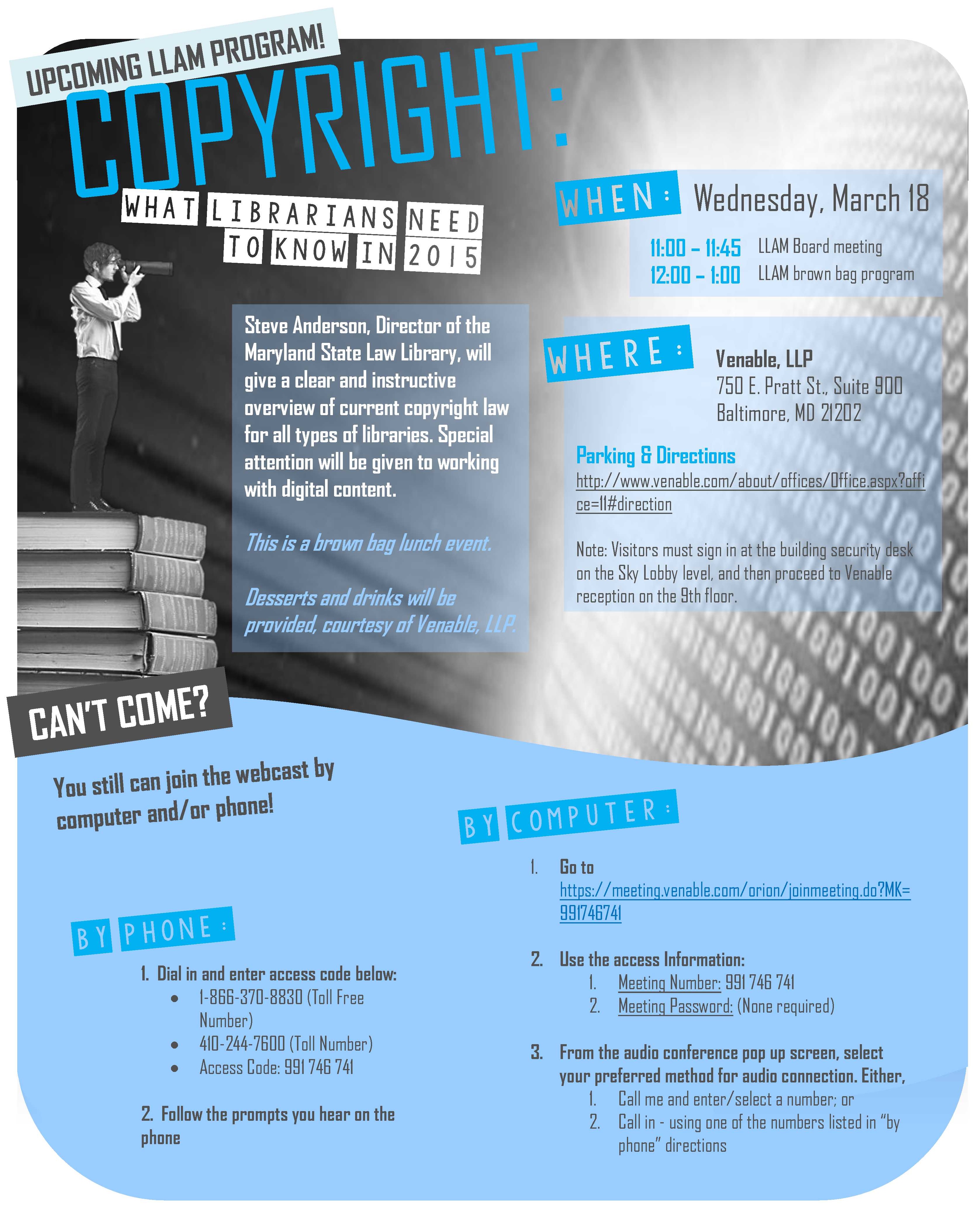
This post has been updated as of 3/18/2015 to include the PowerPoint Presentation for this program. CLICK HERE FOR THE PROGRAM MATERIALS: LLAM Copyright
Earlier this week at the Maryland State Archives, Mary Alice Baish the U.S. Superintendent of Documents, presented the National Plant for Access to US Government Information to a group of LLAM members for our February Program. The attached PDF is a copy of her Powerpoint presentation. Check it out for some really helpful nuggets of information!
Next Wednesday, February 18th is LLAM’s opportunity to make a real difference. It is Maryland Library Legislative Day, a chance to meet with your legislators and urge them to support libraries and UEMLA: House Bill 162 and Senate Bill 611. During the day members of the various county libraries visit with their delegations. LLAM has arranged to have county delegations to adopt a LLAMer for a day so you do not need to worry about making appointments, finding buildings, and rooms. They are vets at this process and will welcome your expertise in UELMA.
The agenda for the day is below and the attached PDF includes the day’s agenda, map, and MLA talking points and info on UELMA.
CLICK HERE: Md Lib Leg Day for LLAMers
for more information on the agenda, parking and other important information.
Need more info contact:
Mary Jo Lazun
mjlazun@gmail.com | mjlazun@mdcourts.gov
410-260-1441 work | 410-292-8882 cell
LLAM Needs You In Annapolis On February 18th
Now is the time LLAM really needs you. The Maryland Uniform Legal Materials Act (UELMA) is on track for potential passage for this year. We have a hearing in the House of Delegates scheduled for Wednesday, February 18th at 1:00. That day also coincides with Maryland Library Day. We need you in Annapolis that day.
During Maryland Library Day members of the various county libraries visit with their delegations. Joanie Bellistri and I have asked the Maryland Library Association county delegations to adopt you for a day so you do not need to worry about making appointments, finding buildings, and rooms. They are vets at this process and will welcome your expertise in UELMA.
If you need a crash course in UELMA the AALL and Uniform Commissioner’s web sites have LOTS of information to make you an expert very fast. Joan Bellistri and I are available to answer any questions you may have.
Please let me know if plan to attend, even if right now it is just tentative. I also need to know what county you live in so we can hook you up with your county delegation.
Need more info contact:
Mary Jo Lazun
mjlazun@gmail.com | mjlazun@mdcourts.gov
410-260-1441 work | 410-292-8882 cell
PS if you have not sent the UEMLA message to your delegates PLEASE do so. See https://llamonline.org/2015/02/02/uelma-introduced-in-maryland/
Good news! Last week The Maryland Uniform Legal Materials Act (HB 162) was introduced in the General Assembly and is sporting a growing list of sponsors throughout the state. Many thanks to Del. Cathy Vitale of Anne Arundel County who introduced the bill.
We need your help to increase the number of sponsors of the bill so we are asking LLAM members to contact their legislators to request their sponsorship of the bill. If you do not know who represents you (there have been a lot of changes) see Locate Your Legislators.
Below is a sample message that will fit perfectly in the Contact Legislators form available for each legislator. FYI, this form has a 1,500 character limit and the sample message below is around 1400 characters.
Also, please mark your calendar for Maryland Library Legislative Day on February 18. The schedule begins with a terrific breakfast at the Anne Arundel County Circuit Court law library. Details will be forthcoming.
Time is of the essence so please contact your legislators right away and urge them to support UELMA.
For more information, you can contact:
Mary Jo Lazun
410-260-1441
mjlazun@gmail.com
-or-
Joan Bellistri
410-222-1387
joan.bellistri@gmail.com
SAMPLE MESSAGE TO DELEGATES
I write in support of House Bill 162, the Maryland Uniform Electronic Legal Materials Act (UELMA). I strongly urge to you to sponsor this important legislation.
UELMA ensures that online state legal materials that are deemed official — for example, the Code of Maryland, Maryland Rules, reported appellate court decisions, Attorney General Opinions, and the Code of Maryland Regulations — will be preserved in unaltered form and made permanently available to the public.
In Maryland, there have been efforts to discard traditional print access with no method to ensure access, preservation, or authentication to these materials. For example, The Division of State Documents recently proposed offering online-only access to the Maryland Register. Last year the General Assembly exempted the state judiciary from publishing rules committee materials in the Maryland Register if they are promptly posted on the Judiciary web site. Some states no longer publish important legal materials in print — a decision that Maryland may eventually make as well.
UELMA is the people’s insurance policy that our state’s laws are available, preserved, and authenticated online.
To date, twelve states have passed UELMA. By adopting UELMA, Maryland will establish itself as a national leader and demonstrate its commitment to providing its citizens with access to legal materials regardless of format.
Let’s talk about DRM.
Digital Rights Management, or DRM for short, can be generally defined as a system that restricts how one is able to view, save or share digitally acquired information. Much like the now ubiquitous “Terms of Use” agreement required to use most digital services, DRM is a way that publishers can control who, how and where material is being viewed.
DRMs can be particularly problematic for libraries. Librarians are being put in the position of either breaking the electronic locks in order to exercise their legal rights under the Fair use Exemptions or letting a company determine how best to serve library patrons. Fortunately, those put in this predicament now have some recourse. You might recall that in October there was mention of upcoming opportunities for public comment. That day has come! The Copyright Office published a Notice of Proposed Rulemaking. <Proposed rule: http://www.copyright.gov/fedreg/2014/79fr73856.pdf >
Here are a few highlights of the proposed rules:
Re-reading the preamble, prior to commenting, is encouraged. The required formatting is very specific and it might be best to use the long or short form guidelines provided by the Copyright office. <Link is here: http://copyright.gov/1201/comment-forms/>
Each of us is in a different and unique position to provide insight, guidance and advocate for our users. Go forth! February 6, 2015, is the deadline for comments.
Part 4 of our Copyright Series is forthcoming.
by Rachel Englander
A vacancy announcement for a Law Librarian (GS-1410-11) has been posted on USAJOBS. The vacancy number is #150003. The application deadline is Friday, February 6, 2015. Additional details are available at: https://www.usajobs.gov/GetJob/ViewDetails/391828900 . Please share the announcement with anyone you feel might be interested in the position. Questions should be addressed to the Library of Congress Employment Office at (202) 707-5627 JobHelp@loc.gov.
The LLAM Executive Board recently passed a resolution in support of the enactment of the Uniform Electronic Legal Material Act in Maryland. UELMA got some traction here in Maryland but ultimately failed to pass.
LLAM has uploaded a copy of the resolution to our website so it’s easy for you to access and review. https://llamonline.org/uelma/llam-resolution-on-uelma/
UELMA is now law in 12 states, with 4 states added in 2014.
Let’s keep the momentum going here in Maryland!
The ven-diagram of copyright and licensing rights: little overlap
This is part two of our multi-part series on copyright.
One of my current, favorite soapbox topics is e-books. In fact, I was tempted to title this post E-books: The great evil of our time but thought that might too easily reveal my feelings on the matter.
E-books have been the subject of quite a lot of controversy in the library community. The conversation has centered on their difficulty to access, lend and administer. Bess Reynolds of Debovise & Pilmpton LLP recently authored a white paper (published by ALTA & AALL) that lists, in perfect detail, the overly complicated systems employed by the top vendors and the administrative nightmares that result. (There was a follow up published in Spectrum in April, 2014.) Bess’s paper(s) succinctly sums up many of the technical issues regarding e-books, but it was one of the closing lines that really stuck with me.
“[W]e should demand the right to own e-books just as we own our print titles.”
Think about that for a moment. As fellow librarians, I’m confident that most of you agree. While frustrating and often obnoxious, the clunky technical hoops of the vendors’ e-book platforms are the least of our worries when it comes to copyright. Copyright Rules dictate the terms by which Libraries license e-books and are written to work around the First Sale Doctrine and almost all of the other regulations libraries are accustomed accommodating for print works. This core issue of “exclusive rights” affects user borrowing privileges, inter-library loans, accessibility and historic preservation; basically everything that makes libraries, libraries.
As is the norm in electronic resources, libraries rarely own e-books outright. Once the contract is over, so too is access to the content. In many cases it is the vendors who get to determine how the information is accessed, stored, viewed and/or transmitted. The main question here is how do we as librarians increase our rights to use the information as libraries are wont to do (as in the examples given above). Contract negotiations might be an alternative for extending our options of how to use it, but that assumes that we have some leverage. Because the legal publishing world is concentrated in 3-5 key players, law libraries do not always have the option of picking someone else to work with or taking a stand against overly aggressive licensing agreements. Smaller private libraries, in particular, do not always have a good alternative to use as leverage.
If this state of affairs concerns you, here are a few concrete suggestions of what you can do to help make advancements in this area.
Part 3 of our Copyright Series is forthcoming!
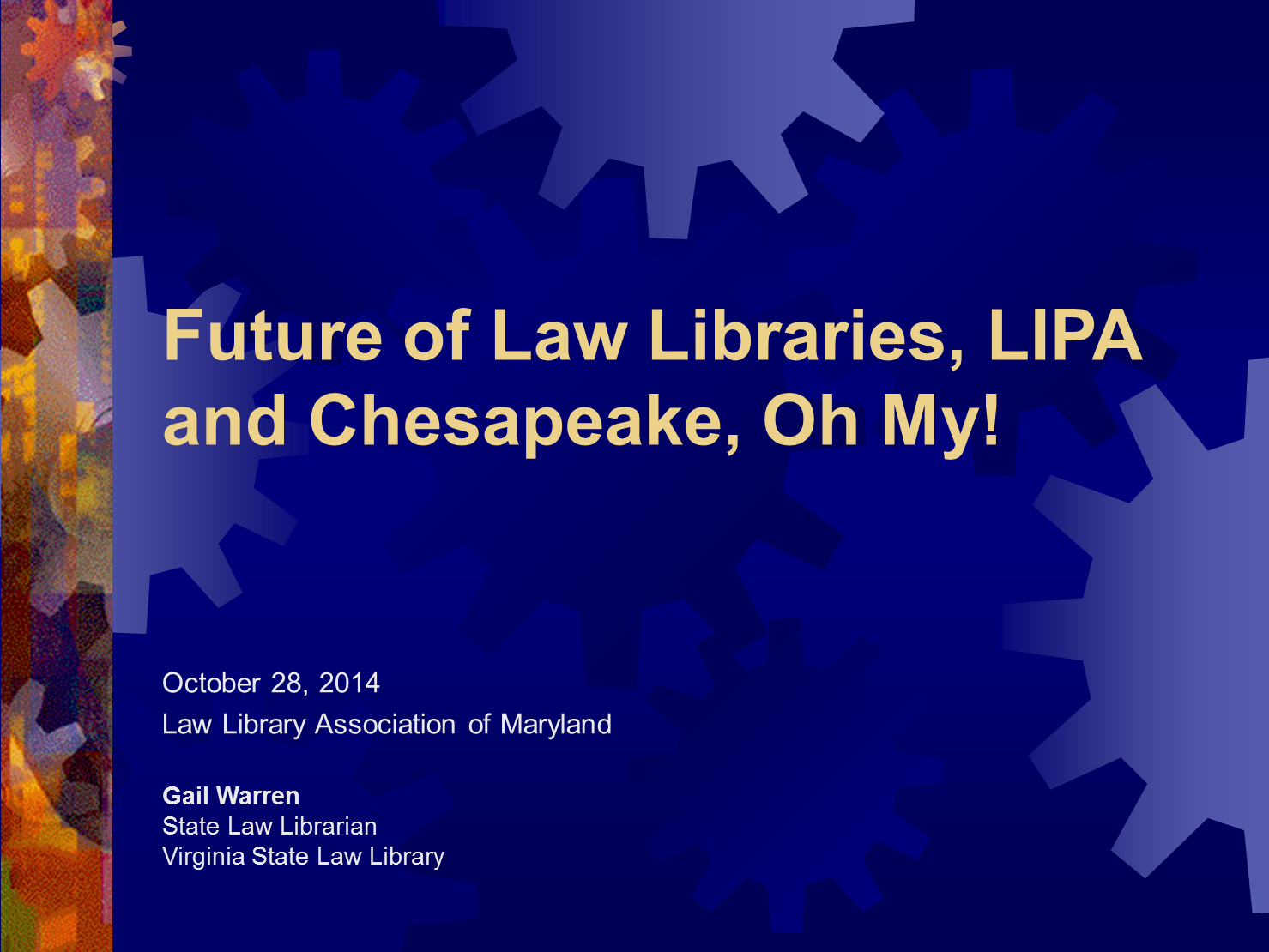
On Tuesday, October 28, after LLAM’s fall board meeting, the Thurgood Marshall Law Library hosted a brown bag lunch and program featuring two presentations by Gail Warren, Director of the Virginia State Law Library and Treasurer of the American Association of Law Libraries. In the first, Ms. Warren looked back at the predictions made by AALL’s Special Committee on Law Libraries in the Digital Age in its 2002 report Beyond the Boundaries: Report of the Special Committee on the Future of Law Libraries in the Digital Age. This report provided impetus for the formation of Legal Information Preservation Alliance in 2003, and the Chesapeake Digital Preservation Group in 2007. Predicting the future of law libraries is more art than science, and her frank assessment will be useful for those members who are called upon to make long term planning decisions in their own shops: Beyond the Boundaries, LIPA and Chesapeake (slides).
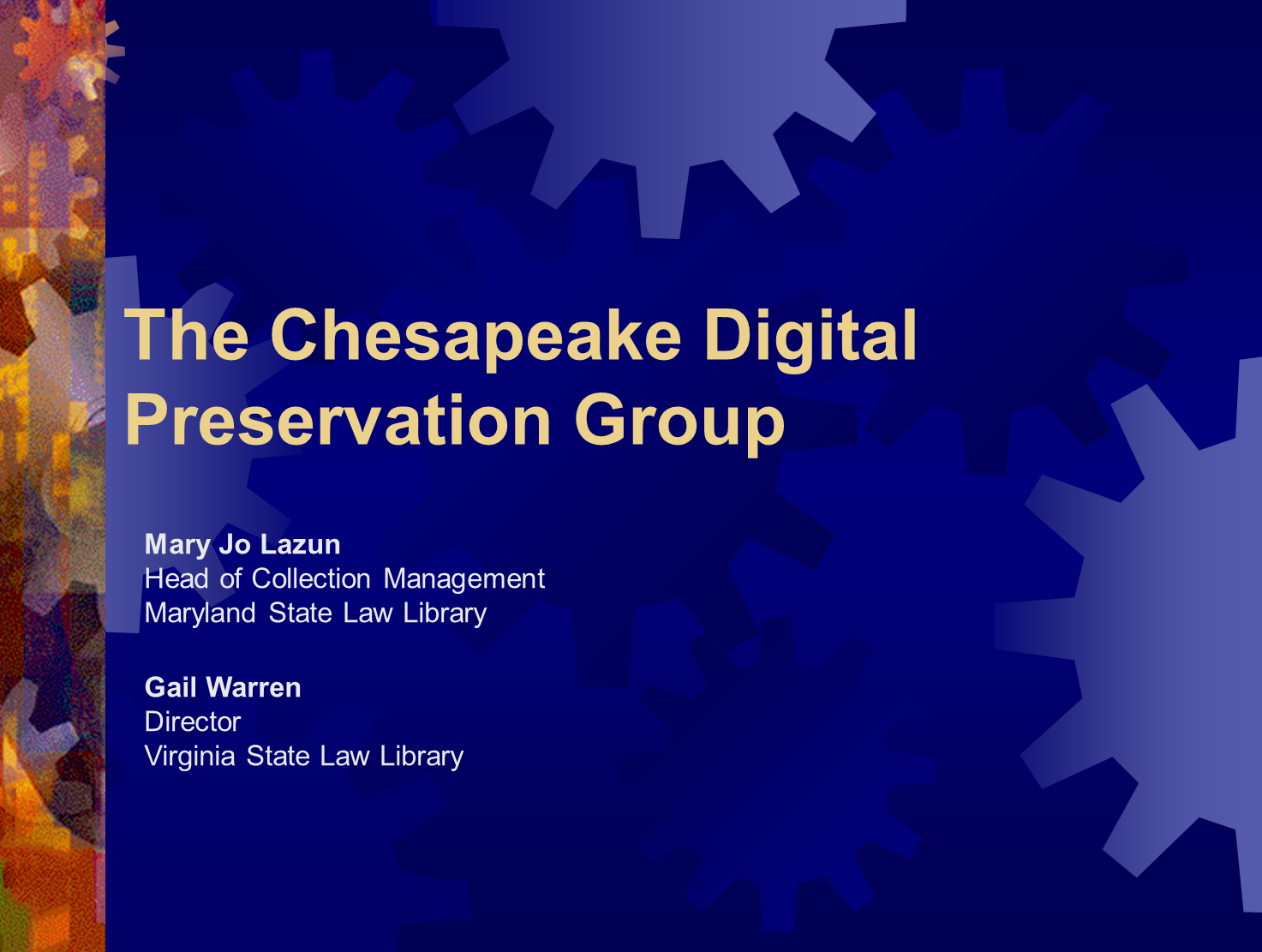
In the second presentation, Ms. Warren was joined by Mary Jo Lazun, Head of Collection Management at the Maryland State Law Library, and Joan Bellistri, Director of the Anne Arundel County Public Law Library, for an update on the work of the Chesapeake Digital Preservation Group. The Chesapeake Digital Preservation Group is a collaborative effort of Legal Information Preservation Alliance members to address the challenges of born-digital legal information shared by the Virginia and Maryland State Law Libraries, Georgetown University Law Library, and Harvard University Law Library: The Chesapeake Digital Preservation Group (slides).
LLAM’s Vice President and Chair of the Programs Committee, James Durham, has put together an exciting list of events for the next 6 months. Please check out the list below and mark your calendar so you don’t miss out on any of the fun!
If you have any questions or would like more information, please forward your inquiries to LLAMNewsMD.
The following is the first offering of a multi part series on Copyright that will be published over the next month.
Copyright.
In library circles it’s a dirty word.
When I use the word “copyright” in my professional capacity, it is usually when I am trying to convince someone to desist from something, preferably immediately. As a librarian, it is my least favorite conversation. I’m sure you hate having it as well. And copyright probably comes up far more often than you would like. I don’t know about you, but the reason I hate the conversation is because there is so much debate about what copyright law is exactly and how it works.
Copyright law can be loosely defined as the combination of laws governing the rights of the producers or owners regarding the use, sale and availability of works. As professionals, we work with copyright material every day. We also rely on a number of exceptions written into copyright law that apply specifically to libraries in order to serve our patron’s needs. Copyright is not just the law that protects the owners rights. It is also a framework that allows for fair use or license agreements with people who want to use what they created (Us!).
Deceptively straightforward looking, isn’t it?
Sorry to burst your bubble. Those of you who breathed a sigh of relief upon reading the last paragraph will be distressed to learn that the copyright landscape is changing in a number of significant ways. By “changes”, of course, I mean lawsuits.
There are two recent cases in particular which we as a profession should be looking at very closely. The first is Authors Guild,Inc. v. HathiTrust. The second, the Google Books case, is currently before the Supreme Court. Both have significant implications regarding the role of technology, accessibility and the transformational nature of fully searchable titles. There have also been rumblings of changes coming from the Legislative branch of the Government. The times, they are a’changing (was that a copyright violation? Read on!)
The Honorable Maria A. Pallante (who is the U.S. Register of Copyrights) gave a well-received lecture at Columbia Law last year. Her remarks set off a firestorm of discussion. Her basic position is that the law governing copyright needs an overhaul. Changes in technology have always driven changes in copyright law. Usually, law has lagged behind somewhat. In the past, when technology did not change quite so quickly, that lag was a drag race between a souped-up hot rod and a VW bug. In the last few decades however, the lag is more like a bicycle trying to keep pace with a space shuttle.
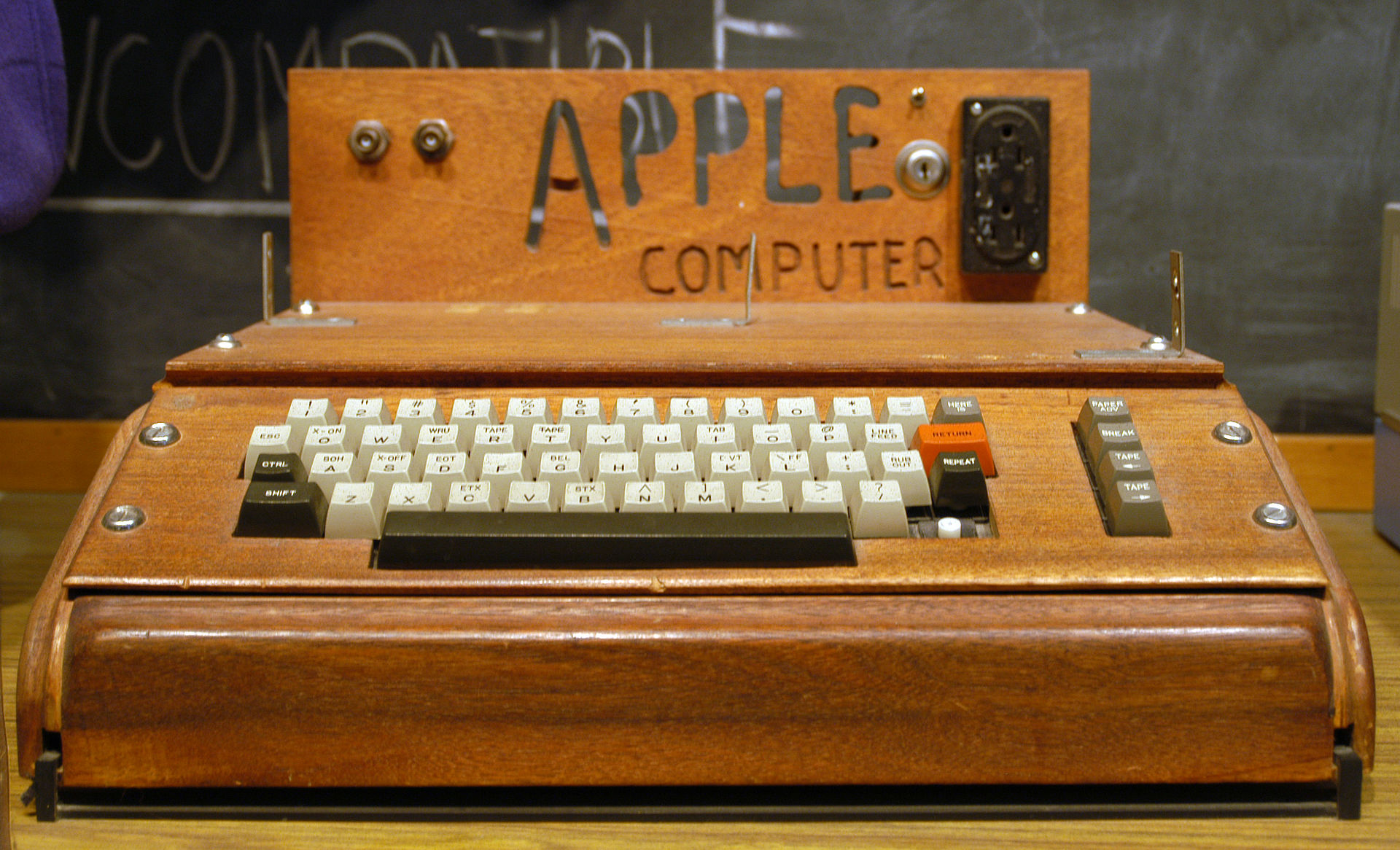
Not surprisingly, Congress has been holding hearings on this subject in the last year. Sources in the know have hinted that a series of bill will be introduced in the near future. These bills will amend copyright law for the first time since 1976 (legislation passed in 1976 but effective date was January, 1978). As a point of reference, 1976 was the year that Steve Wozniak designed a single board computer for hobbyists called the “Apple 1”. Everyone take a moment now to glance at your i-phone and marvel at the fact that we are working off legislation that was created when the fanciest technology available looked like something from The Flintstones.
Photo Credit: Ed Uthman / Flickr
I am an unabashed policy nerd, so I am looking forward to the upcoming opportunities for public comment. While this definition of excitement may call into question my quality of life, I think that, in this instance, the entire profession really ought to be excited about this opportunity. Because 2016 will be an election year (and we all know how much legislation gets passed in an election year), this next cycle may be the next window for quite some time in which THE LAW MIGHT ACTUALLY CHANGE. Look at your i-phone again. Think of that vintage 1976 Rube Goldberg device you just saw. Judging by the historical record of copyright revision, this is possibly the only time in our professional careers that copyright law will be rewritten. Think of what you do daily at work. You make decisions about purchasing information and granting access to information. You help people find and use information. You are the information guide and sherpa. Your voice, the voice of the library professionals, is the most knowledgeable voice in the arena of the use of copyrighted information. Shouldn’t it logically be the loudest voice in the debate over what the laws that govern copyright say?
Yes, it should be. It should be (I say loudly with exclamation points)! We, the librarians, the information lighthouses that lead the meandering ships of knowledge seekers towards safe shores, we should be the ones advocating for changes in antiquated laws!
We should advocate the heck out of it! And other, stronger, words! Think of every time you’ve been confounded by usage, every time you’ve had to warn someone (using very sharp words) to read but not copy under pain of death by copyright infringement lawsuit. We have a duty to our library patrons, our profession, and (dare I say it) to our own sanity to advocate for laws that actually reflect the technology that we are using.
Don’t touch that dial (as they used to say in the days when our current copyright laws were written). I will be keeping all of you informed of opportunities for public comment as the process of revision goes forward in Congress. Stay tuned to this station (or blog in the current technological parlance) for part 2 of our series on Copyright!
-Rachel Englander
Maryland State Department of Education, Division of Library Development and Services will be hosting a workshop and panel discussion called “Alternative Revenue Streams: Development, Fundraising, and Grant Writing for Libraries.” The event will include a panel discussion by development and fundraising specialists from across the state, an introduction to and presentation on Finding Funders by Maryland’s Foundation Center Funding Information Network Supervisors, a lightning round discussion of fundraising events that have succeeded and failed, and a grant writing workshop focused on developing a specific idea or project into a grant proposal that can be used to win grants and entice funders.
The program will take place at Miller Library on September 9 from 9am to 4pm. The day’s agenda is attached. You can register here.
Please contact Rocco DeBonis with any questions at rdebonis@msde.state.md.us
Rocco DeBonis
LSTA Grant Coordinator
Maryland State Department of Education, Division of Library Development and Services
200 West Baltimore Street, Baltimore MD 21201
410.767.0437 phone | 410.333.2507 fax | rocco.debonis@maryland.gov
Head of Content Acquisitions and Management
Georgetown University Law Library
The Head of Content Acquisitions and Management is responsible for the supervision and management of all aspects of acquisitions and serials operations, which includes ordering and receipt of library materials in all formats, implementing collection management policies, and overseeing vendor relations and purchasing/licensing agreements. This position directly supervises seven staff in the library’s Acquisitions and Collection Care department.
The Head of Content Acquisitions and Management also plays a key role in the assessment and management of the library’s collection. This includes coordinating the selection and de-selection of library materials; compiling and reporting statistical data for collection assessment; coordinating and pursuing intercampus and interlibrary collaborative collection development opportunities; and working cooperatively with subject selectors, staff across all departments in the library, and faculty to provide access to information.
Required
Master’s degree from an ALA-accredited school of library and/or information studies, or equivalent; strong supervisory skills; excellent written and verbal communication skills; at least two years of collection development experience; familiarity with integrated library systems.
Preferred
Law library experience or familiarity with legal publishing trade and vendors; Acquisitions experience; JD or equivalent.
Salary is commensurate with experience and qualifications.
To apply for this position, please submit applications via the Georgetown University Jobs website by using Job Number 20141165. Address applications to Stacy Queen, and include a cover letter, a current resume, and the names and contact information for three references.
Review of applications will begin on August 6, 2014 and continue until the position is filled.
Georgetown University is an EOE/AA employer.
Join the LLAM Dine-Around in San Antonio
Saturday, July 12th at 6:30 pm
If you are you attending the 2014 AALL Annual Meeting & Conference in San Antonio, please consider joining the members of LLAM for the annual “LLAM Dine-Around.” This year, the group will meet at La Paloma Riverwalk, 215 Lasoya, on the San Antonio Riverwalk, which is a short distance from the Henry B. Gonzalez Convention Center. The reservation, under the name of “Maryland Law Librarians,” is for 6:30 p.m. on Saturday evening, July 12. We have requested a patio or Riverwalk table, if available. To view photos and a menu, visit http://www.lapalomariverwalk.com. Vegetarian options are offered. If you plan to attend, please RSVP to james.durham@mdcourts.gov, so that the reservation can be amended to accommodate the actual size of our group. See you in Texas!
By: James G. Durham, Deputy Director of the Maryland State Law Library
SAVE THE DATE for this upcoming symposium about link rot that will be held at Georgetown University Law Library!
The Web is fluid and mutable, and this is a “feature” rather than a “bug”. But it also creates challenges in the legal environment (and elsewhere) when fixed content is necessary for legal writers to support their conclusions. Judges, attorneys, academics, and others using citations need systems and practices to preserve web content as it exists in a particular moment in time, and make it reliably available.
On October 24, 2014 Georgetown University Law Library in Washington, D.C. will host a symposium that explores the problem of link and reference rot.
Preliminary Agenda
• Keynote speech to contextualize the issues and discuss conflict between the naturally fluid state of the internet and the expectations by legal professionals that once something is published (in whatever form) that it should be static.
• Presentations and panel on “Whose problem is this?” with members from academia, government, the judiciary, law reviews
• The webmaster’s view – what pressures are there to continually change websites to reflect current look/feel trends, new usability technologies, etc. that contribute to link rot?
• Presentations and panel on current initiatives with members from organizations like The Chesapeake Project, Perma.cc, Archive.org, etc. What tools exist, and what are the remaining needs?
• Wrap-up detailing current, pragmatic steps attendees can take upon going home.
Presenters include
• Jonathan Zittrain, Harvard University
• Robert Miller, Internet Archive
• Prof. Karen Eltis, University of Toronto Law School
• Rod Wittenberg, Reed Technology and Information Services
• Kim Dulin, Harvard University
• Carolyn Campbell, Georgetown University Law Library
We will post additional information as it gets finalized to the event webpage at: http://www.law.georgetown.edu/library/404/
LLAM’s All Access to Justice Legal Research Institute was held last Friday, March 21st at the University of Baltimore Angelos Law Center. The event was a huge success; Kate Martin and her committee did a terrific job and we thank them for their efforts!
Librarians from across the state and all over the country convened at UB to learn about current issues and solutions for ensuring Access to Justice for all of our patrons. The programming covered the A2J topic from a variety of aspects; discussions included the basics of what Access to Justice is, how Public Libraries play a role in the future of the movement, what Private Law Librarians can do to advance the cause, the Academic Library’s role, and the type of assistance State and County Law Libraries should provide. The major theme throughout the day was that we need to remember we are librarians and while we can help a patron locate and utilize the correct resources, we must be careful not to give legal advice.
The number of Self-Represented Litigants (“SRLs”) in the country is growing for a variety of reasons and the Librarian’s role in helping them navigate the confusing and tumultuous legal landscape is an essential one. It was exhilarating to gather with librarians from a variety of backgrounds and learn how each of us can contribute to this effort.
You can find more information, videos, slides, and PDFs of all of the handouts from the seminar HERE.
-Sara Thomas
Communications Committee Chair
We want to make next time even better! If you haven’t done so already, please take a moment to give us some feedback about your conference experience at https://www.surveymonkey.com/s/justice2014.

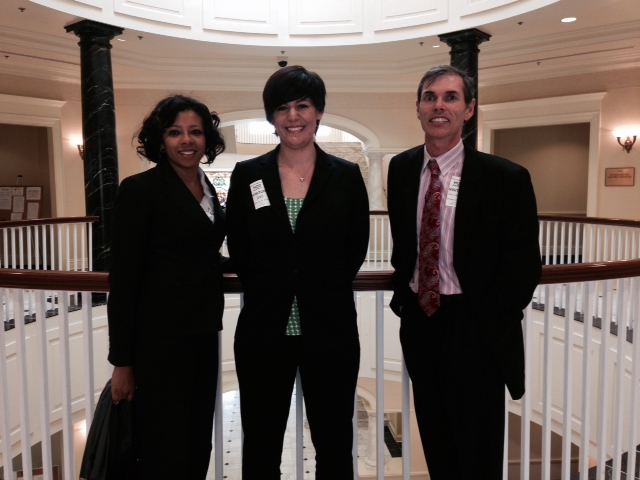
Tonya Baroudi LLAM President. Emily Feltren AALL Director Govt Relations, Steve Anderson AALL President
LLAM needs your help in advocating for the Maryland Uniform Electronic Materials Act (MUELMA). Pre-filed HB46 is sponsored by by Del. Sam Arora, District 19, Montgomery County.
The First Hearing was held on Thursday, 1/23/2014 before the Health and Government Operations Committee. Testimony in favor of UELMA was provided by Delegate Arora; Steve Leitess, Uniform Law Commission, Maryland Member; Emily Feltren, AALL Government Relations Office; and Tonya Baroudi, LLAM President. Steve Anderson, Mary Jo Lazun, Paul Lagasse, and Joanie Bellistri attended the hearing to show support for the panel.
An interlineated copy was provided by Delegate Arora to the committee that included amendments to the pre-filed bill that removed requirements for reported decisions of the circuit and district courts and for certain administrative materials. The revision also added the Maryland Register to the list of legal materials. Tonya and Emily both voiced support as amended.
The Committee Co-Chair, Del. Shane E. Pendergrass, District 13, Howard County, had three questions:
Answers were provided by Steve Leitess of the ULC who stated that it is not unusual for a Uniform Act to take more than one year for adoption, that there are no major differences between the acts and that there are no known instances of a fix being needed after adoption.
Now that the first hearing has taken place, LLAM members can advocate for UELMA by contacting their delegates who are on the Health and Government Operations Committee. Read on to find out how.
LLAM members can help by contacting their delegate if a member of the Committee:
~By Joanie Bellistri, Anne Arundel County Public Law Library
Date: Thursday, March 27, 2014
Time: 8:30 am – 5:00 pm EDT
Location: Capitol Hill*, Washington, D.C.
Who: Washington-area AALL members and local chapters, including LLAM, LLSDC,
SEAALL, VALL, and others who can visit D.C.
Join AALL President Steven P. Anderson, AALL’s Government Relations Office staff, local chapters, and AALL members at AALL’s second-annual Local Advocate Lobby Day on March 27.
Last year’s lobby day was such a success, we’re doing it again! At this full-day event, you’ll become an expert on our top priority issues and learn best practices for successful advocacy. Then, you’ll put your knowledge into practice, attending pre-scheduled meetings with your members of Congress and/or their staff to advocate for AALL’s policy positions.
According to a 2011 survey by the Congressional Management Foundation, 97 percent of congressional staff say that in-person visits from constituents have an influence on the member. As law librarians and members of AALL, you are experts who represent not only yourselves, but your profession, other librarians, and your patrons. Exercise your influence to make a difference for your libraries!
The Lobby Day is free of charge for all AALL members and chapter members. Breakfast, coffee, lunch and an afternoon snack will be provided. Participants will have the opportunity to visit area sites including the Library of Congress, Law Library of Congress, and Folger Shakespeare Library during afternoon free hours.
RSVP to Elizabeth Holland at eholland@aall.org by March 1.
*Training will take place at a TBD location on Capitol Hill within close walking distance of the Senate and House Office Buildings, where lobby meetings will take place.
This Polar Vortex and our current “arctic” temperatures have gotten me thinking… What happens when books freeze? Is it damaging to the paper? Does the extreme cold cause deterioration? Or are there hidden possibilities to be found there….?
After a bit of research, I discovered that freezing is a common method of preservation after a water disaster and can actually be effective for recovering wet books and paper records. Freezing water-damaged materials prevents (further) mold growth and also inhibits additional water absorption into the paper. (For the record, it can also eradicate insects – should you have that sort of dilemma!)
Freezing can be used as a temporary solution to preserve materials while deciding how to ultimately salvage, treat or replace the damaged collection. Or items left in freezing conditions will eventually dry on their own, if left indefinitely, but this is not a particularly efficient method since it takes several months to a year to thoroughly dehydrate.
While water-damaged materials will always exhibit signs of their trauma, freezing can vastly prolong their “shelf-life” (how’s that for a librarian joke?) and save them from untimely ruin.
Now you know… I hope you never need to employ these techniques in your own Library; but if you do, I found these resources particularly helpful in researching and writing this post.
http://www.lib.umich.edu/files/services/preservation/wetbooks-1.pdf
http://www.lib.msu.edu/preservation/wetbooks.jsp
-Sara Thomas (Head Librarian, Miles & Stockbridge PC)
LLAM members, your presence is needed more than ever at this year’s Maryland Legislative Day. If at all possible, PLEASE find room in your schedule on Wednesday, February 19, 2014.
Uniform Electronic Legal Material Act is an important issue on the table for discussion in the legislature and by attending Legislative Day, you can make sure your local delegate is aware and informed! This link has more information so you can educate yourself about the topic. http://www.aallnet.org/Documents/Government-Relations/UELMA
Perks to attending:
We hope to see you there!
Happy Holidays and best wishes for 2014!
Finally, Online Legal Information Is a Topic of Serious Discussion!
Legal link rot has been a newsworthy topic since the publication of “Something Rotten in the State of Legal Citation: The Life Span of a United States Supreme Court Citation Containing an Internet Link (1996-2010) in Yale Journal of Law and Technology. The New York Times featured the study in its September 23, 2013 article In Supreme Court Opinions, Web Links to Nowhere.
The ABA Journal has joined the discussion this month with “Link rot’ is degrading legal research and case cites.” The article features Chesapeake Digital Preservation Group (CDPG) which includes the Maryland State Law Library, Virginia State Law Library and the libraries of Georgetown and Harvard law schools. CDPG harvests and preserves legally significant publications based on the collection development plans of its member libraries. Annually the members of the group check to see if links to a sample set of publications still work. The number of dead links has grown annually, but the 2013 report was significant because for the first over 50 percent of .gov links no longer worked.
It is gratifying to see the preservation of online legal information a topic of serious discussion and the work of groups like CDPG recognized. New tools like permaCC offer the promise of a consistent and permanent links to online legal information. Maybe by the end of the decade link rot will become a quaint artifact, like the sound of a 56K baud modem.
Mary Jo Lazun, Maryland State Law Library
Many counties in Maryland have open forums to allow community organizations to make an “elevator pitch” to their delegations. This Tuesday, Joan Bellistri, Paul Lagasse, and I attended the Anne Arundel County delegation’s forum in order to give them a quick introduction to the Uniform Electronic Legal Material Act (UELMA).
Although we were the second-to -last organization on the agenda, the delegates examined our packet of materials and appeared to be engaged by what we had to say. Of course Joanie is an excellent public speaker and came prepared with a succinct four-minute talk based a sample speech from the AALL UELMA resources page. (Thank you, Emily Feltren Felton of AALL’s Government Relations!)
Following our presentation, one of the delegates asked a question regarding funding; no big surprise there. And after the forum, Paul and I had an opportunity to chat with one of the delegates about the importance of preserving born-digital legal materials. We referenced the Chesapeake Project linkrot study that revealed that after five years, over 50% documents with .gov domain were no longer available at their original URLs.
Forums like this are a great (and easy) opportunity to educate our delegates and senators about UELMA. Keep an eye out for similar forums in your county. Joanie and I have a packet of material and a speech ready to go. Won’t you volunteer to the same in your county? Consider volunteering with your county and bring a fellow librarian…it is more fun with a colleague.
Mary Jo Lazun, Maryland State Law Library
The Law Library Association of Maryland invites you to a
Holiday English Tea
Friday, December 6, 2013
4:00-7:00 P.M.
at 17th Floor Bistro
100 Light Street, 17th Floor
Baltimore, MD 21202
http://www.17thfloorcafe.catertrax.com
Join fellow LLAMers in viewing the magnificent Baltimore Inner Harbor at a festive Holiday English Tea complete with sweets, savories, wines and sherry.
Holiday shopping: This year’s silent auction benefits Rebuilding Together and the LLAM scholarship fund, so please get your auction items ready.
Special Offer: Invite a non-member friend or colleague and get your second registration fee at half price.
Tickets: $25.00 per person ($12.50 for a non-member guest)
You may pay by check. Make the check payable to “LLAM” and mail to
Pat Behles
University of Baltimore Law Library
1401 N. Charles St.
Baltimore, Maryland 21201
We hope to see you there!
Questions? Contact
Kate Martin, LLAM Program Chair
kmartin@mcccourt.com
240-777-9121
Fabulous News: UELMA to be Introduced This Year in Maryland
by: Mary Jo Lazun and Joanie Bellistri
Next year, hopefully, will be Maryland’s turn. LLAM has just received word that the Maryland state delegate Sam Arora (D-Montgomery County) will be sponsoring the Uniform Electronic Legal Material Act (UELMA) in the 2014 Maryland General Assembly.
UELMA provides a technology-neutral, outcomes-based approach to ensuring that online state legal material deemed official will be preserved and will be permanently available to the public in unaltered form. UELMA has become law in eight states: California, Colorado, Connecticut, Hawaii, Minnesota, Nevada, North Dakota, and Oregon and hopefully this spring, Maryland.
LLAM is in a unique position to help stakeholders and legislators understand the importance of UELMA. Now is the time to seek out opportunities to educate our attorneys, educators, and government officials about the importance of UELMA. The AALL Government Relations Office has made this easy by providing a useful selection of background information, advocacy materials, and sample letters at http://www.aallnet.org/Documents/Government-Relations/UELMA.
Take a few minutes to familiarize yourself on the law and its importance so that when an elevator moment presents itself, you will be ready to provide information and answer questions about UELMA.
This year’s library Legislative Day in Annapolis will be a great opportunity to talk face-to-face with our legislators about the importance UELMA. We’ll be announcing the date soon.