FDSys Training in Baltimore: Thursday April 19th

FDSys Training in Baltimore: Thursday April 19th

With Kathy Bayer and Ashley Dahlen  from GPO
Thursday, April 19th from 1:00 – 4:00 pm
Marshall Law Library at the University of Maryland School of Law
500 W. Baltimore Street Baltimore, MD 21201-1786
Level 4 Class room, Room number 4403

An in-depth training session, just for librarians. Kathy and Kristina will provide an overview and introduction to FDSys; basic searching using simple and complex searches; advanced searching techniques; an overview of the “browse” and “retrieve by citation” features of FDys; and how to track a legislation and regulations.

If you  have a laptop, notebook, netbook, tablet, etc. feel free to bring it a long. The class is suited to a hands-on format.

Register online

Directions and parking information
http://www.law.umaryland.edu/marshall/aboutlibrary/location.html

Advocating for Maryland Libraries: MLA Legislative Day in Annapolis

Joan Bellistri
Anne Arundel CountyPublic Law Library
 
Cas Taylor

Cas Taylor

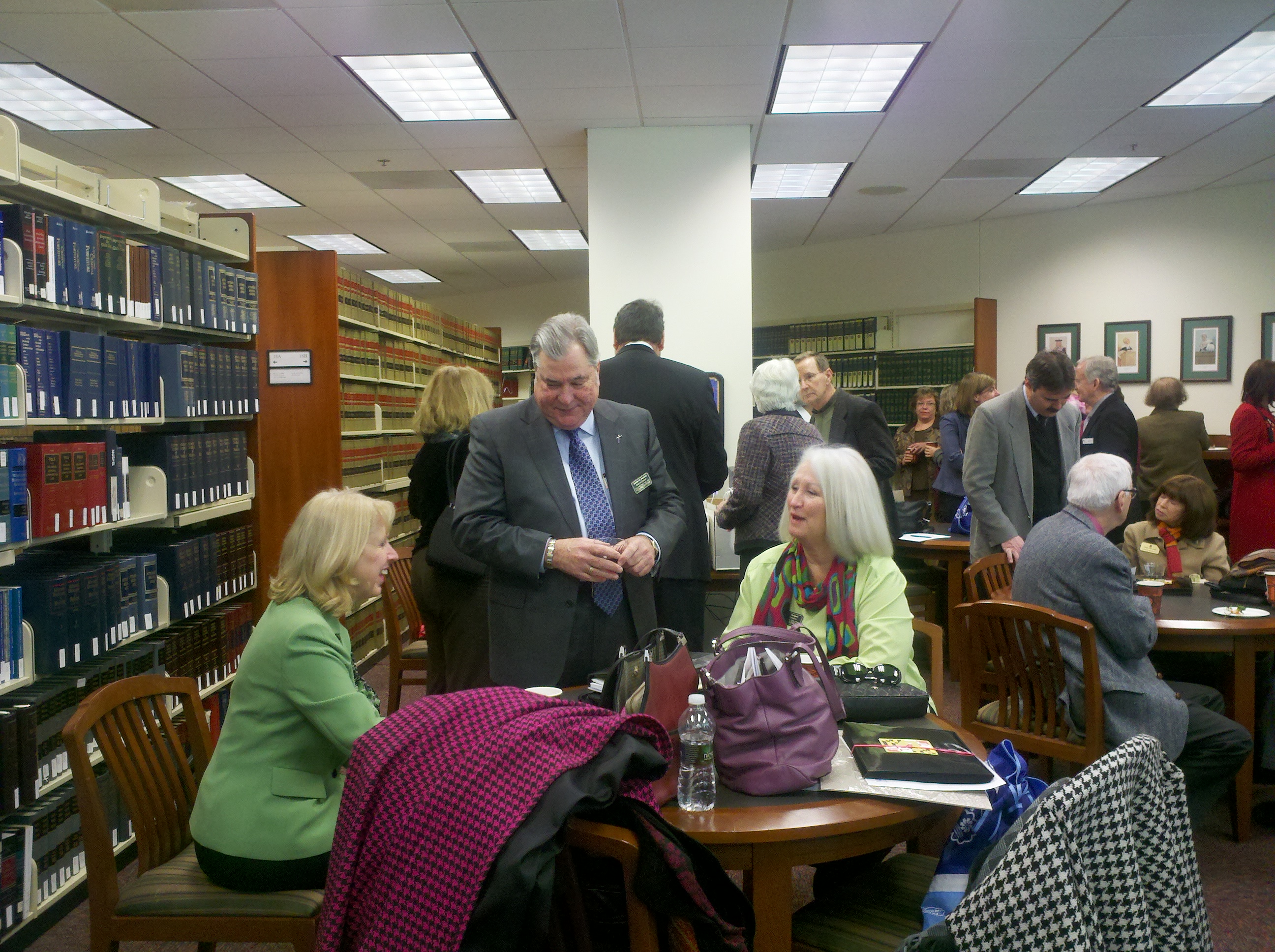
The Maryland Library Association Maryland Legislative Day was held on January 25, 2012, a bit earlier than in years past.  The day began as always with a breakfast briefing in Anne Arundel County Public Law Library.  The breakfast, provided by LLAM, is always appreciated by the librarians who have traveled from across the state for the event.  Cas Taylor, former Speaker of the House and now lobbyist with the firm Alexander and Cleaver that represents the Maryland Association of Public Library Administrators, briefed the group on the issues before the legislature of significance to Maryland libraries.

After the briefing everyone headed to the State House where proclamations were read in both the Senate and House chambers.  The House even gave MLA president, Lucy Holman, an opportunity to speak.

The rest of the day was dedicated to delegate visits.  Librarians from most of Maryland’s counties visited their delegations to distribute information packets and talk about library issues.  With the Library Legislative Day being scheduled earlier in the session than usual, more delegates were available to meet with the librarians.  All members of the House and Senate and the Governor’s office were invited to the MLA reception.  As usual, this was a lovely event with librarians and members of library friends groups being able to talk with the legislators.  This year DLLR Secretary, Alexander M. Sanchez, addressed attendees and voiced his support for the DLLR /public library partnership in workforce initiatives.

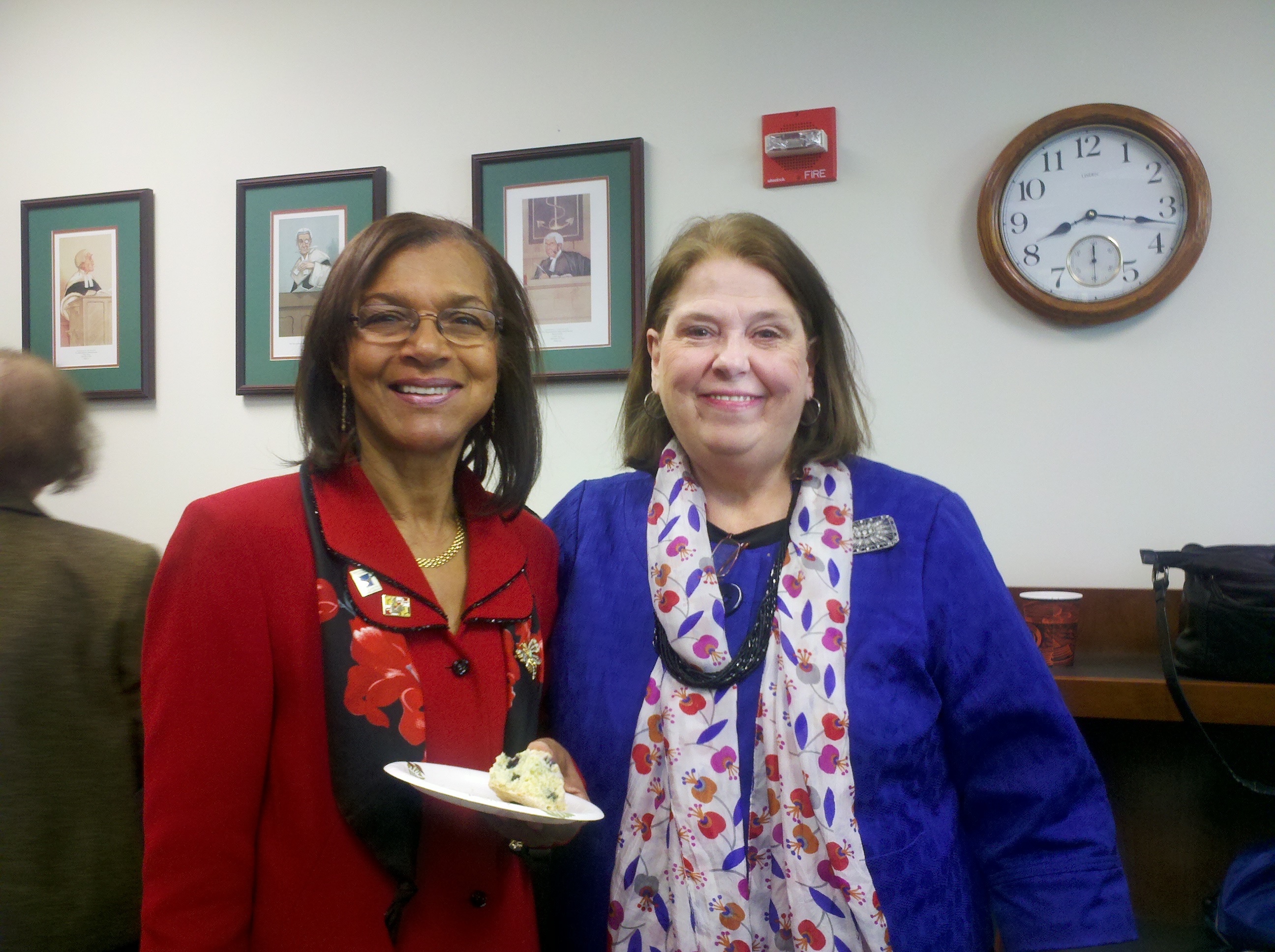
Glennor Shirley and Mary Baykan

The number one issue this session involves the budget proposal to shift pension costs from the state to counties.  Although this proposal is most often seen as an issue that concerns teacher pensions, it would also affect public libraries.  Libraries are only a tiny percentage of the whole pension shift, yet such a move could have a large detrimental impact. There is a concern that since schools have the protection of maintenance of effort, the libraries would shoulder the burden of the pension shift.  Delegates were asked to see that library pensions not be shifted to the counties.  Other budget issues concerning libraries were capital funding for public libraries and the per capita funding.  Librarians asked their representatives to protect both of these sources that are essential in the continued operation and growth of Maryland public libraries. As of this writing, it has not been recommended that the capital funding be removed from the budget.

There were bills introduced, SB858/HB1001, that did not concern funding of libraries. These bills would designate public libraries as essential services in times of emergencies. This bill will make public libraries  among those public services that Maryland’s Emergency Management Administration (MEMA) will list as a priority in getting services restored and funds allocated. Both of the bills have passed.

It is always a relief when there are no bills introduced that would affect law libraries adversely.  Still, it is nice to know that if there were such a bill that the MLA Legislative Panel is there to address it.  We will look to MLA for support if  UELMA is introduced in Maryland.

LLAM members who attended Maryland Library Day at the Legislature this year were Joan Bellistri of the Anne Arundel County Public Law Library, Monica Clements of Legislative Services, Susan Herrick of the University of Maryland School of Law, Mary Jo Lazun of the Maryland State Law Library, and Vicky Yiannoulou of the Prince George’s County Public Law Library.

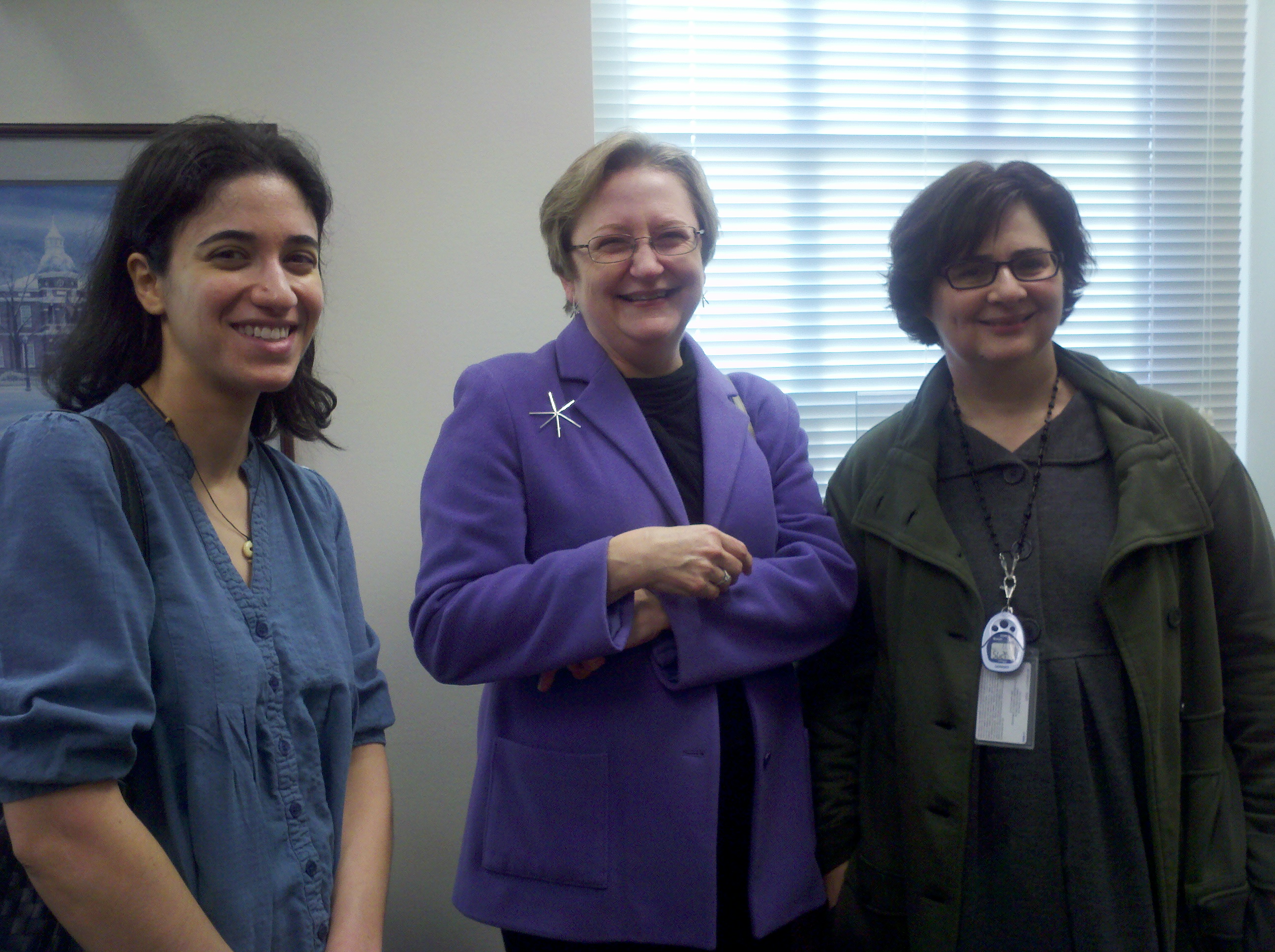
Vicky Yiannoulou, Susan Herrick and Mary Jo Lazun

Ideas in Client Service: Lean Techniques for Law Libraries

By Monique LaForce
Corporate Intelligence Analyst
Steptoe & Johnson LLP
 

“The use of the term “Lean”, in a business or manufacturing environment, describes a philosophy that incorporates a collection of tools and techniques into … business processes to optimize time, human resources, assets, and productivity, while improving the quality level of products and services … [for] customers.”[i] Traditionally, Lean techniques have been applied to streamline manufacturing operations by eliminating waste from repeatable processes, but in the October 2011 issue of the Harvard Business Review, Bradley R. Staats and David M. Upton authored a piece analyzing the application of Lean principles to knowledge workers.[ii]  Staats and Upton maintain that Lean principles can be applied to knowledge work, even though many aspects of it are not repetitive (unlike, say, an assembly line at a widget factory).  Staats and Upton argue that Lean techniques can make knowledge work (like that performed by law librarians) more efficient and more predictable, and thus, provide better client service for patrons.

While Staats and Upton discuss many Lean techniques in their article, a few that may be applied to law libraries include:

Eliminate waste in routine, repeatable activities. 

While each research project undertaken by a law library’s research team is unique, the process by which queries are received, logged, and disseminated generally has routinized aspects that might be standardized to eliminate waste.  Other law library processes could also be streamlined.  Are there multiple access points for reporting time spent on projects?  For example, in some law firm libraries, librarians bill their time via a time entry program, but also separately report on projects to a department head.  Could these processes be combined? Is equipment used by librarians and patrons located to maximize efficiency?  For example, in a law school library, are photocopiers located near collections that patrons must frequently photocopy (such as historic materials that are not available electronically), or are they in an area that requires users to travel long distances laden with materials for copying (and which subsequently need to be taken back by the library staff for re-shelving)? 

Make tacit knowledge explicit. 

Waste can be eliminated by ensuring that the wheel is not reinvented for every similar project.  Librarians implicitly recognize this by creating research guides or pathfinders.  Likewise, legal project management seeks to tame this area by creating timelines and decision trees for various legal proceedings (from real estate closings to complex litigation).  Commercial databases that gather data (such as information about transactions, or clauses in various contracts) and attempt to create accumulated knowledge also seek to eliminate waste, as do KM systems, which allow retrieval of past work upon which to base current projects.  Are there internal law library functions that might benefit from similar processes to avoid recreating past work?

Use communications effectively.

Effectively managing communications may increase efficiency in the law library.  In their article, Staats and Upton suggest, for example, that implementing guidelines as to whom to copy on emails can eliminate waste, by culling unnecessary time spend reading irrelevant communications — time that could be better spent serving clients.  Additionally, guidelines for the method of communication between librarians and patrons might also create more streamlined processes.  For example, it may be more efficient for researchers to refrain from sending results on a rolling basis, unless specifically requested, to reduce the volume of email requestors receive and the chances that results may be buried in the vast tide of correspondence faced by lawyers on a daily basis.  

 While Lean techniques are not universally applicable to knowledge workers, the fundamental idea behind Lean – elimination of waste – may be helpful in improving client service in the law library.  


[i] Lean Manufacturing and the Toyota Production System, R. Becker, http://www.sae.org/manufacturing/lean/column/leanjun01.htm.

[ii] Lean Knowledge Work, B.R. Staats and D. Upton, Harvard Business Review, October 2011,  pp. 100-110. 

Maryland’s People’s Law Library Seeks Contributors

This spring, the People’s Law Library (PLL) will begin its annual review of site content. PLL needs editors and writers to assist with maintaining our award-winning website. Contributing to PLL is an excellent opportunity for librarians to assist pro se litigants throughout the state. With over 1.3 million hits per month, PLL is one of the most effective ways to reach out to those in need. Volunteers are welcome to edit existing content or to submit new articles.

For over a decade, PLL has provided easy-to-understand legal information to Marylanders in need. Containing hundreds of pages covering a broad array of legal topics and a legal services directory, PLL is a vital resource promoting access to justice in Maryland.  Since receiving the site in 2007, the Maryland State Law Library has continuously expanded PLL’s content and has significantly redesigned its layout and navigation. In 2011, PLL was honored with the American Association of Law Libraries’ Innovation in Technology Award and the Herbert S. Garten Public Citizen Award from the Maryland Legal Services Corporation.

PLL has over 900 pages of content on a variety of legal topics including: Consumer Law, Criminal Law, Education, Elder Law, Employment, Family Law, Government Benefits, Health Law, Housing & Landlord/Tenant Law, Wills/Estates/Probate, and Youth Law. In addition, PLL maintains a calendar of workshops and clinics for self represented litigants. LLAM members are welcome to promote events at their libraries through the calendar.

If you have materials to share on PLL, if you would like to write an original article, or if you wish to edit existing content, please contact Michael Craven, People’s Law Library Web Content Coordinator at 410. 260.3708 or Michael.Craven@mdcourts.gov. Also, Michael can send PLL brochures or posters for your library.

President’s Message — March 2012

Sara Jane WitmanBy Sara Witman
Research Librarian
Gordon Feinblatt, LLC

Recharged.

If I had to put how I felt after the LLAM conference on March 20 into one word, it would be “recharged.”

The Full Disclosure conference was successful, not just because there were more than 100 attendees, but because of that invigorating feeling at the end of the day. “Five hour energy” has got nothing on the recent LLAM program.

You would think seeing ten or more presentations in one day might be exhausting, but it was just the opposite.  Apparently, fifteen or twenty minutes is just the right amount of time to learn something new without feeling overwhelmed.

If you didn’t have a chance to attend the conference, or if you’d like to read about presentations you missed, this issue of e-News contains short reviews of most of them.  You’ll see that the presenters (who took a real chance on this one) hit it out of the park.  The keynote speakers – ALA president-elect Maureen Sullivan, AALL president-elect Steve Anderson, and MLA president Lucy Holman – also deftly tackled some pretty heavy topics (eBooks and publishers, anyone?).

The conference committee should be very proud of themselves!  Conference chair Mary Jo Lazun and the rest of the gang — Katherine Baer, Pat Behles, Joanne Colvin, Susan Herrick, Kate Martin, Kirstin Nelson, Jenny Rensler, and Bijal Shah – are all conference planning pros!

It’s a good thing we’re charged up, because the year is certainly not over.  There are two programs in April alone.  On April 11, Scott Meiser will talk about how they are tackling eBooks at Lexis. Scott has promised some exciting news from Lexis on the eBook front, so I’m looking forward to seeing what’s next there.  That program will be held at the University of Maryland Law Library.

Also at the University of Maryland Law Library, Kathy Bayer and Ashley Dahlen from GPO will give an in-depth training session on FDSys on April 19.  If the reaction from the class Kathy and Ashley gave in Annapolis at the Maryland State Law Library in February is any indication, you won’t want to miss this one. And given that GPOAccess is gone for good now, the timing couldn’t be any better!

On the afternoon of May 10, Jane McWilliams, the author of Annapolis, City on the Severn: A History will speak about the research that went into her book and about Annapolis history at the Maryland State Law Library.  Jane is a captivating speaker, so this one should be a lot of fun.

And – yes there’s more – you’ll want to save the date for the Spring Fling, of course!  My personal favorite LLAM event of the year will be held on Friday May 4 at Nick’s Fish House in Baltimore.

I’d also like to thank Joan Bellistri for spearheading LLAM’s testimony in opposition to HB998, a bill that would allow counties to publish their codes online and just notify institutions of the update rather than send a print copy of the code.  The bill had many problems with respect to authentication and permanent public access, and, thanks at least in part to our efforts (we hope!), it was withdrawn earlier this month after an unfavorable report from the House Environmental Committee.

The day after…

Thank you again for attending or attending and presenting at Full Disclosure: Librarians Sharing Best Practices.  Overall I think the conference was a success and that success was in large part due to our  30+presenters. Below are some items we promised to follow up on:

Download Presentations
Many people requested that we post the presentations on the conference web site and we agree. They will be available at https://llamonline.org/agenda and we be posted as we receive them.

Maureen Sullivan Bibliography
I emailed Maureen today for her list of recommended reading and expect to have it posted by early next week.

Session Summaries
Summaries of most conference sessions will be published in the March/April upcoming LLAM eNews. See http://llamnews.wordpress.com/. There will be a link on the conference web site once the issue is published.

Online Evaluation
If you did not get a chance to fill out the survey, or if you have additional comments, please go to https://www.surveymonkey.com/s/fulldisclosure.

Join LLAM
For those who expressed an interest in joining LLAM, we would love to have you, the membership form is available at http://www.aallnet.org/chapter/llam/LLAM_membership_form_2011.doc.

The day after…

Thank you again for attending or attending and presenting at Full Disclosure: Librarians Sharing Best Practices.  Overall I think the conference was a success and that success was in large part due to our  30+presenters. Below are some items we promised to follow up on:

Download Presentations
Many people requested that we post the presentations on the conference web site and we agree. They will be available at https://llamonline.org/agenda and we be posted as we receive them.

Maureen Sullivan Bibliography
I emailed Maureen today for her list of recommended reading and expect to have it posted by early next week.

Session Summaries
Summaries of most conference sessions will be published in the March/April upcoming LLAM eNews. See http://llamnews.wordpress.com/. There will be a link on the conference web site once the issue is published.

Online Evaluation
If you did not get a chance to fill out the survey, or if you have additional comments, please go to https://www.surveymonkey.com/s/fulldisclosure.

Join LLAM
For those who expressed an interest in joining LLAM, we would love to have you, the membership form is available at http://www.aallnet.org/chapter/llam/LLAM_membership_form_2011.doc.

e-Books with Lexis: Wednesday April 11th

Scott Meiser, Director, Product Planning at Lexis will discuss the challenges e-Books present to both publishers and librarians. We all need to contend with multiple file formats and multiple readers. There appears to be almost a direct ratio between the number of readers and the number of issues libraries need to address. These include: How do libraries lend eBooks? Do we let people download a title or just lend them a reader with titles pre-loaded. Does the library own the title or is it licensed? What is a fair price? How do we measure “circulation?”

Wednesday, April 11th at Noon
Marshall Law Library at the University of Maryland School of Law
Room 4409, Level 4 Study Lounge
Register online

Directions and parking information
http://www.law.umaryland.edu/marshall/aboutlibrary/location.html

AALL Announcements – December 2011

  1. 2012 Call for Papers
  2. AALL2go Pick of the Month
  3. AALL Launches New Legislative Action Center

_______________________________________________________________

The 2012 “Call for Papers” has begun!

Have you been thinking of writing an article of interest to law librarians?  The AALL/LexisNexis Call for Papers Committee is soliciting articles in four divisions:

Open Division:  for active and retired AALL members and law librarians with five or more years of professional experience;
New Members Division
:  for recent graduates and AALL members who have become law librarians since July 1, 2007;
Student Division
:  Participants in this division need not be members of AALL. To be eligible in this category, you must have been enrolled in law school, or in a library school, information management, or an equivalent program, either in the Fall 2011 or Spring 2012 semester.

The winner in the Open, New Member, and Student Divisions will receive $650 generously donated by LexisNexis, plus the opportunity to present the winning paper at a program during the 2012 AALL Annual Meeting in Boston!  Winning papers are also considered for publication in the Association’s prestigious Law Library Journal.

Short Form Division (NEW FOR 2012)!  Articles in this category will be shorter than a traditional scholarly article, and appropriate for publication in AALL Spectrum, a bar journal, or a chapter or SIS newsletter.  Participants must be AALL members. The winner will be awarded $300 from LexisNexis.

Articles in the Open, New Members, and Short Form Divisions must be submitted by March 1, 2012.  Articles in the Student Division must be received by May 15, 2012.

APPLICATION:  Application form and details, including word limits, can be found at the Call for Papers website http://www.aallnet.org/main-menu/Leadership-Governance/committee/activecmtes/call-for-papers.html.  If you have any questions, please contact a member of the AALL/LexisNexis Call for Papers Committee: Jennifer Lentz, lentz@law.ucla.edu, Chair; Mark Podvia, mwp3@psu.edu, Vice Chair; Benjamin Keele, bjkeele@wm.edu; James P. Kelly, jim.kelly@vanderbilt.edu; Shawn Nevers, neverss@law.byu.edu
_______________________________________________________________

AALL2go Pick of the Month

AALL’s Continuing Professional Education Committee presents the AALL2go pick of the month: Reinventing the Law School Library.

What do we, as law librarians, envision for the law library of 2020? Will it be a mere shadow of what we know today, or will it not have changed as drastically as we might think?

This presentation is a panel discussion that addresses the idea of the law library in the year 2020. Each panelist speaks regarding different facets of what makes the library and how things may change over time. The idea of the library as a physical space is mentioned, as well as the notion that law libraries may eventually be defined by the librarians rather than the physical space the law libraries occupy. Library collections are discussed, bringing up such topics as the change in formats to digital collections, as well as the access and ownership issues that follow. The final panelist proposes the idea that there may not be as much change as we anticipate due to budgets and the current disconnect that is common between services provided by law libraries and the profiles they carry. With this comes the idea of switching the focus of librarians as service providers to becoming more proactive partners with faculty members and the resulting benefits of doing so. All these notions combine to provide a thought-provoking session about the future and direction of our law libraries.

Find this and other free continuing education programs for AALL members on AALL2go.
_______________________________________________________________

AALL Launches New Legislative Action Center

From Emily Feltren, AALL Advocacy Communications Assistant:

I am very excited to announce the launch of AALL’s new Legislative Action Center. The new Action Center gives AALL and chapter members the tools to easily send targeted messages to your Members of Congress, look up information about your elected representatives, and share our alerts with friends and colleagues through email or social media. This new resource will make it easier than ever before to speak out on the critical information policy issues that affect law libraries.

Please use our Action Center to respond to our current alert on GPO funding. The alert allows you to use our template to send detailed messages to your Senators and House Representative and personalize your emails with stories and experiences related to FDsys and the Federal Depository Library Program. Your personal experiences and reasons why funding cuts would hurt your lawmakers’ constituents are extremely persuasive and will catch the attention of your lawmakers and their staff.

Letters to all Senators, and House Representatives on the Legislative Branch Appropriations Subcommittee, are urgently needed. Thank you to all of you who have already taken action.

President’s Message — December 2011

Sara Jane WitmanBy Sara Witman
Research Librarian
Gordon, Feinblatt, Rothman, Hoffberger & Hollander

One of the nicest benefits of law librarianship here in Maryland is how much our fellow professionals support each other. Just take a quick look at the LLAM listserv and you’ll see librarians asking and receiving help with finding resources, borrowing materials, and researching issues. I’m sure we can all remember a time when we learned something from each other. Librarianship is clearly not a field where you’re “in it alone.”

This collegiality was part of the inspiration for the upcoming Legal Research Institute, Full Disclosure: Librarians Sharing Best Practices that will take place on March 20, 2012. I’m genuinely excited about this one. The basic idea is that presenters will have at most 15 minutes to share their expertise in a “micro-presentation.” Several tracks in which attendees can participate will take place simultaneously, and we’re opening up the conference to all types of librarians.

For more information, check out the great web page that Mary Jo Lazun and Jenny Rensler put together for the program at http://llamonline.org.

And start thinking about what you’d like to present. Maybe you’ve started to do chat-based reference, or maybe you would like to describe your experience implementing a new cataloging system.  Have you recently finished weeding your collection and want to show off how you made it work? Want to explain how you put out your library newsletter? If you need ideas, there is a list of suggested themes at https://llamonline.org/presenters. The presenter application form should be available early next year.

We’ve already had two great programs this year – one on administrative law and another on appellate practice. Both were packed with attendees! If you missed either of them, reports from these are available in this issue of eNews.

There are a number of other great programs coming up, as well. On January 10, Claire Twose and Blair Alton from the Welsh Medical Library will talk about their experience as “embedded librarians” there. Losing physical collections is something many of us may have to think about, and it will be interesting to hear from them about that.  Then, on February 7, Scott Meiser from Lexis will talk about eBooks and their possible future in the world of law libraries.

Also, consider attending the Maryland Library Legislative Day in Annapolis, which is being held on February 23. The Anne Arundel County Law Library, thanks to the wonderful efforts of Joanie Bellistri, will offer breakfast for the attendees. This annual event allows LLAM members to join with other library associations in the state to promote awareness of the benefits of libraries to our delegates and senators.

Annapolis was also the location of this year’s Holiday Party, and you can see from the pictures in this eNews issue that it was well-attended and in a delightfully cute location. We could not have asked for better food, drink, and atmosphere than what we got at bb bistro. So much fun! We raised more than $500 through our Silent Auction, half of which will be donated to the Maryland Food Bank.  It was another smashing success.  Special thanks to Mary Jo Lazun for all of her work in organizing such a fantastic party.

I would also like to send my congratulations to Steve Anderson Director of the Maryland State Law Library, who will be the next AALL Vice President/President-Elect.  This feat is a first for a LLAM member, and is certainly well-deserved.

James G. Durham: New Deputy Director at Maryland State Law Library

The Maryland State Law Library is pleased to welcome James G. Durham as the Library’s first Deputy Director.  Before recently moving to Baltimore, James was Head of Public Services for the Gould Law Library of Touro Law Center in Central Islip, NY.  In that capacity, he had overall responsibility for the supervision and management  of the staff and services of both the reference and circulation departments.  He provided additional assistance to the Touro Law Center community by serving on various faculty and administrative committees and as the program administrator for the school’s summer study abroad programs in India and Israel.

From 1998 to 2005, James served as Publications and Reference Librarian at the Fred Parks Law Library of South Texas College of Law in Houston, where he developed significant expertise in web publishing.  During the course of his career, he has become an accomplished educator, possessing experience in library-based research instruction and as an adjunct professor of graduate and law school courses, including legal bibliography, various aspects of foreign and international law, and sexual orientation law.

He also has a noteworthy record of professional involvement in the law community.  James received his J.D. in 1997, from Ohio State University’s Moritz College of Law.  While in law school, he interned one memorable summer at DNA – People’s Legal Services in Window Rock, AZ, assisting with the legal needs of members of the Navajo and Hopi Nations.

Prior to entering the legal profession, James worked for the Columbus (OH) Metropolitan Library system, where he was the assistant manager of two branch libraries. He holds Bachelor of Arts and Master of Library and Information Science degrees from the University of Illinois in Urbana-Champaign.  He began his new position on October 5th.

People’s Law Library Wins Herbert S. Garten Public Citizen Award

On December 5, 2011, the Maryland Legal Services Corporation awarded the Herbert S. Garten Public Citizen Award to the State Law Library for the People’s Law Library website.

From the MLSC website:  “The Herbert S. Garten Public Citizen Award is presented to an entity or organization (not regularly engaged in the delivery of legal services to low-income persons) that has demonstrated an extraordinary commitment to increase access to justice for the poor in Maryland.”

Congratulations to all the people who put their time and effort into the useful site.

2011 Holiday Party

LLAM raised over $500 in the Holiday Party Silent Auction with half the proceeding going to the Maryland Food Bank.

This slideshow requires JavaScript.

bb Bistro in West Annapolis, December 1, 2011

LLAM November Program – Administrative Law

by Susan Herrick
Research Librarian
University of Maryland School of Law

Twenty-five LLAM members gathered to hear Arnold Rochvarg, Professor of Law at University of Baltimore, address the topic “Getting More Admin Law Questions? Get Answers”, on Wednesday, November 9, at the U. of B. Student Center. Prof. Rochvarg is the author of the recently released Principles and Practice of Maryland Administrative Law and MICPEL’s Maryland Administrative Law, as well as many articles on the topic.

Previously a litigator with an administrative law practice in a large D.C. firm, Prof. Rochvarg began teaching administrative law in 1979. He posited that 98 percent of the material generally covered in law school administrative law courses at that time was federal – and that not much has changed since then. His interest in state administrative law dates back to at least 1990, when Maryland pioneered the concept of a centralized court with independent administrative law judges (ALJs) to conduct hearings for many state agencies, and established the Office of Administrative Hearings (OAH).

Prof. Rochvarg recalled the influence of Maryland’s first Chief ALJ, John W. Hardwicke Sr. As chair of an ABA Committee and executive director of the National Association of Administrative Law Judges, Chief Judge Hardwicke encouraged other states to adopt the Maryland model of a centralized ALJ court as opposed to use of agency-based ALJs, and about half the states eventually did so. It was also with Chief Judge Hardwicke’s encouragement, based on his belief that lawyers needed specialized training to effectively represent clients before OAH, that Prof. Rochvarg developed his course on Maryland Administrative Law at University of Baltimore – one of the first law school courses in the country to focus on state administrative law. After teaching the course for eight or nine years, Prof. Rochvarg decided to write his first book on Maryland administrative law, which was published in two editions by MICPEL. The adoption of new rules by OAH, effective in 2010, along with the demise of MICPEL, inspired Prof. Rochvarg to write the new and greatly expanded version of his book, which contains extensive information about practice and procedure before OAH.

Prof. Rochvarg stressed that Principles and Practice of Maryland Administrative Law contains not only analysis of the formal procedural and evidentiary rules but also the informal “folklore” of customary practice before OAH – for example, the fact that a request for postponement or stay because a party will be out of town requires a showing of proof such as travel tickets or receipts, and that a pending settlement is not considered good cause for a postponement. The book also addresses practice before state agencies which were permitted to opt out of adoption of the OAH system and retain agency-based hearings, including the Office of the Comptroller, the Maryland Workers’ Compensation Commission, and the Public Service Commission. Also provided is information about COMAR and how to research regulations, and about the Maryland Administrative Procedure Act (APA), including agency formal and informal rulemaking, contested cases, and the process of seeking judicial review of ALJ or agency decisions.

Prof. Rochvarg also posited that people – and by this he means attorneys and librarians in addition to self-represented litigants and even judges – often don’t recognize that the problem or issue they are dealing with involves a question of administrative law. He provided several fascinating illustrations – elaborated in detail in Principles and Practice of Maryland Administrative Law – of how administrative law questions are implicated in many and varied areas of legal practice including family law, employment law, and even criminal law. One example involved whether it violates the Double Jeopardy Clause’s prohibition against multiple punishments for the same offense for a driver to have his license suspended by an ALJ for driving while intoxicated and to subsequently be prosecuted in district court for that offense. (See Rochvarg at § 8.7.) The larger question here is the relationship between APA contested cases and issues of res judicata, collateral estoppel, and double jeopardy. In perhaps the ultimate example, he also described the infiltration of administrative law into the death penalty; currently executions have been suspended in Maryland solely due to administrative law issues. The Department of Corrections follows the protocol set forth in the Execution Operations Manual (EOM) to carry out lethal injections. The Court of Appeals halted executions in Maryland when it held, in Evans v. Maryland, 914 A.2d 25 (Md. 2006) that the EOM lethal injection protocol was invalid because it was not adopted according to the state APA rulemaking procedures for regulations. (See Rochvarg at §2.17) The broader question here is the issue of what constitutes a regulation and when an agency practice or activity can be challenged on APA rulemaking procedure grounds.

The presentation closed with a number of questions from the attendees, who clearly appreciated Prof. Rochvarg’s knowledgability of and enthusiasm for his topic. All who attended came away with a deeper understanding of the complexities of administrative law, and with the ability to better appreciate and address questions that come our way that may involve this area. Many thanks to Prof. Rochvarg for his energetic and informative presentation, and to Program Chair Mary Jo Lazun for arranging it.

Photos from the Program

This slideshow requires JavaScript.

New! Maryland Law Firm Publications Search

The Maryland State Law Library is pleased to announce a new tool for local legal research, Maryland Law Firm Publications Search.  This new feature, simple in design and functionality, is comprised of a specialized Google search utility, which indexes the publications pages of the websites of the largest Maryland law firms. It is available from the “Maryland”  link  on the Library’s Databases page.

According to its collection development policy, the Library strives to collect as many Maryland legal publications as possible. In recent years, of course, the advent of the web has enabled corporate and individual authors the ability to publish their own law-related content. This seems to be especially true of area law firms, which have generated a copious number of articles, client alerts, and newsletters that contribute to an improved understanding of Maryland law. When one considers that the focus of many of these communications is the client, it is easy to see that these resources’ greatest value may be in the straightforward explanations and language the authors use.  The difficulty for a library in collecting this useful material; however, is that its quantity makes cataloging and acquisition challenging. Because the Library presumes that these materials are copyrighted, digital archiving also is not feasible. Therefore, the Library chose to implement this search tool in an effort to better highlight these beneficial resources.

The search utility points to one or more pages of a website that contains links to individual documents. In some cases, a firm may include resources about the law in other jurisdictions, so while there is significant local content, Maryland materials are not included exclusively. The Library does not make any selections based on the firms’ online information offerings. Rather, the Library will update the lists of law firms and links frequently.

The Library appreciates any feedback or suggestions that the local law library community might have about this new feature. Please send your comments to lawlibrary@mdcourts.gov

Ideas in Client Service: Customer Satisfaction is Worthless, Customer Loyalty is Priceless*

By Monique LaForce
Steptoe & Johnson LLP


The final month of Q4 is often a time for old chestnuts – like stories about hair combs and pocket watches, and memories of Official Red Ryder Carbine-Action Two-Hundred-Shot Range Model Air Rifles.  The time seemed ripe to review ideas from the pages of the very popular Customer Satisfaction is Worthless, Customer Loyalty is Priceless, written by Jeffrey Gitomer in 1998 to guide sales representatives in retaining customers.  In the book, Gitomer takes a practical approach to customer retention  – noting that even though customers (or, for librarians, patrons) may appear to be at times overbearing and demanding (among other attributes), they are the source of our paychecks, and thus are always deserving of superlative customer service.

Gitomer argues that clients want five things from those that serve them:

1. Know Me.  As the library ceases to be a physical space, librarians can leverage our (primarily) electronic interactions (e.g., e-mail, social media) with our clients to know who they are (literally their names, but also what types of research they require, what their practices focus on, and what their expectations are for deliverables).

2. Understand Me.  For librarians, understanding our clients requires determining the needs of our particular client populations (e.g., law students, lawyers, law professors, the general public).  Are we focused on providing research and analysis that our clients actually value, or do we provide service and access to materials that we think they might value?

3. Lead Me.  With the disintermediation of access to information, clients perform more primary research in far more databases and sources than ever before.  With the increasing cacophony in the marketplace, are librarians taking the lead in vetting and recommending sources?  Do we understand the intricacies of these databases — their limits and benefits?  Are we sorting through irrelevancies and noise to lead our clients to accurate information that is appropriate to their needs?

4. Help Me.  Are our libraries appropriately staffed to provide the correct level of service to clients?  Do we have a standard protocol for how we respond to requests?  Do we treat our patrons, as Gitomer suggests, as though they were our favorite celebrity, hero, friend, neighbor, or grandmother every time they seek our expertise?

5. Serve Me the Way I Expect to be Served — Now.  Technology, the media, and the immediacy of communications have contributed to increased expectations as to the speed with which patrons will receive answers to their questions.  As librarians, are we attuned to these expectations?  Do we, as part of our reference interview, ask probing questions to determine what the particular client’s definition of “now” is?  For an attorney faced with filing a response to a motion for a TRO, “now” might mean something different than it does for a faculty member drafting a law review article.  As librarians, are we managing our clients’ expectations on the realities of obtaining information?  We might be able to provide a federal trial court docket sheet immediately, but may not be able to provide English language copies of the laws of a particular province in China on the same timetable.

In summary, during the hustle and bustle of end-of-the-year budgeting, exams, and business development, it may be useful to take stock of some classic customer service ideas.  New Year’s resolutions are just around the corner, after all.

*Ideas and quotations for this article are drawn from 1998’s Customer Satisfaction is Worthless, Customer Loyalty is Priceless by Jeffrey Gitomer.

Embedded Librarians – January 10 at Noon

Claire Twose and Blair Alton from Welsh Medical Library, Johns Hopkins
Tuesday, January 10th Noon
Gordon, Feinblatt, Rothman, Hoffberger & Hollander, LLC
233 East Redwood Street Baltimore, Maryland 21202
Third floor

Many librarians are moving out of their libraries and actually working on-site with their users. Claire Twose and Blair Alton from the Welsh Medical Library at Johns Hopkins will discuss their experience as embedded librarians including setting up an embedded librarians program and the advantages and disadvantages of this kind of service delivery model.

Directions:
 http://www.gfrlaw.com/aboutus/xprGeneralContent2.aspx?xpST=AboutUsDirections

For validated parking please park at:
Arrow Garage – Located at 204 E. Lombard Street (preferred)
Renaissance Hotel Gallery Garage – Entrances are located on Calvert Street or South Street between Pratt and Lombard Streets.

LLAM Conference — Librarians Sharing Best Practices March 20, 2011

Mark your calendar for March 20th 2012 for Full Disclosure:  Librarians Sharing Best Practices at the University of Baltimore

Every other year the Law Library Association (LLAM) sponsors a day long conference. In the past, LLAM’s Legal Research Institute has focused on the finer points of legal research. For 2012, LLAM has decided to do something different. This year’s conference will highlight best practices of librarians, not just law librarians, but all types of librarians.

Full Disclosure: Sharing Best Practices will not be an ordinary library conference—by the end of the day participants will have heard at least a dozen librarians share their best practices in librarianship. The conference is modeled after the Best Practices Exchange, an annual national conference attended by librarians and archivists who manage digital collections. At Best Practices all participants are encouraged to be presenters. The conference format revolves around tracks and themes. Presentations are short—limited to 10 to 15 minutes.

Full Disclosure will follow a very similar format. What LLAM foresees is that on March 20th, 2012 librarians and library students from throughout the region will gather and share their expertise, best practices, research, tips, successes and failures. The conference agenda is up to us, the librarians and library students who submit presentations. This micro-presentation format will enable all of us to hear and learn from many people in a single day. It will be an exceptional networking opportunity.  To kick off the event, Maureen Sullivan, a Maryland resident and incoming president of ALA will share her vision of ALA and librarianship in Maryland.  She will be joined by incoming AALL Vice President/President- elect Steve Anderson.

The call for presentations will go out in early 2012. We will provide a long list of topics and themes to help you come up with ideas.  This will include everything from cataloging to collection development. You, or a group, will be asked to provide a title, list of objectives, and a paragraph summary of what you, or your group, wish to present and discuss. Once all the presentations have been received, LLAM will sort them and group them into tracks. We expect, but cannot promise, that all submissions will be accepted. We will notify you of your track and theme and the time and location of your presentation. The only requirement is that you  attend the entire conference.

LLAM’s goal is to keep this conference highly affordable with substantial discounts for attendees who are also presenters and for library students and those currently unemployed.

For details on Full Disclosure see http://llamonline.org

Information on the conference will posted on the new LLAM web site at https://llamonline.org/

LLAM’s Own Steve Anderson Elected AALL President

Long-time LLAM member and former LLAM president Steve Anderson was elected Vice-President/President Elect of the American Association of Law Libraries and will be sworn-in at the AALL Conference in July 2012.  This is the first time a Marylander and LLAM member has been elected to this position.  Steve is currently Director of the Maryland State Law Library where he has made his mark as a talented manager and thoughtful leader.

Chief Judge Bell of the Maryland Court of Appeals was delighted when he heard the news of Steve’s election.  So was his staff of eighteen, who sent a big bunch of balloons to Steve to celebrate his election.  Predictably, Steve said that his election would not be possible without the hard work and support of his staff.

One of Steve’s first outings as our incoming Vice-President/President Elect will be to share the stage with fellow Marylander and incoming ALA Vice-President/President Elect Maureen Sullivan at the LLAM’s Full Disclosure conference this coming March.

One thing we know for sure, AALL could not be in better hands.

EasyBib: More than just citation management

By Mark Desierto
Systems Librarian
Venable LLP
 

Looking for an inexpensive holiday gift to give to that college student that doesn’t enjoy citing sources as much as you do?

EasyBib (www.easybib.com) is an online bibliography generator that helps users search for websites, books, or other materials and create citations for those sources, formatted to MLA standards (for free) or to APA or Chicago styles (for a fee). Once the bibliography is complete, EasyBib offers a nice range of output options, including export to Word or Google Docs.

Based on some thoroughly unscientific testing, EasyBib performs at its best on website sources. It pulls in article title, author, and date information at the push of a button. For journals (print or online) or other more traditional research formats, however, EasyBib is a little less intuitive. It is hard to say what bibliographic indices EasyBib is searching, and the ranking is a bit confusing; a search for a recent Law Library Journal article yielded a hodgepodge of results.

Nonetheless, when EasyBib cannot find a source and generate its citation automatically, it offers a handy guided form for entering the necessary bibliographic details, then outputs the citation to one of the major citation styles. So a user is no worse off than had she or he used Microsoft Word’s native citation tools or any other online bibliography guide (e.g., Son of Citation Machine).

EasyBib, which has been available for about five years, now also offers to institutional/school partners a suite of research and information literacy tools, including virtual notecards, footnote, and parenthetical formatting output options, and even guidelines for website evaluation. (These premium features were not reviewed.)

Don’t put the Bluebook or ALWD away just yet, though: EasyBib does not offer legal citation formats in the free or premium version. But for wading through the rest of the citation universe, EasyBib is a fast, friendly tool.

EasyBib
www.easybib.com
MLA style only: Free
APA, Chicago style and additional tools: $4.99/month, $14.99/6 months, $19.99/year; institutional rates also available
iPhone app: Free