Getting UEMLA on the General Assembly’s Agenda

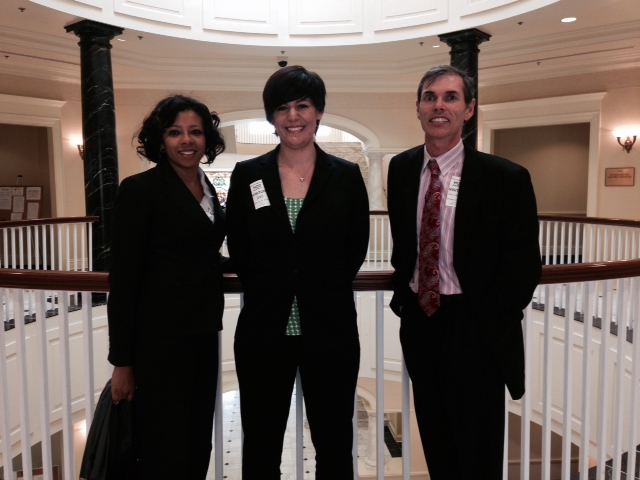
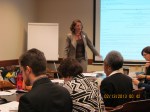
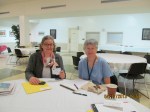
Many counties in Maryland have open forums to allow community organizations to make an “elevator pitch” to their delegations. This Tuesday, Joan Bellistri, Paul Lagasse, and I attended the Anne Arundel County delegation’s forum in order to give them a quick introduction to the Uniform Electronic Legal Material Act (UELMA).

Although we were the second-to -last organization on the agenda, the delegates examined our packet of materials and appeared to be engaged by what we had to say. Of course Joanie is an excellent public speaker and came prepared with a succinct four-minute talk based a sample speech from the AALL UELMA resources page. (Thank you, Emily Feltren Felton of AALL’s Government Relations!)

Following our presentation, one of the delegates asked a question regarding funding; no big surprise there. And after the forum, Paul and I had an opportunity to chat with one of the delegates about the importance of preserving born-digital legal materials. We referenced the Chesapeake Project linkrot study that revealed that after five years, over 50% documents with .gov domain were no longer available at their original URLs.

Forums like this are a great (and easy) opportunity to educate our delegates and senators about UELMA. Keep an eye out for similar forums in your county. Joanie and I have a packet of material and a speech ready to go. Won’t you volunteer to the same in your county?  Consider volunteering with your county and bring a fellow librarian…it is more fun with a colleague.

Mary Jo Lazun,  Maryland State Law Library

LLAM Holiday Party and Silent Auction 2013

HolidayPartyBaltimoreatNightSave the Date!

The Law Library Association of Maryland invites you to a

Holiday English Tea

Friday, December 6, 2013
4:00-7:00 P.M.
at 17th Floor Bistro

100 Light Street, 17th Floor
Baltimore, MD 21202
http://www.17thfloorcafe.catertrax.com

Join fellow LLAMers in viewing the magnificent Baltimore Inner Harbor at a festive Holiday English Tea complete with sweets, savories, wines and sherry.

Holiday shopping: This year’s silent auction benefits Rebuilding Together and the LLAM scholarship fund, so please get your auction items ready.

Special Offer: Invite a non-member friend or colleague and get your second registration fee at half price.

Tickets: $25.00 per person ($12.50 for a non-member guest)
You may pay by check. Make the check payable to “LLAM” and mail to
Pat Behles
University of Baltimore Law Library
1401 N. Charles St.
Baltimore, Maryland 21201

We hope to see you there!

Questions? Contact
Kate Martin, LLAM Program Chair
kmartin@mcccourt.com
240-777-9121

Fabulous News: UELMA to be Introduced This Year in Maryland

Fabulous News: UELMA to be Introduced This Year in Maryland
by: Mary Jo Lazun and Joanie Bellistri

Next year, hopefully, will be Maryland’s turn. LLAM has just received word that the Maryland state delegate Sam Arora (D-Montgomery County) will be sponsoring the Uniform Electronic Legal Material Act (UELMA) in the 2014 Maryland General Assembly.

UELMA provides a technology-neutral, outcomes-based approach to ensuring that online state legal material deemed official will be preserved and will be permanently available to the public in unaltered form. UELMA has become law in eight states: California, Colorado, Connecticut, Hawaii, Minnesota, Nevada, North Dakota, and Oregon and hopefully this spring, Maryland.

LLAM is in a unique position to help stakeholders and legislators understand the importance of UELMA. Now is the time to seek out opportunities to educate our attorneys, educators, and government officials about the importance of UELMA. The AALL Government Relations Office has made this easy by providing a useful selection of background information, advocacy materials, and sample letters at http://www.aallnet.org/Documents/Government-Relations/UELMA.

Take a few minutes to familiarize yourself on the law and its importance so that when an elevator moment presents itself, you will be ready to provide information and answer questions about UELMA.

This year’s library Legislative Day in Annapolis will be a great opportunity to talk face-to-face with our legislators about the importance UELMA. We’ll be announcing the date soon.

November LLAM Program: Judge Irma Raker on Maryland Pattern Jury Instructions

JudgeIrmaRakerHear the Honorable Irma S. Raker speak on

“Everything you need to know about Maryland Pattern Jury Instructions”
November 6, 2013 at 3:00-4:00 p.m.
Anne Arundel Circuit Court Library, Room 303
7 Church Circle
Annapolis MD 21401

A dynamic speaker, Judge Raker will recount her 30 years chairing the committee producing the popular Maryland criminal and civil pattern jury instruction books.

These books are relied on by judges across the state and cited by attorneys for their succinctness, clarity and attention to detail. Retired Chief Judge Bell calls them “of paramount importance to the court.”

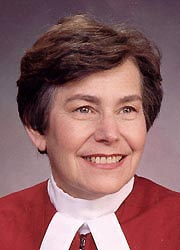
The Honorable Irma Raker, a distinguished jurist and legal pioneer, was the second woman appointed to the Maryland Court of Appeals. She currently chairs the MD Access to Justice Commission and works in private mediation.

An open Q-and-A session about her illustrious legal career will follow the talk.

RSVP to Kate Martin at kmartin@mcccourt.com, 240-777-9121.

How Legislative History Really Works – Exhibit A — The Affordable Care Act

LLAM Program with John Cannan: How Legislative History Really Works — Exhibit A, The Affordable Care Act
October 15, 2013 at 12:00 P.M.
The Brown Room, Library Company of the Baltimore Bar 100 North Calvert Street, Baltimore MD 21202

A video recording of the presentation by John Cannan is now available online:

————————————————————

Still using USCCAN, Google or THOMAS?  The rules have changed! New, unconventional tools are now available to mine more complex and different legislative procedure models.

Be ready to operate in this new reality. Legislative History is a core law library competence and a unique skill we can offer our patrons – a sure way to improve our ROI.

Join John Cannan of the Drexel University Law Library for a provocative talk on how to compile a federal legislative history.

A frequent writer on legal research topics, most recently in the Law Library Journal (http://www.aallnet.org/main-menu/  publications/llj/LLJ-Archives/Vol-105/no-2/2013-7.pdf), John’s current research interests are in services for self-represented litigants, Web 2.0 and judicial rules.

John received his JD and MLS from the University of Maryland and he has worked at the Montgomery County (MD) Circuit Court Law Library and then at the Law Library of Congress.

This program will be taped for later viewing on the LLAM site.

Parking: Limited parking, two garages are within a block of the

Bar library, north on St. Paul Street and west of Lexington Street. No onsite parking.

NEXT PROGRAM: November 6th, the Honorable Irma Raker will speak on chairing the MSBA committee that produced the popular Maryland Pattern Jury Instructions and her life as a Circuit Court and Court of Appeals Judge.

How Librarians Can Make the Shutdown Work for Them

This post is LLAM’s Maiden Voyage into the blogosphere and there is one hot topic boiling in the hearts of all Americans. Whichever side of the political fence we fall on, we are all faced with a disturbing reality – the United States Federal Government has shuttered all “non-essential” doors and shut down. We each recognize that on some level this affects everyone; some more than others.

As law librarians, this situation threatens to have a colossal impact on how we perform our jobs. Some of our colleagues have been furloughed and aren’t even able to go to work. Those of us that are still standing face a number of frustrations because the government resources we use have been suspended. Many of the government websites that we access daily to perform reference services are already shut down. If the situation continues much longer, there will be more that go dark.

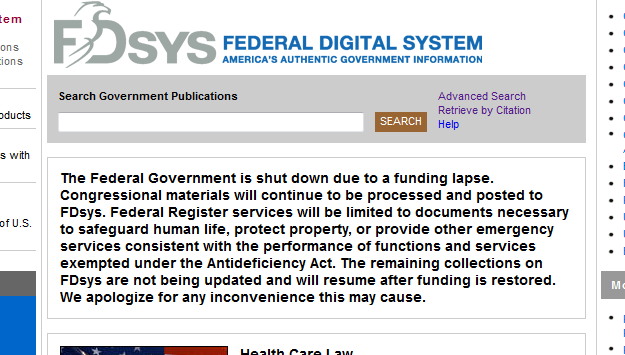
Some of our most essential databases, like FDsys, aren’t being updated. When we visit many government webpages, we are met with glaring messages about budget appropriations and lapses in funding. How long will it be before the Federal Courts close? And PACER shuts down?

Fdsys Shutdown Image

Some of the less-essential (but still important) services are also closed. For example, there is no one at National Library of Medicine to pull the medical articles that my patent attorneys need.

This situation should motivate us all to step up to the hypothetical plate and provide some clarity in this crisis of uncertainty. We Librarians need to provide stability. We need to use this state of affairs to our advantage and demonstrate our VALUE to our user communities. In this time of confusion we must emerge as the knowledge experts. We should know the alternate sources that are available and be prepared to guide our patrons to them. Dig deep in your bag of Librarian tricks and think of every clever way you can prove your Library to be the authoritative resource. This is the moment that we Librarians must to seize to show our continued need and importance.

I certainly hope this shut down doesn’t last much longer. I hope our lawmakers can come together and do what needs to be done to get up and running again. In the meantime, let’s be the best information providers we can be, use this as an opportunity to show our ingenuity and in the words of Tim Gunn, “Make it work!”

LLAM Legislative & Advocacy Activities

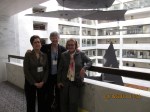
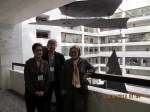
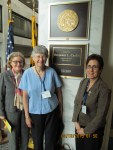
Here are photos from Maryland Legislative Day on February 13th and AALL Advocacy Day in DC on April 18th. Thank you Joanie Bellistri and Janet Camillo.

LLAM Spring Fling 2013

A great time was had by all at the 2013 Spring Fling at Kinder Farm Park. Special kudos goes out to Kate Martin for her wonderful catering and party planning.

February LLAM Program: Speaker Andrew Jezic, Maryland Law of Confessions

LLAM warmly welcomes Mr. Andrew Jezic, co-author of Maryland Law of Confessions, as a guest speaker on February 6, 2013, in which he will shed light on his experience with the publisher, Thomson Reuters,  and the relevancy and connection of this resource and libraries.

In 2011 and 2012, Mr. Andrew Jezic, was recognized as a Super Lawyer, an accolade that goes to only the top 5% of attorneys in Maryland.  In 2012, Mr. Jezic received another honor by appearing in Washingtonian magazine as one of the best defense attorneys in the area.

Please RSVP to Tonya Baroudi at tebaroudi@co.pg.md.us by Thursday, January 31, 2013.  Thank you and we look forward to seeing you on February 6, 2013.  Beverages and desserts provided.

Wednesday, February 6, 2013, 3:00 pm – 4:30 pm
Maryland State Law Library
Conference Room
361 Rowe Boulevard
Annapolis, Maryland  21401

November LLAM Program: Charlotte Harrington, Bloomberg Law

You won’t want to miss the LLAM Program in November. Charlotte Harrington, Legal Research Specialist, will provide a look into the new world of Bloomberg Law as enhanced by the Bloomberg BNA Content – such as dockets, company analytics and litigation, news and much more.

Date/ Time/ Location:  Thursday, November 15, 2012, 12:00-1:30pm.
University of Baltimore Student Center
21 W. Mt Royal Avenue (corner of Maryland and Mt Royal Avenues)
Student Center Room 301
Baltimore, MD 21201

In order to secure parking vouchers, good for parking at the reduced rate of $7, please RSVP by COB Thursday, November 1, 2012 to Tonya Baroudi at tebaroudi@co.pg.md.us

For parking information see http://www.ubalt.edu/about-ub/offices-and-services/auxiliary/parking-and-public-transportation/visitor-information.cfm.  The campus is also convenient to the light rail, and the Circulator bus.

You are welcome to bring your lunch; beverages & desserts provided.  If you have any questions, please let me know.  Thank you and we look forward to seeing you on November 15.

A Slice of Full Disclosure

Back by popular demand is “A Slice of Full Disclosure”, a segment of LLAM’s Spring 2012 Conference, “Full Disclosure:  Librarians Sharing Best Practices”.  You asked for it, you got it!  Last Spring, LLAM’s conference highlighted best practices of librarians.  Now, five of the many compelling sessions return to the stage on Tuesday, October 16 to offer a second dose.

An additional bonus is a special appearance by AALL’s President, Jean Wenger. Don’t miss out!

“A Slice of Full Disclosure”
Tuesday, October 16 from 12:00 – 2:00 pm
Marshall Law Library at the University of Maryland School of Law
500 W. Baltimore Street, Baltimore, MD 21201-1786
Level 4 Classroom, Room number 4403

 Featuring, LLAM’s Immediate Past-President, Sara Witman, Gordon Feinblatt, LLC, “Free Online Tools for Legal Research” – Learn about the free online tools that Sara uses regularly (sometimes unconventionally!) to make her look like she knows something about researching the law, individuals, and companies.

Michael Shochet ,University of Baltimore, Langsdale Library, “PowerPoint Doesn’t Have to Suck”-  By applying some basic principles of graphic design to slideware (such as PowerPoint),  you can make slides that are engaging and that enhance a presentation, instead of detracting from it.

Sara Thomas, Miles & Stockbridge, P.C., “Stuck in the Middle with You: Print v. Online” – Sara will discuss the present dichotomy of legal resources between the “old school” print format and the increasingly emerging electronic options and why both play an important role, both in the present and future, for our researchers and ourselves.

Jason Hawkins and Jenny Rensler, University of Maryland Francis King Carey School of Law, “Teaching Technologies for Legal Research Instruction” – This presentation will introduce selected multimedia technologies that support legal research instruction. Participants will discover tools and techniques for using these technologies to create innovative user-centered lessons, applicable in both formal classroom settings, and information settings at the “point of need.”

Wendy Maines, Thomson Reuters Westlaw, “Library Yogi” – In this mini Office Yogi session, an RYT-200 yoga teacher will move you through some simple poses.  These postures can be performed at your desk to ease common workplace discomforts such as carpal tunnel, tight shoulders, and low back issues. Wendy will discuss a corresponding handout that can be posted on an intranet/portal so that your patrons may also benefit.

Please RSVP by COB Tuesday, October 9, 2012 to Tonya Baroudi at tebaroudi@co.pg.md.us. If you have any questions, please let me know.  Thank you and we look forward to seeing you on October 16.

You are welcome to bring your lunch; beverages provided.

Directions and parking information:
http://www.law.umaryland.edu/marshall/aboutlibrary/location.html

Embedded Librarians – AALL Session Review

Embedding Librarians to Add Value to Your Institution
Tuesday, July 24

This session was interesting for its content and unique in its format.  The hour and half session was divided into two parts. The session began with a traditional panel discussion that was followed by breakout sessions. I often cringe at suggestion of “breakout” sessions but in this case it was a prefect way to both learn about and discuss the topic.

David Shumaker, one of our field’s recognized authorities on embedded librarianship and professor at Catholic University’s School of Library and Information Science began discussing the evolution of embedded librarianship. He noted that while this model may be ideal for many environments, it not a magic bullet. Embedded librarianship also requires a unique set of skills that are not often highlighted in library school and something that David believes needs to quickly change.

His presentation was followed by Marguerita T. Young-Jones of Reed Smith LLP who discussed the success Reed Smith has had with the embedded model.  Marguerita noted some of the potential problems with embedded librarianship like “mission creep” have surfaced in her experience. “Mission creep” is when librarians are asked to do non-librarian tasks. Talented and responsive embedded librarians may be rewarded with requests to assist or perform tasks outside of our area of expertise and requires a deft response so keep the client happy but not take on additional unrelated duties.

Finally, Owen G. Smith, of the 6th Circuit Library of the U.S. Court of Appeals discussed a draft plan he working on to embedded libraries with judges. Owen noted that introducing librarians into judge’s chambers  (or at least nearby) has a special set of challenges but when presented as a way to save money and space, while increasing service, judges are very willing to listen.

After these presentations the audience was asked to participate in breakout sessions by library type: academic, private and court. I attended the court group which consisted of about a dozen court librarians mostly from federal libraries. Owen described detail his concept of embedded librarians could be an excellent model if the right librarian(s) could be found. We also discussed how this type of librarianship is not for everyone and does demand a special set of skills. And although many of us clearly think the embedded librarian is a terrific idea a for courts, there was general agreement that a better title is needed market and sell to our courts.. Owen said he was using “librarians without walls.”

I thought the breakout idea, after the general session was a terrific idea.  The smaller groups gave us a chance to discuss the topic from a more “local” point of view that would not be possible in a large group.  It is also much easier to ask delicate questions that may not be appropriate for a larger audience.  I hope AALL considers expanding this format for next year. I had mentioned new format to another attendee who as it turns out was at the “firm” library breakout session. She said she liked the concept but her group was too large to have a real discussion. Our courts group was a perfect size but the room we were given for our breakout session was not ideal. While this format does present more challenges than traditional session, the problems we experienced could easily be overcome.
PS–David Shumaker just published a new book, The Embedded Librarian: Innovative Strategies for Talking Knowledge to Where It’s Needed.  He says, “this new model is replacing traditional reference librarianship, and is changing the profession at the same time–replacing outdated stereotypes with a new image of effective competence and engagement. ”  I hope to have a book review in the next issue of LLAM eNews.

AALL 2012 Annual Meeting Recap

By Katherine Baer, MD State Law Library

As you all know the state budget is undergoing some major constraints, therefore the LLAM grant allowed me to attend the AALL conference this year.  So first off, thank you very much.  The conference was held in Boston, which was feeling the heat as most of the country this summer, so it was not that much of a problem to stay indoors for a few days and “learn, connect and grow” which was the theme of this year’s conference.

The conference sessions opened up with a keynote by Richard Susskind, a Scottish professor and lawyer who specializes in looking into the future, focusing on the areas of law and technology.  Professor Susskind covered the overwhelming growth of technology and how lawyers are reluctant to embrace this growth.  Along with this, is the increasing demand to do more for less and the ongoing need for access to justice.  After a sometimes frightening look into the future, he finished up by explaining that librarians are in an ideal position to redefine themselves and adapt to these changes in the legal world.

I won’t go into all of the sessions I attended, but will highlight a few of my favorites.  There was a session on the National Declassification Center (NDC).  They have been tasked with the job of declassifying over 380 million government documents.  Their director, Sheryl Shenberger reviewed their progress including successes and obstacles and clearly outlined how herculean a task this was.  One of the biggest challenges is that while they are trying to tackle the backlog, new materials continue to accumulate. Nate Jones from the National Security Archive, a watchdog group on government openness, assessed NDC’s progress.  As you can imagine, Mr. Jones was fairly critical of NDC’s progress and the reasons behind it.  He stated that the mindset that remains is over bureaucratic and inefficient.  The two speakers realized that they were never going to agree.

Copyright is a strong interest, so I attended the “Hot Topics in Copyright for Librarians”.  There was an overview of basic copyright law and some key issues that librarians need to be aware of when tackling copyright questions.  They then went on to discuss some major cases that have occurred in the past year; including the Georgia State case which dealt with e-reserves and the Google books lawsuit.

I usually try to attend at least one session on a topic that I know very little about and this year I chose patent law.  There was a session entitled “I Have a Patent Number – Now What?” The challenges of a patent number actually gives COMAR a run for its money.  The speakers ran through the intricacies of deciphering a patent number and  where you go once you have some direction.  It takes a special skill set to work with patents.

I recently joined AALL and in doing so joined the Government Documents Special Interest Group.  I attended their morning breakfast and was impressed by the turn-out and agenda.  They started off introducing the VIP guests, including David Mao of the Law Library of Congress who is the AALL programming liaison. We also heard a GPO update from Mary Alice Baish.

The conference was in Boston, a city I had spent a fair amount of time in while I was young, but hadn’t been back to in 20 years. One highlight was the State, Court, Counties gathering at the Social Law Library.  It was especially exciting for my husband who is a Herman Melville fanatic.  Did you know Melville’s father-in-law was the Chief Justice of the Massachusetts Supreme Court?  Well, they had part of his library and even the chair he died in!  Definitely, the highlight.  All in all, it was great chance to learn, connect and grow with some fabulously talented librarians.

Featured Article – Ideas in Client Service: Preparing Deliverables

By Monique LaForce

Deliverables are the “quantifiable goods or services . . . provided upon the completion of a project.”[1] In the context of reference and research services, deliverables are the results produced by a research librarian that are given to a requestor.

Deliverables are a key component of a library’s client service. Producing excellent deliverables requires both researching the information given in response to a request and packaging that information to the requestor. This article raises considerations for the librarian when determining how to present the end results of a research project.

  • Deliverables are the essence of a project. All the client sees is the final product delivered to her. She doesn’t see the hours of effort that may have gone into finding and compiling the information – only what is presented to her. Thus, the final project is important – it is the critical link between a researcher and his client.
  • Deliverables should be clear, responsive, easy to read and understand, and accurate. A requestor should not have to dig through a pile of material (paper or electronic) to find what she is looking for. The information requested should respond accurately to the request, and be clearly labeled and presented.
  • Deliverables should be proportional to the request they respond to. Deliverables should be proportional not only to any budget allocated for a request, but also to the request itself. Verifying a court phone number doesn’t warrant creating a PowerPoint presentation. A simple email, text message, or telephone call should suffice. Likewise, a request for an in-depth company profile will likely merit additional packaging, perhaps including an executive summary of findings, charts, a written report, and exhibits.
  • Deliverables should provide source information. The source of the information contained in a deliverable should be noted.  Generally the information in a deliverable will be used by the client in another context (for example, incorporated into an article, brief, or pitch) and the requestor may need to reference or refer back to the original source material.
  • Deliverables vary by project and may evolve as a project proceeds. The format for a deliverable may be dictated by the person making an information request. She may specifically request a book, a chart, a pleading, or a summary email. Often, the deliverable will vary depending upon the information located. For example, if a researcher is compiling outcomes of a certain type of case brought against a particular litigant, the deliverable may look very different if there are only three lawsuits matching the relevant criteria, as opposed to 300. Time and budget constraints may also dictate a deliverable’s format.
  • Deliverables should always meet client expectations. What is delivered to a client varies depending upon what is requested, as outlined above, but deliverables should meet the client’s expectations each and every time they are presented. Ken Blanchard and Sheldon Bowles argue in their 1993 book, Raving Fans, that it is far better to meet expectations on all levels consistently rather than to exceed expectations sometimes or only in some areas. According to Blanchard and Bowles, always meeting expectations creates a trust that elevates a customer to a “raving fan.” Meeting client expectations may require communication with the client at the outset of or throughout a project in order to calibrate those expectations (if, for example, the information the requestor seeks is not publicly available or cannot be obtained within the client’s budget or deadline).

Deliverables are a key component of the relationship between research librarian and patron and the manner in which they are presented should be carefully considered and well-executed to provide excellent client service.

On the Radar: What’s New in the Library World?

By James Durham, Deputy Director of the Maryland State Law Library

This selection of new tools, upcoming conferences, and announcements has been gleaned from library organization discussion lists, blogs, websites, and conversations. Perhaps one will spark your interest…?

  •  The Bluebook: A Uniform System of Citation is now available as an iPad application. The Bluebook continues to be available in paper and online. A new guide by Mary Whisner, called Bluebook Technologies, is available through LLRX at http://www.llrx.com/features/bluebooktechnologies.htm.|
  • Google now offers free Course Builder software to create online classes. Course Builder enables posting of course materials, creating a course community, and evaluating student progress. Course Builder is the same software used to present the recent online course series called Power Searching with Google. To learn more about Course Builder and to watch an intro video, please visit https://code.google.com/p/course-builder.
  • The Library of Congress recently launched the beta site of Congress.gov, the successor to Thomas.gov. The new site currently contains legislation from 2001 to the present, and Congressional profiles from 1973 to the present. Over the next two years, Congress.gov will incorporate all of the information currently provided by Thomas.gov. The new site contains improved Google-like search features, updated design, and compatibility with mobile devices.
  • Support the Maryland Library Association (MLA) with every sip of coffee! MLA will receive 20% of the purchase price of any MLA Coffee Blend (100% Arabica) purchased through Cabin Creek Roasters. The featured blends are Dewey’s Decaf, Readers’ Brew, and Margaret’s Choice. To order, visit http://www.mdlib.org/.
  • A complete library of Maryland Attorney General Opinions will be available through HeinOnline, beginning in late October or early November. To learn more, visit http://www.heinonline.org.
  • Coming soon! State Library Resource Center (SLRC) Conference, October 31, 2012, Enoch Pratt Free Library / Central Library. This year’s conference will feature traditional programs, discussions, tours, and hands-on instruction. For more information, visit http://www.slrc.info/index.aspx?id=74287 or contact Shayna Siegel at slsiegel@prattlibrary.org.
  • Coming soon! Best Practices Exchange, December 4-6, 2012, at Lowes Annapolis. (Acquiring, preserving, and providing access to government information in the digital era.) For more information, visit http://www.bpexchange.org/.Registration Now Open! American Library Association (ALA) Midwinter Meeting & Exhibits, January 25-29, 2013, in Seattle. For more information, visit http://www.ala.org/conferencesevents/.
  • Save the date: Bridging the Spectrum: The Fifth Annual Symposium on Scholarship and Practice, February 1, 2013, from 10:00 a.m. – 3:00 p.m., Great Room of the Pryzbyla Student Center at Catholic University of America. The conference will feature briefings, poster sessions, and panels on a wide range of library and information topics. Visit http://slis.cua.edu/symposium/2013/index.cfm.
  • Save the date: AALL 2013 Management Institute, March 7-9, 2013, Palomar Hotel in Chicago (Developing future managers; leading new managers to success). Details not yet available.

AALL Announcements

Call for Proposals

The 2013 Annual Meeting Call for Proposals is now open.   All submissions are due by end of day on Monday October 15.  There are a few changes in the proposal process so be sure to read the updates included in the above link.

September Issue of Washington E-Bulletin

The latest edition of the Washingtin E-Bulletin outlines what can be expected between now and upcoming election.  AALL are working on a few bills including; HR 1974, Access to Congressionally Mandated Reports Act (ACMRA).  Be sure to take a look at AALL in action.

AALL2go

The 2012 Annual Meeting handouts and Opening seesion/Keynote Speaker available for review and a listen.

LLAM Member News

Anna Cole Retires!

After almost 40 years as law librarian, Anna retired this past Summer.  She was with Miles & Stockbridge for 32 years and was at Weinberg and Green for seven years before then. Anna enjoyed working with all the Summer Associates and new Attorneys especially, but her work at M & S  and with LLAM was always meaningful and fulfilling! Very proud of her assistants who went on to get Library degrees. And grateful to her staff because they worked so well together.

Anna wishes her successor Sara Thomas best of luck and many good wishes for a happy and long experience at M & S.

*******

New Librarian Joins Gordon Feinblatt

Annette Goodman is now the Research Librarian at Gordon Feinblatt, LLC in Baltimore.  Annette was previously the Law Library Supervisor at the Baltimore City Detention Center. Gordon Feinblatt (and Library Director Sara Witman, in particular) are thrilled to welcome her there. If you need to reach Annette, her new email address is agoodman@gfrlaw.com.