AALL Maryland Working Group Update

By Joan M. Bellistri
Anne Arundel County Public Law Library

If you visit the AALL Government Relations Office page on AALL’s website, you will see that “AALL is organizing working groups in every state to respond to challenges that threaten the authentication and preservation of online legal resources, and to contribute to the development of a ground-breaking national inventory of primary legal information at all levels of government.”

The following objectives in the AALL 2010-2013 Strategic Directions for Advocacy demonstrate the importance of the availability of authentic, permanent and publicly accessible legal information to law librarians:

Continue advocacy efforts to ensure the authentication and preservation of official digital legal resources.

Continue to advocate that government information must be in the public domain, and that information on government websites must be permanently available to the public at no charge.

The AALL Access to Electronic Legal Information Committee (AELIC) adopted “Core Values Concerning Public Information on Government Web Sites.”   These core values stress that information on government web sites be accessible and reliable, and that official status of electronic versions be designated, comprehensive, and preserved.  The core values act as a guide for the formation of the AALL Working Groups.

The goals of the AALL Working Groups are outlined in the GRO Advocacy Toolkit issue brief, “AALL State Working Groups to Ensure Access to Electronic Legal Information.” The first goal of the working groups is to challenge and stop attempts to discontinue print of legal sources unless “there is an official, authenticated online version that will be preserved for permanent public access.”  Working groups will also work to ensure that legal information included in the state’s data portal have a disclaimer stating the information is not official if the information is not authenticated or preserved.  The third task of the working groups is to contribute to the national inventory of all U.S. primary legal resources.  The data collected will be analyzed and used by LAW.gov, the Law Library of Congress and AALL policy committees.

The Maryland AALL Working Group was the first to form.  However, we formed our Working Group under pressure in November of 2009 when we had to respond to the prospect of the Maryland Register ceasing to publish in print without any provision for authentication or permanent public access to the proposed digital only publication.  We still have a print Register through the efforts of our working group and the advocacy efforts of the Maryland Judiciary. The whole story is included in the AALL GRO Advocacy Toolkit case study, “Maryland Working Group Stops Elimination of Print Register.”   No sooner than we began work on the Register issue, we became aware of bills introduced during the 2010 session that would have allowed counties publishing their county codes electronically to discontinue providing print copies to certain institutions as the law currently provided.  The Working Group provided testimony and the bills were part of bills mentioned to legislators during MLA Library Day at the Legislature.  As a result, only the print copies required to be sent to the county delegations were discontinued.

So from the start, the Maryland Working Group has worked to respond to challenges that threaten the authentication and preservation of online legal resources.   With our group already formed, it was easy to answer the call to contribute to the National Inventory of Primary Legal Information.  By collecting data on all of Maryland’s primary legal information, we will contribute to this large national project, and at the same time will have created a great resource for use in Maryland.

A spreadsheet on Google Docs is being used to collect the information for all levels of Maryland government (state, county, and municipal),  and for all branches of government (executive, judicial, and legislative) for each of the levels.  The spreadsheet is populated via a fill-in-the blank form that has a section for each level of government.  So far, we have completed the state level for all branches.  We have created a Google group for group discussion of Maryland issues and we also belong to the AALL Google group for communication with other working groups.

The Working Group met at the Maryland State Law Library in August for a demonstration of the spreadsheet and form.  We were able to add the first entries as a group. Members of the group then volunteered to collect information for the judicial and legislative branches.  The executive branch was divided alphabetically using the Maryland Manual online, Maryland.gov, and a search of the Maryland State Law Library catalog.  We gave ourselves a deadline of November 1, which we did a pretty good job of meeting.  The deadline for the national inventory is June of 2011.

Our next step is the counties.  Court librarians have already volunteered to gather the information for most of the counties, but there are still some counties that are not yet spoken for.   The State Law Library has made this step easy with links to all codes and/or catalog records.  The Maryland Manual county page is another source for links to the county information.  After the county information is complete, we will then go on to the municipalities.  Fortunately, the Maryland State Law Library and the Maryland Manual have provided links to all of Maryland’s municipalities as well.  (I am working on a list that will combine the two.)  Still, this will be quite a job as there are about 250 municipalities in Maryland.

Emily Feldman in the AALL GRO office has just issued a challenge to all of the working groups.  Working groups are being challenged to add 75 new titles to their inventories before the end of the year. There will be a contest to see who can add 75 titles in the least amount of time, and then who can add 100 or more titles before the end of the month.

If you would like to volunteer for this project, we will be happy to have you.  You can contact me for more information (library@circuitcourt.org or 410-222-1387).  If you would like further information, see section 4.4 of the Advocacy Toolkit on working groups and take advantage of the slides from the AALL webinar on the National Inventory.
It’s Going to be Hard to Say Goodbye to Janet Camillo

By Joan M. Bellistri
Anne Arundel County Public Law Library

Janet Camillo, the Director of the Montgomery County Circuit Court Law Library and active member of LLAM, will be retiring at the end of this year.

Janet’s library experience began in high school and continued through college and law school.  Her first job after law school was as a research librarian at her law school law library.  Janet pursued a legal career as a public interest attorney working for Neighborhood Legal Services and Legal Aid, but took a break from lawyering with the birth of her two sons.  She decided that it would be a good time to go to library school and pursue a career that might fit better with her new role as a mother.  While in library school, Janet was able to work part-time for the law firm Linowes and Blocher, and became the head librarian there after graduation.  After 11 years, she moved to the court library sector as head of the Arlington Circuit Court library.  Janet later moved to the Montgomery County Circuit Court Law Library as assistant librarian and eventually became the director.

It will be hard to say goodbye to someone who has done so much for LLAM.  Janet has served as Secretary, Vice President, and President.  She has chaired and served on many LLAM committees as well, most recently Archives, Nominations, and Awards.  She is responsible for getting the LLAM Procedure Manual together; she served on the 25th Anniversary Committee; and she worked on the bylaws revisions and researching LLAM’s tax status.  Janet was also part of LLAM’s planning committee for the Northeast Regional Conference held in Toronto in 2007.

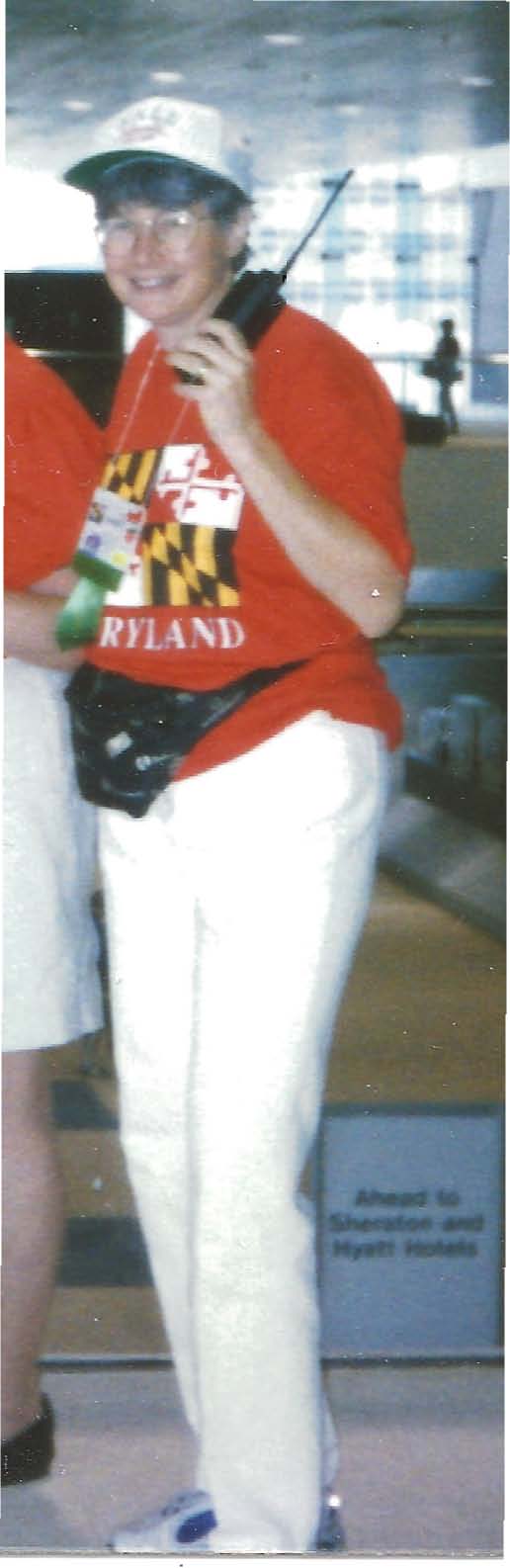
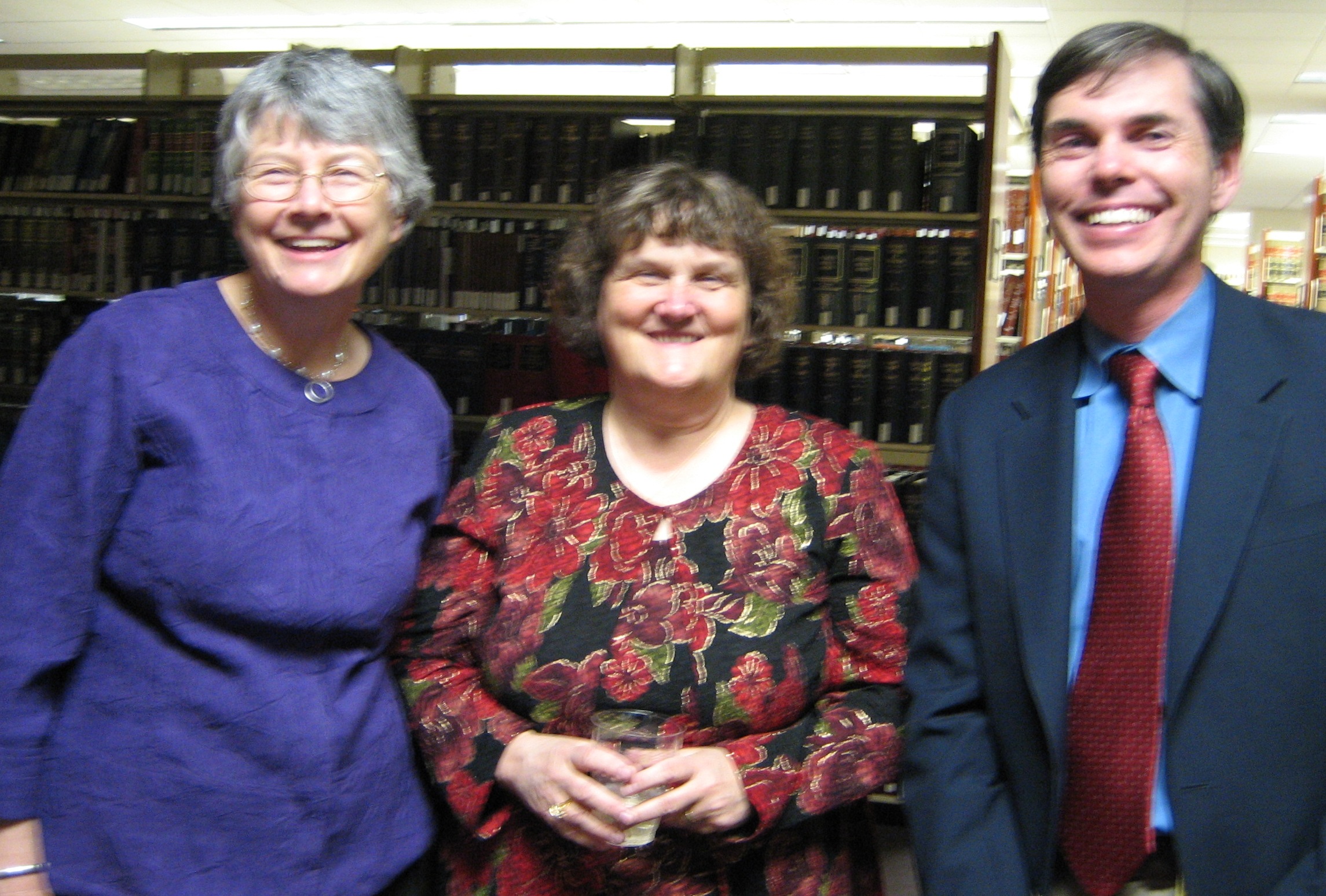
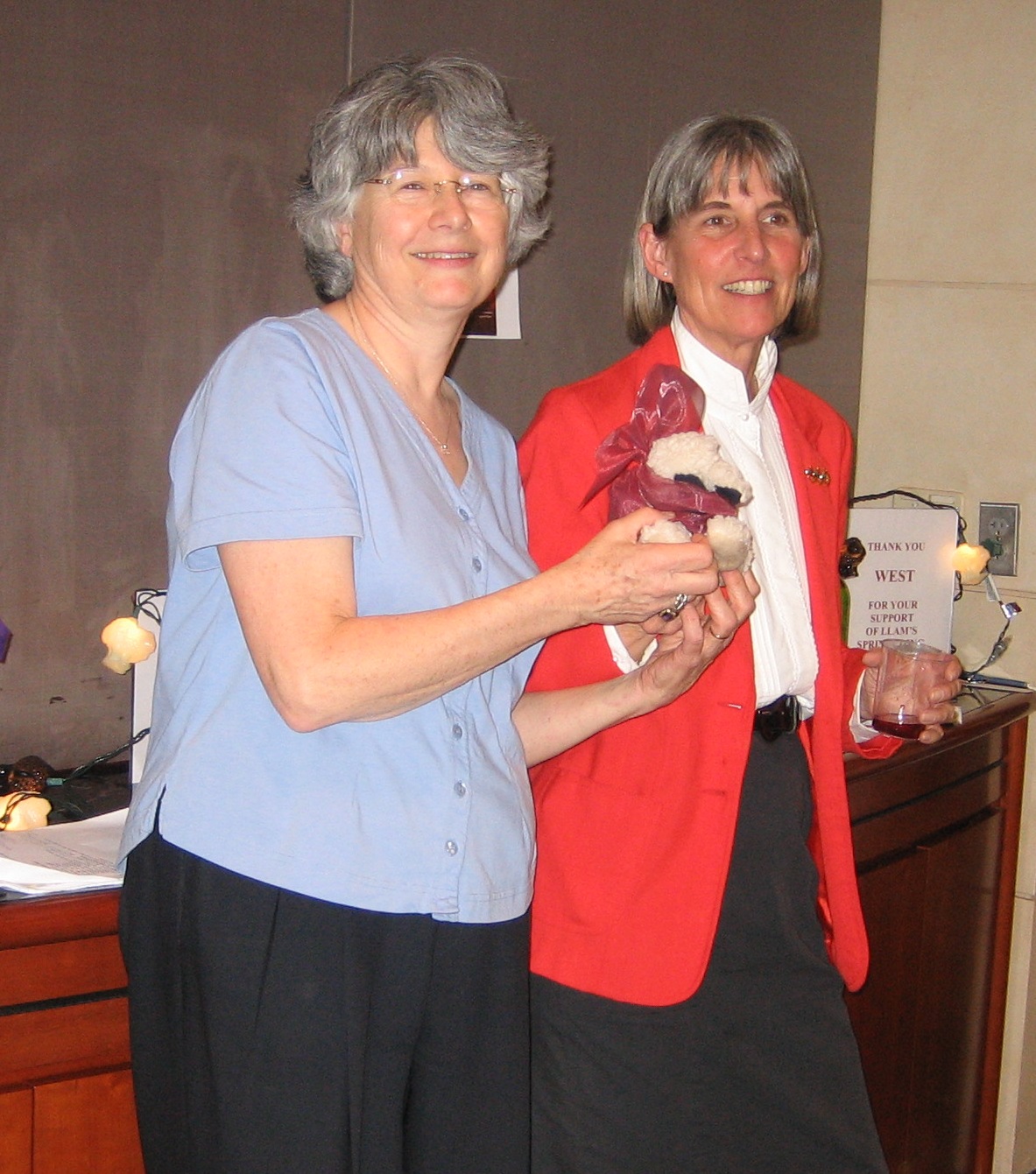
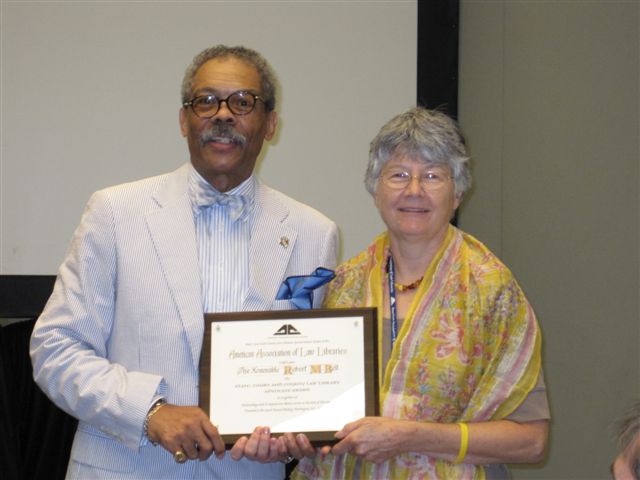
It will be hard to day goodbye to someone who has contributed so much on the national level as well.  As the photo attests, Janet worked as a function coordinator at the AALL Annual Meeting held in Baltimore.  You can find Janet’s name on the roster of various AALL SIS committees: Nominations for SCCLL, Awards and the Ad Hoc Professional Development Committee for TS-SIS, and the Patron Services Committee for RIPS.  She co-authored the LISP Public Librarian’s toolkit it for Maryland.  Janet is now a member of the AALL Maryland Working Group and is contributing to the National Inventory of Primary Legal Materials.

It will be hard to say goodbye to someone who has taken such an active role in the formation of the official Conference of Maryland Court Law Library Directors.  Janet was instrumental in getting this conference going.  We will miss her as the current chair of the conference.

It will be hard to say goodbye to someone who always had an idea for a program, whether local, regional, or national.  Janet shared her expertise on preservation with LLAM, and joined me at Jessup to teach legal research to the women there. Janet got the Conference of Court Library Directors to present at MACCM and coordinated a program for the SEAALL annual meeting.

It will be hard to say goodbye to our social coordinator at AALL.  Janet was always able to organize the LLAM Dine Around and get the LLAM runners together for the Hein Fun Run.

Looking at all of Janet’s accomplishments, we might easily see why she would want to retire.  Still, I had to ask her what she will do with her new found time.  Janet will be jumping right into a big home renovation project.  She looks forward to travel with her husband, Larry, taking classes, and continuing her volunteer work with therapeutic riding.  Janet will be careful that she doesn’t end up with too many commitments at the start of her retirement.  She will be available to help with the transition of the new library director in Montgomery County.

When asked what she will miss most, Janet was quick to say that she will miss more than anything the people she has worked with over the years: her staff and colleagues in Montgomery County, and all of the members of LLAM she has worked with and gotten to know.  When asked what she will miss the least, Janet answered that she is not sorry that she will no longer have to negotiate contracts with vendors.

I asked Janet if she had a “best” memory of her years as a law librarian.  She could not boil it all down to just one memory, but helping people is what made it all meaningful.  Janet remembers an Asian couple who returned to the library to thank her for all of the help she was able to provide in the library.  They insisted on a gift of a small Vietnamese bowl which serves as a lovely reminder of what Janet loved most about her career.

It will be hard to say goodbye to someone who is such good friend.  I know we will all miss her and hope that Janet keeps in touch as she begins this new and exciting phase of her life.

Dinner at Ronald McDonald House

By Jean Hessenauer
Librarian
Tydings & Rosenberg LLP

LLAM volunteers pictured l to r: Pat Behles, Univ. of Balto.; Jean Hessenauer, Tydings & Rosenberg; Sara Thomas, Whiteford Taylor; and Kathy Sweeney, Semmes, Bowen & Semmes

For the past two years, LLAM has been serving dinner twice a year at the Ronald McDonald House.  Each time we serve, four or five LLAM Members have volunteered.  We purchase the food, transport it to the house, prepare it, and then serve it.  The house holds approximately forty people, and it is usually full.  The Ronald McDonald House is set up like a small hotel.  On the first floor there is a nice family room with a large TV, a playroom, and a game room.  The second and third floors each have kitchens and hotel type rooms.  The kitchens were recently  remodeled and  are very well equipped.  We try to serve several choices of nutritious food and our “bakers” always whip up tasty desserts.

I have been serving dinner at the House for about eight years, and I think everyone who has participated will say how rewarding it is.  The families are so appreciative to have dinner waiting for them when they return from the hospital.  Last month, one dad said, “it is so nice to come back here at night and not have to worry about preparing dinner for my daughter and me.”  Having a very sick child is stressful, so it is nice to be able to take some of the burden from these families.

AACC Offers CEU Classes in Legal Research

By Mary Jo Lazun
Head of Electronic Services
Maryland State Law Library

Anne Arundel Community College, known for its strong paralegal program, began offering continuing education unit (CEU) classes this fall in the areas of legal research, negotiation, and mediation.

The legal research classes were taught by Mary Jo Lazun of the Maryland State Law Library. The first class focused on print sources and the second class on using online resources. Ten people got up early on a Saturday morning to attended the first session and fourteen for the second. About half the class were practicing attorneys and the rest were a mixture of paralegals, students and even a librarian!


In the first class, held at the State law library, focused on the print sources. Mary Jo taught students how to maximize the use of secondary sources and how to locate superseded Maryland Code and COMAR and do a basic legislative history.The session was designed so that over 50% of the class time was devoted to using the materials in the library. Students quickly learned their way around the library and were impressed the library’s collections, particularly its superseded codes.

The online class, offered in one of the college’s computer labs, gave students a hands-on opportunity to compare Lexis and Westlaw while learning the basics of Boolean searches and locating case law by topic and headnote. Having access to both databases was a major plus. Students either focused their attention on the database they used the most or used the class as an opportunity to learn a new system. Like the “print” class, most of the time was devoted to hands on exercises and kept Mary Jo very busy answering moving from computer to computer.

According to Karen Cook, the director of the Legal Studies Program at AACC, “The feedback from the courses has been wonderful!.” The college is working on its fall schedule of CEU classes and both legal research classes offered again.