November LLAM Program: Judge Irma Raker on Maryland Pattern Jury Instructions

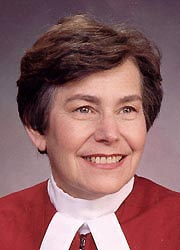
JudgeIrmaRakerHear the Honorable Irma S. Raker speak on

“Everything you need to know about Maryland Pattern Jury Instructions”
November 6, 2013 at 3:00-4:00 p.m.
Anne Arundel Circuit Court Library, Room 303
7 Church Circle
Annapolis MD 21401

A dynamic speaker, Judge Raker will recount her 30 years chairing the committee producing the popular Maryland criminal and civil pattern jury instruction books.

These books are relied on by judges across the state and cited by attorneys for their succinctness, clarity and attention to detail. Retired Chief Judge Bell calls them “of paramount importance to the court.”

The Honorable Irma Raker, a distinguished jurist and legal pioneer, was the second woman appointed to the Maryland Court of Appeals. She currently chairs the MD Access to Justice Commission and works in private mediation.

An open Q-and-A session about her illustrious legal career will follow the talk.

RSVP to Kate Martin at kmartin@mcccourt.com, 240-777-9121.

How Legislative History Really Works – Exhibit A — The Affordable Care Act

LLAM Program with John Cannan: How Legislative History Really Works — Exhibit A, The Affordable Care Act
October 15, 2013 at 12:00 P.M.
The Brown Room, Library Company of the Baltimore Bar 100 North Calvert Street, Baltimore MD 21202

A video recording of the presentation by John Cannan is now available online:

————————————————————

Still using USCCAN, Google or THOMAS?  The rules have changed! New, unconventional tools are now available to mine more complex and different legislative procedure models.

Be ready to operate in this new reality. Legislative History is a core law library competence and a unique skill we can offer our patrons – a sure way to improve our ROI.

Join John Cannan of the Drexel University Law Library for a provocative talk on how to compile a federal legislative history.

A frequent writer on legal research topics, most recently in the Law Library Journal (http://www.aallnet.org/main-menu/  publications/llj/LLJ-Archives/Vol-105/no-2/2013-7.pdf), John’s current research interests are in services for self-represented litigants, Web 2.0 and judicial rules.

John received his JD and MLS from the University of Maryland and he has worked at the Montgomery County (MD) Circuit Court Law Library and then at the Law Library of Congress.

This program will be taped for later viewing on the LLAM site.

Parking: Limited parking, two garages are within a block of the

Bar library, north on St. Paul Street and west of Lexington Street. No onsite parking.

NEXT PROGRAM: November 6th, the Honorable Irma Raker will speak on chairing the MSBA committee that produced the popular Maryland Pattern Jury Instructions and her life as a Circuit Court and Court of Appeals Judge.

How Librarians Can Make the Shutdown Work for Them

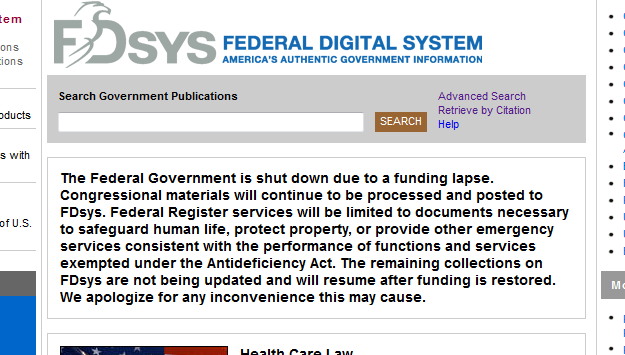
This post is LLAM’s Maiden Voyage into the blogosphere and there is one hot topic boiling in the hearts of all Americans. Whichever side of the political fence we fall on, we are all faced with a disturbing reality – the United States Federal Government has shuttered all “non-essential” doors and shut down. We each recognize that on some level this affects everyone; some more than others.

As law librarians, this situation threatens to have a colossal impact on how we perform our jobs. Some of our colleagues have been furloughed and aren’t even able to go to work. Those of us that are still standing face a number of frustrations because the government resources we use have been suspended. Many of the government websites that we access daily to perform reference services are already shut down. If the situation continues much longer, there will be more that go dark.

Some of our most essential databases, like FDsys, aren’t being updated. When we visit many government webpages, we are met with glaring messages about budget appropriations and lapses in funding. How long will it be before the Federal Courts close? And PACER shuts down?

Fdsys Shutdown Image

Some of the less-essential (but still important) services are also closed. For example, there is no one at National Library of Medicine to pull the medical articles that my patent attorneys need.

This situation should motivate us all to step up to the hypothetical plate and provide some clarity in this crisis of uncertainty. We Librarians need to provide stability. We need to use this state of affairs to our advantage and demonstrate our VALUE to our user communities. In this time of confusion we must emerge as the knowledge experts. We should know the alternate sources that are available and be prepared to guide our patrons to them. Dig deep in your bag of Librarian tricks and think of every clever way you can prove your Library to be the authoritative resource. This is the moment that we Librarians must to seize to show our continued need and importance.

I certainly hope this shut down doesn’t last much longer. I hope our lawmakers can come together and do what needs to be done to get up and running again. In the meantime, let’s be the best information providers we can be, use this as an opportunity to show our ingenuity and in the words of Tim Gunn, “Make it work!”