Important Information about Maryland Uniform Electronic Materials Act (MUELMA)

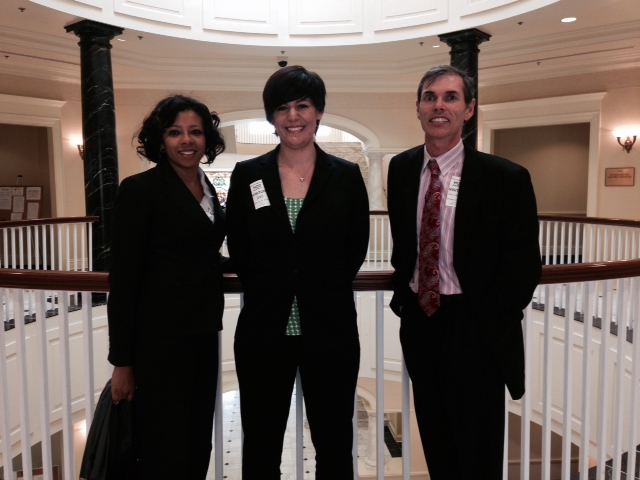
Photo   Tonya Baroudi LLAM President. Emily Feltren AALL Director Govt Relations, Steve Anderson AALL President

Tonya Baroudi LLAM President. Emily Feltren AALL Director Govt Relations, Steve Anderson AALL President

LLAM needs your help in advocating for the Maryland Uniform Electronic Materials Act (MUELMA). Pre-filed HB46 is sponsored by by Del. Sam Arora, District 19, Montgomery County.

The First Hearing was held on Thursday, 1/23/2014 before the Health and Government Operations Committee. Testimony in favor of UELMA was provided by Delegate Arora; Steve Leitess, Uniform Law Commission, Maryland Member; Emily Feltren, AALL Government Relations Office; and Tonya Baroudi, LLAM President. Steve Anderson, Mary Jo Lazun, Paul Lagasse, and Joanie Bellistri attended the hearing to show support for the panel.

An interlineated copy was provided by Delegate Arora to the committee that included amendments to the pre-filed bill that removed requirements for reported decisions of the circuit and district courts and for certain administrative materials. The revision also added the Maryland Register to the list of legal materials. Tonya and Emily both voiced support as amended.

The Committee Co-Chair, Del. Shane E. Pendergrass, District 13, Howard County, had three questions:

  1. Why has the Act only been adopted in only 8 states in the last two years?
  2. Are there major differences between the Model Act and the Maryland Act?
  3. Have there been any problems where the Act has been adopted that have required a retroactive fix?

Answers were provided by Steve Leitess of the ULC who stated that it is not unusual for a Uniform Act to take more than one year for adoption, that there are no major differences between the acts and that there are no known instances of a fix being needed after adoption.

Now that the first hearing has taken place, LLAM members can advocate for UELMA by contacting their delegates who are on the Health and Government Operations Committee. Read on to find out how.

HB46 Action Alert:

LLAM members can help by contacting their delegate if a member of the Committee:

  1. Who are your delegates?
  2. Is one of them a member of the House >Health and Government Operations Committee?
  3. If so call or write to your delegate requesting support

~By Joanie Bellistri, Anne Arundel County Public Law Library

AALL Local Advocate Lobby Day – March 27, 2014

AALL Logo

Date:         Thursday, March 27, 2014

Time:         8:30 am – 5:00 pm EDT

Location:   Capitol Hill*, Washington, D.C.

Who:         Washington-area AALL members and local chapters, including LLAM, LLSDC,
SEAALL, VALL, and others who can visit D.C.

Join AALL President Steven P. Anderson, AALL’s Government Relations Office staff, local chapters, and AALL members at AALL’s second-annual Local Advocate Lobby Day on March 27.

Last year’s lobby day was such a success, we’re doing it again! At this full-day event, you’ll become an expert on our top priority issues and learn best practices for successful advocacy. Then, you’ll put your knowledge into practice, attending pre-scheduled meetings with your members of Congress and/or their staff to advocate for AALL’s policy positions.

According to a 2011 survey by the Congressional Management Foundation, 97 percent of congressional staff say that in-person visits from constituents have an influence on the member. As law librarians and members of AALL, you are experts who represent not only yourselves, but your profession, other librarians, and your patrons. Exercise your influence to make a difference for your libraries!

The Lobby Day is free of charge for all AALL members and chapter members. Breakfast, coffee, lunch and an afternoon snack will be provided. Participants will have the opportunity to visit area sites including the Library of Congress, Law Library of Congress, and Folger Shakespeare Library during afternoon free hours.

RSVP to Elizabeth Holland at eholland@aall.org by March 1.

*Training will take place at a TBD location on Capitol Hill within close walking distance of the Senate and House Office Buildings, where lobby meetings will take place.

What Happens When Books Freeze?

This Polar Vortex and our current “arctic” temperatures have gotten me thinking…  What happens when books freeze?  Is it damaging to the paper? Does the extreme cold cause deterioration? Or are there hidden possibilities to be found there….?

After a bit of research, I discovered that freezing is a common method of preservation after a water disaster and can actually be effective for recovering wet books and paper records.  Freezing water-damaged materials prevents (further) mold growth and also inhibits additional water absorption into the paper. (For the record, it can also eradicate insects – should you have that sort of dilemma!)

Freezing can be used as a temporary solution to preserve materials while deciding how to ultimately salvage, treat or replace the damaged collection.  Or items left in freezing conditions will eventually dry on their own, if left indefinitely, but this is not a particularly efficient method since it takes several months to a year to thoroughly dehydrate.

While water-damaged materials will always exhibit signs of their trauma, freezing can vastly prolong their “shelf-life” (how’s that for a librarian joke?) and save them from untimely ruin.

Now you know… I hope you never need to employ these techniques in your own Library; but if you do, I found these resources particularly helpful in researching and writing this post.

http://www.nedcc.org/free-resources/preservation-leaflets/3.-emergency-management/3.12-freezing-and-drying-wet-books-and-records

http://www.lib.umich.edu/files/services/preservation/wetbooks-1.pdf

http://www.lib.msu.edu/preservation/wetbooks.jsp

-Sara Thomas (Head Librarian, Miles & Stockbridge PC)